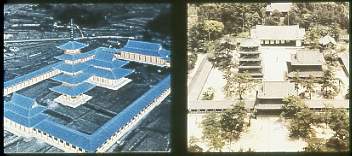
 The
reconstruction on the left shows what the original Hôryûji
might have looked like, in comparison with the existing temple. The original
conformed to the orthodox Chinese and Korean models, in which the five-storied
pagoda and the two-storied Golden Hall were placed in a row. But in the
rebuilt Hôryûji, these two buildings were set side by side.
In this purely Japanese innovation, the strict symmetry of the Chinese
model was upset. Practical reasons might have been involved, but the general
assumption is that the Japanese have an intuitive preference for the indirect
and the asymmetrical. In such a fashion, the intellectual ideals of continental
Buddhism were from an early point being subjected to native intuition.
The
reconstruction on the left shows what the original Hôryûji
might have looked like, in comparison with the existing temple. The original
conformed to the orthodox Chinese and Korean models, in which the five-storied
pagoda and the two-storied Golden Hall were placed in a row. But in the
rebuilt Hôryûji, these two buildings were set side by side.
In this purely Japanese innovation, the strict symmetry of the Chinese
model was upset. Practical reasons might have been involved, but the general
assumption is that the Japanese have an intuitive preference for the indirect
and the asymmetrical. In such a fashion, the intellectual ideals of continental
Buddhism were from an early point being subjected to native intuition.