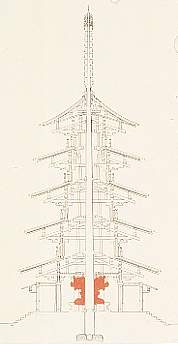
 In
the Hôryûji pagoda, the hold relics were placed in a small
container which rests in a small cavity carved out of the huge foundation
stone buried some ten feet in the ground. On the stone rests the huge central
pillar, a cypress log over one hundred feet long. The structure of the
pagoda went far beyond the practical function as a container of relics,
for it served as an architectural diagram of the cosmos itself. The central
pillar represents the world axis joining heaven and earth, while the separate
stories stand for the several terraces of the Buddhist universe, and the
nine rings at the top represent the various heavens of the gods. At Hôryûji,
this symbolism is carried even further by the construction in the very
center, here shown in red, of a fantastic grotto fashioned from plaster.
This represents Mount Sumeru, the mythical center of the Buddhist terrestrial
world where man and gods join.
In
the Hôryûji pagoda, the hold relics were placed in a small
container which rests in a small cavity carved out of the huge foundation
stone buried some ten feet in the ground. On the stone rests the huge central
pillar, a cypress log over one hundred feet long. The structure of the
pagoda went far beyond the practical function as a container of relics,
for it served as an architectural diagram of the cosmos itself. The central
pillar represents the world axis joining heaven and earth, while the separate
stories stand for the several terraces of the Buddhist universe, and the
nine rings at the top represent the various heavens of the gods. At Hôryûji,
this symbolism is carried even further by the construction in the very
center, here shown in red, of a fantastic grotto fashioned from plaster.
This represents Mount Sumeru, the mythical center of the Buddhist terrestrial
world where man and gods join.