Rachel Donabedian
M.A. 2020, Conservation Biology
Dominance rank acquisition in a primate with low aggression and coaltion rates
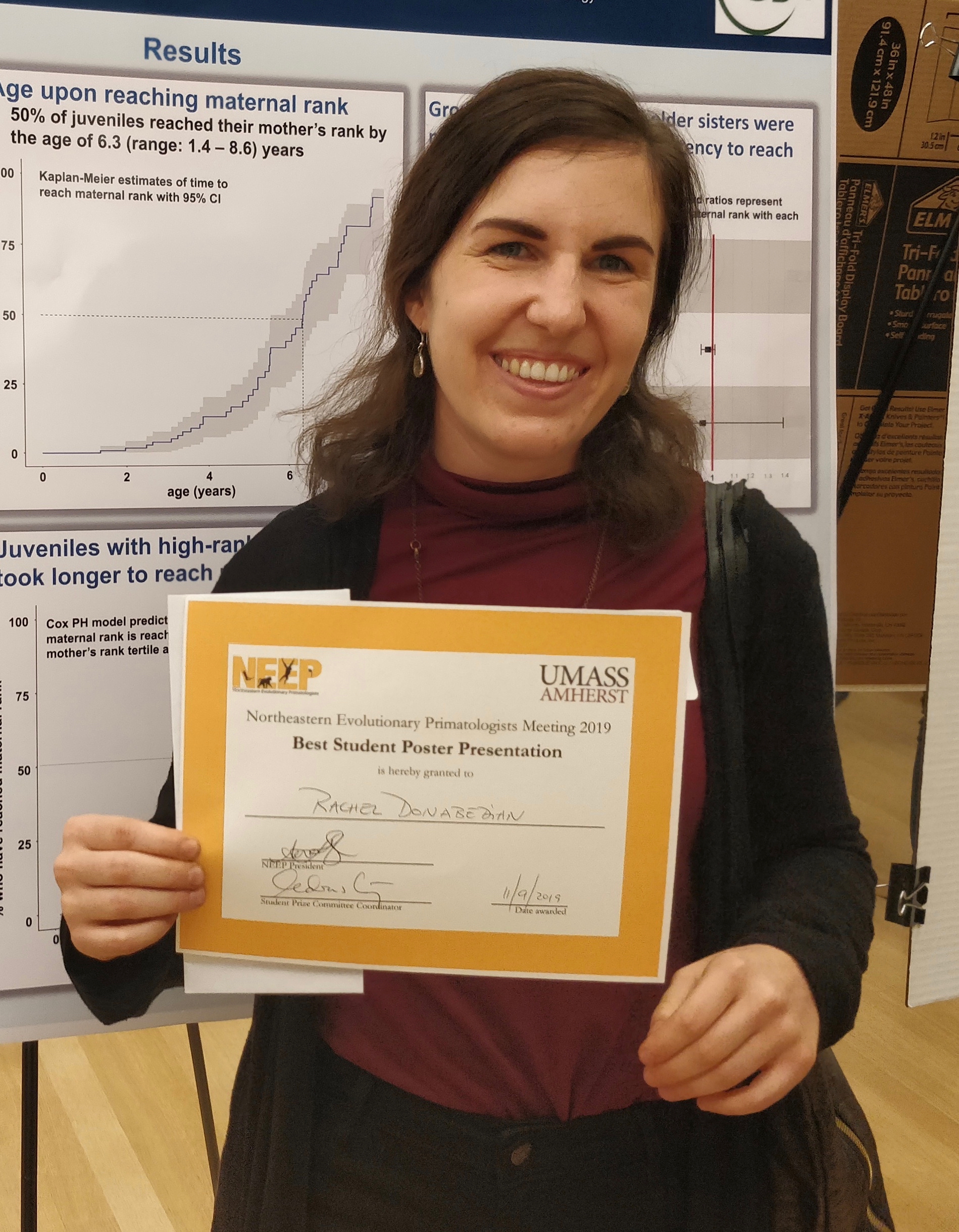 For many animals, acquiring adult
dominance rank is an important social transition that may influence
fitness. In species with maternal rank “inheritance”, juveniles may
acquire their adult rank by receiving coalitionary support from kin and
by targeting individuals from lower-ranking families in aggressive
interactions. Previous studies of rank acquisition, however, have
focused on species with high rates of aggression and coalitionary
support. We studied rank acquisition in blue monkeys, a species with
relatively low aggression and coalition rates. Focusing on juvenile
females in a wild population, we used Elo-ratings to evaluate latency
to reach their maternal status. We also assessed how juvenile female
agonistic behavior changes with age, and whether such changes differ
for opponents that their mother does vs. does not outrank. Finally, we
compared rank acquisition in orphaned vs. non-orphaned juveniles.
Females from high-ranking matrilines took longer to reach their
maternal status, while having more kin did not accelerate rank
acquisition. Subjects showed more aggression as they aged, regardless
of their opponent’s rank. Most orphans reached their matrilineal rank,
and orphans with more or high-ranking kin were not more likely to do
so. These results suggest that age-related changes in agonistic
behavior accompany rank acquisition in blue monkeys. In contrast to
more aggressive species, the availability of kin as coalitionary
partners did not appear to influence rank acquisition in blue monkeys,
and they did not increasingly target lower-ranking individuals as they
aged. We concluded that the behavioral patterns that accompany maternal
rank acquisition may vary between closely related species and that this
variation may correspond with other patterns of social behavior, such
as aggression and coalition rates.
For many animals, acquiring adult
dominance rank is an important social transition that may influence
fitness. In species with maternal rank “inheritance”, juveniles may
acquire their adult rank by receiving coalitionary support from kin and
by targeting individuals from lower-ranking families in aggressive
interactions. Previous studies of rank acquisition, however, have
focused on species with high rates of aggression and coalitionary
support. We studied rank acquisition in blue monkeys, a species with
relatively low aggression and coalition rates. Focusing on juvenile
females in a wild population, we used Elo-ratings to evaluate latency
to reach their maternal status. We also assessed how juvenile female
agonistic behavior changes with age, and whether such changes differ
for opponents that their mother does vs. does not outrank. Finally, we
compared rank acquisition in orphaned vs. non-orphaned juveniles.
Females from high-ranking matrilines took longer to reach their
maternal status, while having more kin did not accelerate rank
acquisition. Subjects showed more aggression as they aged, regardless
of their opponent’s rank. Most orphans reached their matrilineal rank,
and orphans with more or high-ranking kin were not more likely to do
so. These results suggest that age-related changes in agonistic
behavior accompany rank acquisition in blue monkeys. In contrast to
more aggressive species, the availability of kin as coalitionary
partners did not appear to influence rank acquisition in blue monkeys,
and they did not increasingly target lower-ranking individuals as they
aged. We concluded that the behavioral patterns that accompany maternal
rank acquisition may vary between closely related species and that this
variation may correspond with other patterns of social behavior, such
as aggression and coalition rates.