... and they innocently thought that the social sciences would remain unchanged, swallowing science as easily as religion or the arts. But there was a big difference invisible until then. Social scientists did not really believe in religion and popular consumption. They did believe in science, however, from the bottom of their scientistic hearts.
— Bruno Latour (1993:53)

I have chosen to begin with this characteristically caustic quote from Bruno Latour because it serves as reminder of one of the fundamental problems of the ethnographic mode of inquiry, and indeed of the anthropological project in general. It is easy to be 'anthropological' with regards to religion whenever you do not believe in it, when it is merely a social construct. The faithful, for this reason do not make good ethnographers of religion, especially of their own. Alfred Gell (1998) makes a not dissimilar point when he argues that a true anthropology of art necessitates a kind of 'methodological philistinism', by which he means that we must abandon a genuine belief in the transcendent aesthetic qualities of art objects in order to understand them from a truly anthropological standpoint.
For the most part, discussions in the scholarly literature on 'fetishism' or 'idolatry', focus largely on things that we do not, albeit often implicitly, believe in – 'we' of course referring to Western academic anthropologists. Fetishism and idolatry are found amongst Others, not ourselves and these words always connotate a false or illusory ascription of power or agency to that which is merely an 'object'. For the colonial Protestant missionary, tropical savages and Roman Catholics were alike in their supposed worship of idols and thus both were equally damned. The terms 'fetishist' and 'idolater' are inherently pejorative and indeed this was the rhetorical brilliance of Marx's argument on the 'commodity fetish' in capitalism – what better way to embarrass the bourgeoisie than to show them that for all their vaunted modernity and progress, they were still just as confused and benighted as the primitives who spent their days venerating rocks and trees (Mitchell 1986). Thus no matter how hard we try to take seriously the claims of 'the Other' to perceive power in the material world of things, we ultimately cannot escape our skepticism, grounded in an Enlightenment episteme, that objects are nothing more than sites for the projection of agency and power that ultimately remains in the gift of their human makers and users. We might in our generosity treat them as if their power were real, but in the end we do not really believe it to be so.
Mitchell (2005) in his examples of modern fetishes; the present-day 'idols of the mind' discusses the fetish-like quality of abstractions like terrorism, but even with these Western, modern idols, it is still difficult to escape the impression that again these are things the author does not himself truly believe in. So when he speaks of the sacrifices demanded to defeat the terrorist threat, it is implied that terrorism is reified into something that it is not – a device of politicians used to mobilize resources and create political capital and a obsession of the popular consciousness – not something therefore, that a cynical and worldly-wise social scientist would actually believe in.
Herein lies the crux of our problem. Whilst theoretically we can as non-believers study religion, from an anthropological perspective, we cannot be atheists with regards to subjects and objects. As is made clear in Keane's (1998) discussion, whether it be European Christian missionaries or the indigenous societies that they sought to convert, the task of negotiating the ambiguities of the subject-object divide, the awareness of the simultaneous gulf between and inseparability of the material and immaterial realms is ever-present. All societies and cultures, all philosophies, grapple with these fundamental problems of existence. We cannot cease to believe in subjects and objects, and therefore we cannot study them in the way that the atheistic social scientist can study religious life or that the 'philistine' can study art.
It is for this reason that I have chosen 'the bomb', by which I mean the nuclear weapon, as an object of ethnographic study. If we cannot bring ourselves to believe in the objects of power that exercise non-Western peoples, then perhaps we need to turn our attention to those objects of power we really believe in, for I suspect few people, even anthropologists would argue that the power of nuclear weapons is a mere illusion or has been falsely ascribed. Ultimately therefore my question is what is the difference between the nuclear warhead and a more traditional object of power, such as the Nkisi 'nail fetishes' of the Bakongo people of Central Africa, a favourite of anthropologists and collectors of primitive art alike? In the end it is the idea that there is a difference between these two very different objects, or more precisely a fundamental difference, is something that I would like to call into question.

For me, the theoretical issue of paramount importance that we must address is can the nuclear warhead be a fetish? If a fetish is by definition an object whose power is ultimately false and illusory, can a truly powerful object really be thought of as a fetish?
In order to treat with a specific example, I will focus on the current debate within the United Kingdom with regards to the proposed renewal of the Trident nuclear weapons programme. Trident is a US designed and manufactured ballistic missile system designed to fire submarine-mounted nuclear weapons. Currently some two hundred such weapons are maintained by the British government and they form the sole basis of the United Kingdom's 'nuclear deterrent' and long-term policy of maintaining Britain's status as a nuclear power. Currently there is an ongoing debate running in the United Kingdom, in political circles and the media as to whether or not Trident should be upgraded and renewed (at a minimum cost of 15 billion pounds) or whether Britain should abandon nuclear weapons as have some other European nations, notably Germany. For the most part, the government, including the Prime Minister Tony Blair, the cabinet and a majority of Parliament are in favour of renewing Trident. Increasingly however there has been a rising tide of opposition in public discourses largely from the traditional anti-nuclear movements such as CND, celebrities and interestingly, from the Church of England establishment.
in what sense do proponents of nuclear weapons appear to fetishize 'the bomb'?
In Britain and elsewhere the possession of nuclear weapons is heavily bound up with issues of national pride and integrity. Tony Blair has publicly described Trident as the 'ultimate insurance'[1], suggesting that the nuclear weapon is perceived to function as the highest form of protection for the nation, so just as a person might wear a charm as a sure means to ward of evil spirits, Trident is presented as an infallible talisman or amulet. Much of the discourse on nuclear weapons portrays them as an embodiment of the potency of the state, so phrases like 'the nuclear club' and the oft-stated belief that Britain must maintain its position as a member of this group, reinforces the sense that what nuclear warheads are thought to 'do' or 'allow' is not solely, or even primarily based on their potential use as a weapon. Owning such weapons to achieve a certain geopolitical status is more important than their practical deployment as a destructive force.
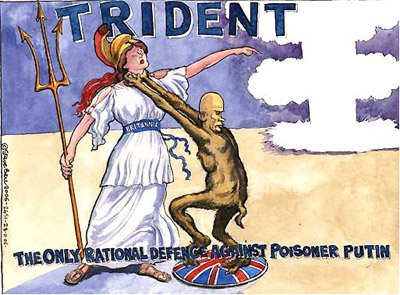
Cohn's (1987) analysis of the language by United States defence analysts during the late Cold War era is useful in understanding the 'fetishization' of nuclear weapons. Writing from a feminist perspective, Cohn shows that the words, phrases and concepts used by (almost exclusively white male) defence experts are highly gendered and this gendered ideology is instrumental in explaining the impetus that drives nuclear militarization. In the logic of formulating defence policy, nuclear disarmament is tantamount to emasculation and therefore beyond contemplation, and states which lack nuclear weapons are described as being in a state of 'virginity'. Most interestingly, Cohn asks what is the subject of the expert discourse on nuclear weapons and goes on to argue that the nuclear weapons themselves become the subject. In discussions of hypothetical nuclear exchanges between the United States and the USSR, the goal is not stated as an attempt to damage or destroy enemy people or infrastructure, but to destroy the opposing sides's nuclear weapons capabilites by targeting the missiles and their silos. Success or failure is measured in terms of depleting the enemy nuclear capability and damage to people and structures is deemed 'collateral'. It is the missiles who are the subjects and the agents, the human actors almost become irrelevant and are seldom even mentioned in this discourse.
in what sense do opponents of nuclear weapons seem to fetishize 'the bomb'?
As has been often pointed out, the irony of iconoclasm is that the iconoclasts, by insisting on the effacement or destruction of the idols tacitly admit that the objects really are powerful, because if it were otherwise, what danger could they possibly present? Thus I would not wish to suggest that it is only the supporters of nuclear weapons programmes who appear to treat the bomb as a fetish. The reactions of the senior levels of the Church of England to the renewal of Trident are a case in point. Consider the words of Peter Price, the Bishop of Bath and Wells who along with 18 other bishops wrote a letter of protest in 2006 attacking the governments policy with regards to Trident:
...I personally have lobbied and campaigned for Trident not to continue. That's been a long-held conviction... borne out of my profound belief that the gift of Creation for us by God... means that we cannot plan the destruction of God's creation...
...their [nuclear weapons] end is evil and both possession and use are profoundly anti-God acts...
— 'The Independent'. 10 July 2006
For these prelates, the nuclear weapon is an embodiment of evil, for it has clearly ceased to be a mere tool which may be put to good or evil purposes depending on the human actor who wields it. The subjectivity of the human agent has disappeared since they have no ability to influence the outcome of the use of nuclear weapons, the weapon itself has ends, those ends are evil, and their use and possession will always therefore lead to evil. The bomb itself has become a subject since its will appears to override that of the very governments and scientists that create them. The power of the nuclear warhead is a destructive one, and this is set up in opposition to the creative power of God, so that the evil in the bomb is inherent to its threat to God's Creation. It's power is immoral, prior to any specific application of that power.
I hope to have demonstrated that nuclear weapons are treated and understood in a way that would be indistinguishable from what we would call 'fetishism' or 'idolatry' if instead of talking about nuclear weapons we were referring to sacred carvings from the Congo Basin. What distinguishes the non-fetish from the fetish is that the non-fetish is believed only to be a symbol of something else, unlike the fetish which is 'the thing itself'. The nuclear weapon therefore would appear to be a fetish if it ceased to be a symbol of masculinity or evil, but actually became and embodied those things. For Marx, money was fetishized within capitalism, for it had ceased to be a mere object but had become 'the thing itself' – wealth, rather than a mere symbol of wealth. Thus it is sensible within a capitalist mode of thought to say that money 'breeds' and that money begets more money (Mitchell 1986:191-193). Moreover, this tendency is not just something that humans may do with money but it becomes inherent in its nature. As Weber (2001) points out in his description of the capitalist-protestant ethic, for money to fail to reproduce is amoral because it is unnatural, a violation of its essence. In just the same way, nuclear weapons 'proliferate', they possess an almost virus-like property to breed, almost beyond the control of the mere human actors and states that construct and maintain them – it is in their nature, in other words.
In his theory of the commodity fetish, Marx considered that the exchange-value that were attributed to things was the ultimate fetish of the capitalist mode of production. Exchange-values of commodities were treated as if they were actual properties of objects, when they were in fact derived from the human labour that had created them, organized through the relations of production. What was in reality a complex of relations between people, was believed to be relationships between objects and herein lied the dehumanizing aspect of commodity production for Marx, arguing that,
...no chemist has ever discovered exchange-value in a pearl or diamond... (Marx 1990 [1865], cited in Mitchell 1986:193)
The power of the fetish object therefore resides in the network of social relations in which it resides, it is the social milieu which ascribes it agency, not any inherent property of the object itself - which would make Nkisi figures, commodities and nuclear weapons all fetishes, apart from the fact that with the bomb the power is believed to be 'real', a scientifically verifiable feature of the bomb as a bomb. But of course, Marx's error was to see the exchange-values of commodities as socially ascribed, whereas their use-values were understood to be prior to the social and thus real and inherent within their natures as objects. But the physical or chemical properties of an object are no less socially assigned than something like exchange-value. The scientific properties of things are given to them in laboratories, by scientists, itself just another social setting. Without suggesting that there is no logically prior materiality (see Latour 1993) the object ultimately has no pre-social existence. It only comes into being as an object when it is recognized as such, in relation to a human subject and thus it has no properties that are not socially ascribed to it. Objects, like subjects are designated, classified and constructed, both materially and conceptually within the social milieu, outside of which they cannot be thought to have any pre-existing character.
Objects such as the bomb have an agency that arises from the belief that they are able to command, the social relationships in which they are produced and maintained and the networks of subject-object relations that are formed around them. There is no real difference here between the agency which operates within the bomb therefore and that which operates within the Nkisi figure, or any other traditional 'fetish'. The nuclear weapon does not have any objectively verifiable power that separates it from its non-Western counterparts. Ultimately we cannot point to any difference between the Nkisi object and Trident other than we, as Western, scientistic individuals believe in the power of the latter, and not the former. A rather superficial distinction. Our conclusion must therefore either be that there are no fetishes, for we cannot divide the world of things into those whose power is 'real' and those that are mere illusions, or that all objects are fetishes, in the sense that no sources of power can exist that are not socially created. To set up a dichotomy between real and imaginary power is meaningless since no such distinction exists.
references
Cohn, C. 1987. Sex and Death in the Rational World of Defence Intellectuals. Signs 12 (4): 687-715
Gell, A. 1998. Art and Agency: An Anthropological Theory. Clarendon Press, New York.
Keane, W. 1998. Calvin in the Tropics: objects and subjects at the religious frontier. In Spyer, P. (ed.) Border Fetishisms: Material Objects in Unstable Spaces, pp. 13-34. Routledge, New York
Latour, B. 1993. We Have Never Been Modern. Harvard University Press, Cambridge.
Marx, K. 1990 [1865]. Capital. Vol.1. Penguin Classics, London.
Mitchell, W. J. T. 1986. The Rhetoric of Iconoclasm: Marxism, Ideology and Fetishism. In Iconology: Image, Text, Ideology, pp. 160-208. University of Chicago Press, Chicago.
Mitchell, W. J. T. 2005. Totemism, fetishism, idolatry. In What Do Pictures Want?, pp. 188-196. University of Chicago Press, Chicago.
Weber. M. 2001 [1930]. The Protestant Ethic and the Spirit of Capitalism. Routledge, New York.