art history and hairy questions
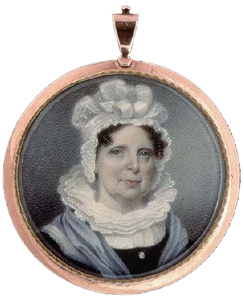
Art historians have often taken a material culture approach when examining or interpreting their objects of study. And over the last few decades, the discipline has continued to extend its boundaries to consider both visual and material objects that fall outside traditional notions of art. Yet, in relation to painting, scholars have tended not to stray far from the canvas. What, then, are art historians to make of objects such the portrait miniature? These small, hand-painted portraits, which were set in frames or incorporated into jewelry, pose a problem to the standard histories of painting that have focused on master narratives and ignored the literal frames in which the paintings hang or sit. The traditional and now often contested Greenbergian formalist trajectory of painting is one based on format or medium. Thus, painting has been a process of purification, in which it becomes about the very properties of painting itself: the flatness of the canvas. The art historical task of describing these portraits particularity as a hybrid type of image (partly painting, partly jewelry, and not a mere symbol) leads us to question our own theoretical and interpretive practices.
In the introduction to the edited volume Materiality, Daniel Miller proposes a “more radical version” of Ernst Gombrich’s thesis that we only notice frames in which artworks are set when they are inappropriate; thus, perhaps “art exists only inasmuch as frames such as art galleries or the category of ‘art’ itself ensure that we pay particular respect, or pay particular money, for that which is contained within such frames.”[1] While Miller’s proposal is hardly radical or new, it is perhaps a productive place to start when analyzing portrait miniatures. When looking at these paintings, how might we consider framing devices important to the meaning, devices that distinguish relations between representational space and viewer and help regulate possible uses. In other words, what might we learn by attending not to hermeneutic analysis of representation but rather to the ubiquitous materiality of images and their frames?
the object
In the United States, portrait miniatures became extremely popular during the colonial period and the early republic; however, the miniature came from a long European tradition that evolved from medieval manuscript illuminations. The term miniature derived from the name of the red lead ink, minium, used to decorate the manuscripts, and was thus a reference to technique or material rather than size. These ornamentations sometimes included small portraits of patrons, either praying or presenting the text to a saint. In the sixteenth century, the French artist Jean Clouet was perhaps the first to detach the devotional portrait from the manuscript, creating a separate work. Over the next few centuries the tradition developed in France, but became especially prominent in England. As a result, early settlers in the New World brought miniatures with them that served as records of family and ancestors that they left behind.
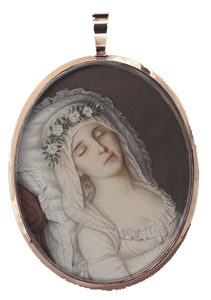
“The miniature’s rise in popularity in the North American colonies in the mid-eighteenth century,” as one scholar has noted, “coincides with both an expanded market economy and a significant shift in social attitudes toward love, marriage, and family.”[2] Like large-scale portraits, however, miniatures generally record the upper and middle classes who demanded luxury goods during this period. Such luxury goods could adorn both the home and the homeowners’ wives and daughters, worn as jewelry or accessories. In addition, choosing the miniature, which in America was often associated with the English court, offered sitters the patina of established wealth. But emulation and luxury does not fully explain these objects. Often housed in or painted on precious material, portrait miniatures fulfilled a range of other intimate and social functions. Many of these portraits were made as declarations of love, such as in the case of an engagement or marriage. Other portraits were commissioned to commemorate births and deaths or were objects for mourning. Such miniatures, whether posthumous portraits or tiny scenes of weeping mourners were private tokens that kept the absent loved on alive in memory and close to the living. And, of course, the same piece of jewelry might signify affection at one time and mourning at another as its own biography change. But these functions correspond with the culture’s shifting values regarding family and love.
social objects
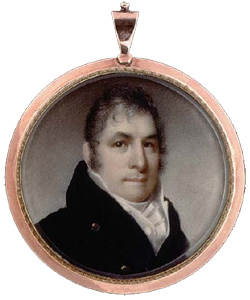
The vogue for creating and exchanging miniatures to mark life’s passages or rites—birth, death, marriage, mourning—represent the changing social relations that occurred during the long-eighteenth century, a time when traditional notions of marriage and childhood were in flux. Lawrence Stone has argued that, while “distance, deference, and patriarchy” characterized marriage before 1760, thereafter the “companionate marriage” formed stronger familial bonds within the nuclear family and brought about more sexual freedom.[3] Taking Christopher Tilley’s lead, however, we must attempt to understand how portrait miniatures were not merely reflective of these cultural values and social relations, but were actively bound in their creations; or, as he puts it, how “through the making, using, exchanging, consuming, interacting, and living with things people make themselves in the process.”[4] As Alfred Gell argued in Art and Agency, objects themselves can be seen as social actors, in that it is not necessarily the meaning of things that are important but their social effects as they influence and help construct the social in ways that would not have occurred if they did not exist or at least did not exist in a certain format, such as the portrait miniature. Accordingly, I would like to suggest that these miniature portraits were social actors that facilitated the changes in family values in which romance, sentiment, and familial bonds took a stronger hold than before during this period. As Marcel Mauss argued long ago, gift giving has long been one of the most powerful ways in which people have created identity and social relations. And, the creation and exchange of these objects provided important ways of creating value, exchanging meaning, and ordering relationships or socializing people. Portrait miniatures represented and facilitated a more romantic and familial bond by offering new forms of exchange between the nuclear family and loved ones. The growth of increasingly private, child-centered families perhaps made loss harder to bear or created the need for an object that dealt with mourning and love. Perhaps the portrait miniature facilitated new ways to imagine mourning and love, helped create new ideas of marriage, family, and childhood.
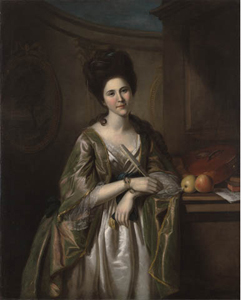
Yet, while these portraits were token of various relationships such as love, marriage, or family, such gifts also signify or perhaps even helped create gendered and stratified social spaces and relationships. In The Enigma of the Gift, Maurice Godelier argues that the act of giving creates a twofold relationship: at once it establishes both solidarity and difference.[5] This might be an interesting hypothesis in relation to portrait miniatures and social spheres during this period. Depictions of people wearing miniature testify to the personal and social significance or function of these tiny objects. While both sexes were portrayed, commissioned, collected, and cherished portrait miniatures, typically only women wore them openly in public. Men would often carry portraits in a coat or vest pocket or as a pendant, but always hidden behind clothing. Thus, the portrait miniatures served as gendered objects that both reflected and helped construct normal notions of gender and sexuality at the time. While the gifts might have been intended to solidify personal and social relationships such as love, portrait miniatures also served to separate or demarcate men and women.
performative objects
While the image itself is central to the act of commissioning, giving, receiving, and utilizing, the materiality of the object is equally part of the social meaning; it is the objects very material that facilitates such exchanges. As I mentioned earlier, these portraits were often incorporated into pendants or jewelry, worn around one’s neck or wrist, kept against one’s breast. Therefore, the presentational forms reflect intent in the use and value of the portraits they embed, since the objects that contain the portraits in many cases are meaningless without the image. With the portrait miniatures, one often displays one’s affection or emotion in public by wearing them not on the sleeve but as a bracelet or pendant. A portrait incorporated into a piece of jewelry is put literally in motion— twisting, turning, and bouncing, sharing the folds, volumes, and movements of the wearer and his or her apparel. No longer seen in isolation, the image and the object become an extension of the wearer. But whatever their form or meaning, these objects also turn the body of their owners into an accessory and invite the touch.
Yet these frames or presentational forms also have the ability to create new meaning through the performance of the object itself with the body and its surroundings. A pendant might contain portraits of a husband and wife or lovers, lying back to back on the opposite sides of their container, never to be parted yet always separate (perhaps an interesting correlation to my earlier discussion of the gendered aspects of these objects). For the object to be fully experienced, it forces the handler to turn it from side to side, continually caressing the object as a result of it design (or the designer). Other miniatures were lockets containing two facing but separate portraits. When closed, the man and woman inside are hidden, pressing and kissing each other in the dark until the locket is opened. A locket or pendant kept beneath one’s clothes, literally presses against and caresses one’s breast, reenacting and performing sexual acts between loved one’s. Such an object might take on new meaning depending on both the gender of the wearer and the person depicted. Yet this act of hiding the portrait also served to hide the relationship. Portraits were often commissioned to commemorate illicit and secret love affairs; therefore, the object acted as a sort of talisman, insuring secrecy.
hairy objects and the limits of representation
One final aspect of portrait miniatures might move us to a fuller understanding of these objects, their materiality, and the limits of representation in relation to memory, one of the supposed functions they served. The same culture of sentimentality in which portrait miniatures developed also fostered a booming business in various kinds of souvenirs that incorporated body parts such as hair. By the nineteenth century, women were already associated as the keepers of memory and hair became one of its raw materials. As Thomas Laqueur notes, “[Hair] became the corporeal auto-icon par excellence, the favoured synecdoche—the real staging for the symbolic—perhaps not eternally incorruptible but long lasting enough, a bit of a person that lives eerily on as a souvenir.”[6] Hair as a material itself is obvious convenient for this purpose. Intimate yet easily detachable or regenerative, long lasting yet malleable, hair could be used for a variety of purposes and could stand in for the body of the subject depicted. Locks of hair would be placed under crystal in rings or kept in a locket or other container. In the last decades of the eighteenth century, artists began to work hair into skillfully crafted objects . Hair was sometime incorporated into the actual bracelet or placed behind or underneath the portrait. Some even turned hair into pigment by chopping it into fine pieces and mixing it with paint, a process whereby the hair relic literally becomes image. Such images painted with hair blur distinctions between jewelry and painting, relic and likeness, and, as a consequence, the body and its representation. Within the context of this economy of gift giving, in which bodily remnants circulate alongside likenesses, the specificity of giving one of these objects adds a new dimension to Marcel Mauss's famous definition of a gift. Once given freely, a gift obliges its reciprocation, according to Mauss. But what does such an object ask in return?
What many of these portrait miniatures provide us is a representation of the person (the painting itself), but with the addition of hair it is also the substance of the person. So are we looking at an image or an essence—at a sign for the thing, or the thing itself? Such objects slip between sign and substance, image and reality. Just as the miniature portrait is linked with its referent, serving not only as a representation but also a substitute for the absent body/person, the hair is metonymically related to a part of the body that remains—albeit as an art object or crafted piece of jewelry. Yet, what purpose does the hair serve, whether visibly worked into the jewelry or kept hidden inside or ground in the paint? Isn’t the portrait or likeness enough to act as a memorial? Isn’t the person already present in the representation? Finally, why adulterate an already artistically produced object with something as ordinary as hair?
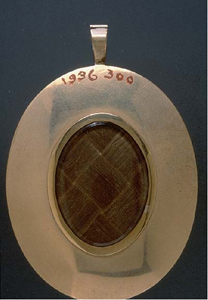
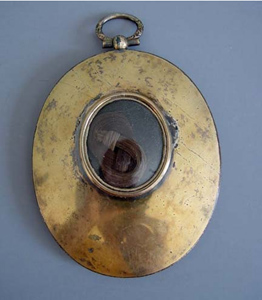
The addition of the hair acts as a kind of bridge between the viewer and the person viewed, between likeness and person, between subject and object, between past and present. Furthermore, the image and hair present a double indexicality of the person (re)present in the object. But what is it about this double indexicality that makes these objects so special? Obviously the painted portrait was not enough—hence, the eventual addition of the hair—yet, presumably, neither was the hair alone. Then, it is the combination of the two that transforms it into an almost sacred or fetishistic object.
Perhaps we can read the addition of hair as highlighting the limits of representation, especially as a mnemonic device. As Peter Pels noted in his essay, “The Spirit of Matter”, “the fetish provides an alternative to those theories that say everything is representation, if representation is understood as a process in which a material signifier is made to stand for an absent signified defined as a mental category or human process.”[7] Thus the very materiality of the fetish and the portrait miniatures with human hair provide counterpoints that marks the limits of a dominant discourse of representation; these objects cross categorical boundaries, destabilizing distinctions between the thing and its meaning, symbol and referent, represented and referent, and signifier and signified. This rupture in meaning and representation occurred simultaneously with the rise of industrial capitalism and the modern commodity; a moment when memory itself was thought to be in crisis. As W.J.T. Mitchell points out in his essay “The Rhetoric of Iconoclasm,” Marx’s whole notion of commodity fetishism hinged on the act of forgetting:
The magic of the fetish depends on the projection of consciousness into the object, and then a forgetting of that act of projection…. Commodity fetishism can be understood, then, as a kind of double forgetting: first the capitalist forgets that it is he and his tribe who have projected life and value into communities in the ritual of exchange. ‘Exchange-value’ comes to seem an attribute of commodities even though ‘no chemist has ever discovered exchange-value either in a pearl or a diamond.’ But then, a second phase of amnesia sets in that is quite unknown to the primitive fetish. The commodity veils itself in familiarity and triviality, in the rationality of purely quantitative relations and ‘natural, self-understood forms of social life.’[8]
If, as Marx and Mitchell suggest, with the rise of capitalism and commodity fetishism—for lack of a better word—we, the capitalists, are involved in a double act of forgetting, a crisis in memory, it is perhaps not surprising that such objects as portrait miniatures became increasingly popular during the eighteenth and nineteenth centuries, reaching their height during the Victorian period. However, the image by itself, even after the advent of photography, was not enough to prevent the act of forgetting. In fact, it even threatened to erase memory or at least re-inscribe it, exposing once again the limits of representation.[9] Yet, the addition of the hair to these objects, because of its own materiality, promised, like the concept of the fetish, a hold on memory or at least offered a re-memory.[1] Daniel Miller, Materiality (Durham, NC: Duke University Press, 2005), 5.
[2] Robin Jaffee Frank, Love and Loss: American Portrait and Mourning Miniatures (New Haven, CT: Yale University Press, 2000), p. 3.
[3] Lawrence Stone, Family, Sex, and Marriage in England, 1500-1800 (London: Weidenfeld and Nicolson, 1977), cited in Margaretta M. Lovell, “Reading Eighteenth-Century American Family Portraits: Social Images and Self-Images,” Winterthur Portfolio 22 (Winter 1987): 251-252.
[4] Christopher Tilley, “Objectification,” in ed. Handbook of Material Culture (London: Sage Publications, 2006), 61.
[5] Maurice Godelier The Enigma of the Gift, (Chicago: University of Chicago Press, 1999), 12.
[6] Thomas Lacqueur, “Clio Looks at Corporal Politics,” in Corporal Politics (Cambridge, MA: MIT Press, 1992) cited in Geoffrey Batchen, “Ere the Substance Fade,” in Photographs Objects Histories (London: Routledge, 2004), 37.
[7] Peter Pels, “The Spirit of Matter: On Fetish, Rarity, Fact, and Fancy,” in Patricia Spyer, ed. Border Fetishisms: Material Objects in Unstable Spaces (New York: Routledge, 1998), 112.
[8] W.J.T. Mitchell, Iconology: Image, Text, Ideology (Chicago: University of Chicago Press, 1986), 193.
[9] For a discussion of photography and memory see Geoffrey Batchen’s Forget Me Not: Photography and Rememberance (Princeton Architectural Press, 2004)