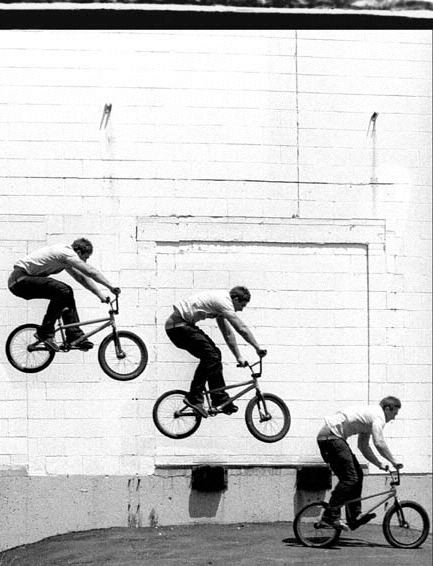
This object ethnography focuses on the intersection of two actants, the bicycle and the human body. The specifics of each actant will be attended to, however, it is their intersection, or as will be shown, their merging into one actant, that is of far more interest and relevance to the study of materiality. This paper will explore the Cartesian dichotomy of the subject and object and the efforts to eradicate this dichotomy in the face of its practical inapplicability and lack of reference to reality. Examining the relationship between actants through an analysis of intersections via touch and power structures between beings, this object ethnography will illuminate an example of a ‘way out’ of the tyranny of the Cartesian dichotomy. This ‘way out’ is manifest and experience through the mutant thing that is the intersection of the bicycle and the body, or as referred to here, the bicycle-machine and the bio-machine. This way out is one of an understanding of the processes that create and realize actants, rather than subject and objects, and it is not an attempt to eradicate these categories, but rather to redesign their compositions and redefine their functions. The point is to demonstrate the futility of the subject/object dichotomy not through erasure but through positing an alternative that recognizes this dualistic framework but offers ways to reframe actants according to their specific instances.
This project is imperative because while actants can be accorded statuses as subject or objects and while actants can fluctuate between these statuses, there are moments in which ‘subject’ nor ‘object’ does not accurately encompass the identity of the actant in the world. That is, there are instances in which an actant is not strictly a subject nor is it strictly an actant and the Cartesian method leaves no categorically or understood place for these instantiations. By reframing the actant within a subject-object analysis that recognizes components of subjectness and objectness, actants that are strictly neither of these can be spaced and understood within the world. The Cartesian dualism is neither accurate nor precise enough to explain or afford understanding of the machines it attempts to incorporate. There is a complex interrelationship and merging of machine identities that occurs when actants disassociate from subject and object positions into simultaneous expressions of subject-like and object-like identities. This sort of thing, relationship, activity, shift, whatever word is more applicable or better understood, takes place when power shifts between the actants to fulfill a combined end goal.
This argument depends upon the acceptance of a few controversial assumptions within the field of materiality studies. The first assumption is one of agency. Agency here is assumed to be not a thing of human beings, but rather a thing of things. Agency, in the sense that Alfred Gell describes the notion in his influential, though criticized text, Art and Agency is applied to actants such that they are agents as “an agent is one who ‘causes events to happen’ in their vicinity” (Gell 16). For Gell, agency is tied to causality by intentionality, that is, things are caused by intent at the root of their happening, not by physics or universal laws of physicality. While this correlate of his idea of agency does not find a real expression within things in the world, it is useful to consider in conjunction with Gell’s notion of agency because it allows a different approach to the concept of agency.
Agency is often understood as a human condition, such that things cannot have ‘power over’ the way that humans have (or more appropriately perceive themselves as having) ‘power over’. Things other than humans cannot have agency, as they do not have the same cognitive process or level of consciousness, yet this distinction starts to deteriorate with the consideration of other animate forms, i.e. animals and plants and viruses and finally into those forms that are inanimate, i.e. objects. This deterioration occurs because of notions of ‘in control’ and ‘out of control’ relative to the human being. Whatever the human being does not have ‘in control’ is external and therefore ‘in control’ by some other thing, thus the ‘power over’ that a human being can exert is limited to that which is ‘in control’ by the human being. Things do things in the world regardless of the human actant involved. It should be remembered that prior to the instantiation of the human form as actant upon the earth, things did things and external to the earth, things do things in that sphere termed ‘space’ or ‘universe’. Doing is a way of causing and thus things as actants have agency.
This discussion of agency might seem to suggest that agency is that of overt activity, perceptible action seen, felt and understood and recognized as with some kind of volition or mobility. However, this is a bit limiting to understanding agency, for actants can have agency that is not perceptible to all of the senses, but rather recognized through reactions to its action. That is, a mountain does not move but it forces a reaction by things that encounter it to act differently because of its ‘action’ or rather because of its agency. This agency emerges with a relationship to another thing, a point that could be added to Gell’s definition, though it explicitly lies within his definition. Agency is not only the effect of an actant that causes an event to happen, but requires another actant with which to engage. The mountain cannot have agency in a vacuum. No actant can have agency in a vacuum. Thus agency is not a force perceptible necessarily in visible action, but at times, is understood through a reaction to it. As will become a recurring thread in this paper, absence does not mean that some thing is a negated or extinct, but rather that thing is reified and confirmed.
The second assumption, relates to identity and it’s application in this discussion of bicycles and bodies. Identity here is not concerned with the anthropophiliac (human focused, centered, favored) idea of identity, that is, it is not related to a person and idea’s a an individual personhood. Identity here refers instead to the actant, to the things. Identity here will refer to personhood in so much as it relates to subjecthood, but not to personhood in any political or popular use of the term, or of the term identity itself. Though it may seem as a conflation of subjectness with identity, this is not the case, since identity will also relate to each machine in terms of objectness as well. Thus identity here will be used to describe qualities or characteristics specific to ideas of subjectness and objectness within each thing.
A third assumption is that the dichotomy of subject-object is useful in aspects of analysis of the intersection between the bicycle and the body. This paper does not purport to defend the Cartesian dichotomy of subject-object, but rather to accept its influence on the understanding of materiality and ordering by humanity of the world in which they inhabit. By acknowledging the historical significance, persistent impact and perpetuated splits, this paper takes as a base assumption that there is something valid to this dichotomy, at the least as a hypothetical consideration and at the most as a point of departure for a discussion of relationships in terms of multiple frameworks, multiple actants, multiple identities, nodes and networks. The idea here is that the subject-object split, along with other such Cartesian efforts at understanding, are only one way of thinking through things about their relationships. This move is to recognize the persistent real world ways of understanding as well as to recognize the reality of these relationships between things.
A fourth and final assumption is about things themselves. ‘Things’ as a category here is not limited to any material. Immateriality is its own thing. It relates to materiality as its own thing, but that relationship is the topic of some other paper, not this one. ‘Things’ here is not meant to be a neutral term/category, but rather a working term/category that allows an understanding of things in the world without the Cartesian system tyrannizing thought, colonizing things into unproductive splits and unproductive assumptions. Human actants, object actants, animals, plants, minerals, viruses, elements, minutiae, etc are all ‘things’. Each thing is its own thing; the idea of ‘thing’ as a category is not to ignore difference but rather to create a base identity upon which to illuminate the relationships between things.
To finally get to the things themselves, it is at this point necessary to examine which things this paper will explore to explain the aforementioned ‘way out’ of Cartesian dualism in studies of materiality. Thing one: the bicycle. Thing two: the body. Thing three: the bike-body. This paper will discuss the bicycle as a thing, its materiality, its functions, its shape, and its mechanics. The same discussion will follow for the body. A discussion will then follow of what happens when these actants are presenced together, when they afford agency for each other, and when this activity produces a mutant thing. This mutant thing will shown to be not quite subject, not quite object, not quite bicycle-actant, not quite human-actant. It is rather a hybrid form, a bike-body. At this point the paper will explore what this identity means in terms of materiality and continued studies in the field of materiality, material culture and the like. Finally this paper will conclude by offering the bike-body as the ‘way out’ of Cartesian dualism, as the very real, very applicable and very reachable means to decolonize materiality from the oppression of static splits. The splits will remain imperative, but their fixity is not. Identity depends upon differentiation, but it does not depend on staticity. The bike-body is not only a hypothetical and academic pursuit of decolonization of materiality, but a real world, reality based and non-academic instantiation of this pursuit. This is why it is viable for such a bold project.
The human body can be understood as an organic machine, composed of complex processes and parts. To avoid a deep discussion of the human body as there are thousands of pages written on it, this paragraph will be devoted to an overview of the body as machine. The idea of the human body as a machine means that all the parts and systems of the body operate to carry out processes of the body. Each of these systems can be understood as machines in their own right – the circulatory system, the respiratory system, the digestive system, etc. These systems can be understood in terms of each other as they depend upon in each. That is, the systems and parts of the body do not function in a vacuum devoid of contact and experience with the other systems and parts – they all interact inextricably from each other so that any disassociation would mean a death of the body. Of focus here is the entire body as a complex composite system, not any particular system with in it or of it, or any particular part. Emphasis will be placed upon the legs in discussions about motive power through rotary motion, but there will be later emphasis on the ability of the human body to access mind.
The bicycle has a historical trajectory that traces from it’s first recognizable form, known as The Running Machine (D) or the Hobby Horse, a frame with wheels that was foot powered by running, to it’s most current form, a diamond-shaped frame, with two equal-sized wheels, gears, shifters, brakes, a chain, chainrings, cables, spokes, reflecting lights. The bicycle took many forms before it assumed the current recognizable form, no matter the different types – mountain, road, track, fixed gear, bmx, dirt, mutant, speed, etc. The construction materials of the bicycle have evolved to fit function, but there is a trend for a certain weight ratio, and indeed, lightness is the goal. Lightweight construction materials allow for great control of the motion of the bicycle and faster locomotion. Even the heaviest of frames are no more than 50 lbs in total. Bicycles at first were the objects of the wealthy though now they are more pedestrian in terms of economic class ownership and use.
Of particular importance to this discussion of bicycles and other bodies and mutant forms is the fixed gear bicycle. Most bicycles today are known as safety bicycles – this is a reference to the diamond shaped frame the distributes weight and balances in a way that once understood is the most safe of all models previously designed. The first diamond shaped frame was dubbed the safety bicycle. However today there are many kinds of bicycles – road, speed, classic, sport, bmx, dirt, trick, mountain, single-speed, cruiser, fixed gear, tandem, hybrids, recumbants etc. The list really could go on and on. While the argument presented here applied to all of these forms of the bicycle body, there is particular resonance with the fixed gear. To really engage with the argument of this paper it is better to think through the fixed gear than any other form. When the term bicycle is used through out, think ‘fixed gear’ not bicycle and the argument will become revealing in a ‘eureka!’ sort of way.
A fixed gear bicycle is a simple frame, diamond in shape with no attachments. There is only one gear. There need not be brakes, but brakes can be added, often the front brake is present[1]. The size of the gear attached to the crank set determines the maximum speed that can be achieved by the bike-body. Generally a 42 teeth gear is used, though some more ambitious (or crazy or show-off ) riders ride with larger gears. Smaller gears don’t work as well. This gear is sometimes also referred to as the front cog. The crank set is the essentially the pedals, the arms of the pedals, the ball bearings and the axel. The crank set demands rotary motion of the legs of the human body engaged with the bicycle body. By turning the cranks, the legs propel the bicycle forward as rotary motion is converted to motive power forward. The back gear, attached to the axel of the rear wheel, usually has 15 teeth and is locked rather than free. A free wheel bike with only one gear is known as a single speed. A free wheel allows for cruising, meaning that the legs do not need to pedal while the bicycle rolls forward on the wheels. The legs and crank set can remain in the same position as the wheels continue to turn. This is possible because the rear gear is not locked to the wheel, so it rotates independently of the axel of the wheel. While the power of the legs is still necessary to propel the bicycle forward, freewheel does not need constant leg motion, nor does it demand constant leg motion.
A locked wheel operates on much different principles. The rear gear does not act independently of the axel of the rear wheel and rather the rear gear remains in motion so long as the wheels are turning. This means that the rider has complete manual control of the speed of the bicycle, since the legs are required to be in constant motion while riding (or synthesizing with) the bicycle. That is, the human body cannot cruise or coast while engaging with a fixed gear bicycle. Instead, the legs must be in constant motion. Slower or faster movements directly effect the speed of the bicycle. Rotary motion in clockwise direction (forward) propels the bicycle frame forward and rotary motion in a counterclockwise direction (backward) reverses the forward motion and reduces the momentum of the bicycle. In this way the bicycle slows down to a stop. Understanding the mechanics of the fixed gear bicycle and the dependence of the bicycle and the body upon each other for operation is of particular importance to this discussion of the bike-boy, exemplifying the concept in a way that non-fixed gear bicycles do not. The fixed gear is the most cogent way to think through the bicycle body to understand the creation of the bike-body.
Is the bicycle a machine or a tool? At first thought, it make sense to classify a bicycle as a machine because of it’s component parts – axels, cranks, chain, wheels – all of which comprise the capacity of the bicycle to afford movement. Each of these parts are simple machines in themselves, and together the work to make the bicycle a machine for transportation. However, it would make sense to classify the bicycle as a tool in relation to a rider. As the rider operates the bicycle, it uses it to move from place to place more efficiently by foot, and environmentally more efficiently by producing no waste by-product of its mobility. The cranks and wheels can be thought of as extensions of the legs, propelling the body forward as the legs would without the wheels and cranks, just faster. Yet, the bicycle is more than a mere extension of the body. But it requires the body to perform its functions. Arguably, the bicycle is more a machine than a tool because “a tool, in the most general sense, is an object that extends the capacity of an agent to operate within a given environment” (Ingold 315).
If tool is understood as an extension of the body, then a tool becomes a thing interior to the body – interior in the sense that it is part of the body. If a machine is understood as a complex that the body can manipulate, operate or interact with, then it is a thing exterior to the body. This exteriority is amplified in McLuhan’s conception of the machine and amputation that is involved when a human body operates a machine (McLuhan 1952). Ingold draws a distinction between machine and tool in the vein of Mumford, “the tool lends itself to manipulation, the machine to automatic action” (Mumford 1946: 10). Yet Ingold does not stop at automatic action, giving power to the human actant over the machine, “human beings merely supply the motive power…turning the crank” (Ingold 302). The connection between the human actant and the machine actant is very present in Ingold’s discussion of the machine and rotary movement. While this connection implies contact of some sort between human actant and machine actant, Ingold limits contact to a source of motive power for the machine. De-centering the human body as the focus of the interaction, Ingold takes a position from the point of the machine, placing the human body in terms of the machine body – the human powers the machine, the human must act in reaction to the machine’s dictates.
The human body mimics the motions required to operate the machine, rather than the machine imitation the motions of the human body to garner its power (Ingold 302-304). Motions that the machine demands of the body, like rotary motion do not “come naturally to the body: it [rotary movement] is acquired only with difficulty and is always discontinuous” (Ingold 303). However, in the case of the bike-body, the first attempts at synthesis – known as learning to ride a bicycle – may follow this script (Latour) but once ‘learned’, this synthesis becomes a process of developing the bike-body with each successive synthesis. Learning to ride a bicycle is not so much the mastery of a machine, but an organic growth between a bike and a human, this organic growth developing as the bike-body. With a bicycle there is no imitation of “the original movement of the body” (Ingold 304) rather the body mimics the motion of the bicycle – the cranks and wheels specifically. The motions of the body conform to the motions dictated by the body of the bicycle, but the bicycle respond to the motions of the body and the means by which it produces motion. This is the synthesis through action and reaction on part of a conjoining of both bodies.
The bicycle is also an agent, an identity that classification even as a machine is denied to the thing. The bicycle as an agent is implicitly an actant, and therefore not an extension only, in the way that a tool is an extension. Finally, the bicycle intersects with the rider in mind and body in such a way that extension fails to describe this interaction. Transformation or mutation is perhaps a more accurate description of the process by which the bicycle and the rider come together. The fact that the bicycle and the rider become a hybrid bike-body excludes the possibility of the bicycle to be understood as a tool, or to be in reality a tool. The bicycle is not a mediator between human actants and other actants in the way that Ingold discusses a key property of what makes a tool a tool. The bicycle rather is an actant to be accounted for in the interaction between thing and thing, machine and machine.
There is a temptation to perpetuate the Cartesian distinction between human and machine when the bike is considered as a machine rather than a tool. But thinking about the bicycle body and the human body as machines both this distinction is blurred, “old borders between man and machine are dissolving” (Becker 2000: 362). Arguably, this distinction has been dissolving since the invention of the wheel. This is particularly understood with the bicycle is considered. The bicycle body cannot operate without the human body. The human body cannot operate the bicycle without mimicking the rotary motion of the cranks, the rotary motion of the legs then propelling the bicycle forward. However, this rotary motion is not a case of extension or even amputation as a theoretician like McLuhan would argue (McLuhan 1952) but rather this rotary motion is part of the becoming that is the bike-body mutant. It is rather a becoming in Heidegger’s since of ‘gathering’. The bike body and the human body gather as machine bodies, gather as bodies, gather as actants, coming together in a becoming that is the bike-body mutant. There is an integration so essential to the proper operation of a bicycle that a rider and a bicycle could be no other thing than a bike-body.
This mutation defies the Cartesian splits between bodies – human and object – between subjects and objects – identifying rather bodies as things, bodies as actants. The old hierarchies of human privilege have begun to dissolve as mutants like the bike-body proliferate. It is not that these mutations create new subjects, but rather that they afford different identities for actants to assume, outside of the normative ‘subject’ and ‘object’ identities. A mutant identity like the bike-body is not a ‘subject’ nor an ‘object’ but rather a thing that incorporates differentially aspects of subjectness and objectness, incorporating qualities of ‘subject’ identity and ‘object’ identity. There is a systematic incorporation at the level of the bike-body as a mutant thing, but this systematic incorporation is framed only within the convergence or gathering of the bike body and the human body. Beyond this convergence, the mutant can take a shape and form specific to the bike body and the human body and specific ways in which they relate as one identity. In this sense, there is an intersubjectivity subsumed within the gathering.
The mutant that is the bike-body follows a line of argument by Haraway in Becker that states, “organisms and bodies can no longer be regarded as unities with clear boundaries and a specific, unchanging identity; new concepts like codes, network, fragmentation and dispersion have replaced the old hierarchical and solipsistic models” (Haraway in Becker 2000: 362). Furthermore, Becker goes on to say that bodies are neither fixed nor pure entities, but rather “exist as a result of a continuous modification in relation to their particular environments and the discourses in which they are embedded” (Becker 2000: 363). All this is to reiterate what is experienced when a human body engages with a bike body. The bike-body mutant is no longer divisible into distinct entities of human body and bicycle body, the boundaries are blurred, even in terms of the motion – is it the motion that propels the bicycle? Or the mimicry of motion acted upon the cranks? Or the motion of the cranks dictating motion of the legs? Can motion be disarticulated from those things that make it possible? Indeed bodies do articulate themselves in constant changing relationship with the things around them, entering into discourses, embedding themselves in practices, modification of bodies occurs such that when there is a convergence, disarticulation is impossible and the bodies become a different embodied entity – a mutant thing of two distinctly recognizable bodies.
This process of modification or continuous interchange between bodies weakens the Cartesian object and subject, inside and outside and whatever duality can be ascribed to the interdigitation that results in the bike-body. Becker and Haraway together understand this process of modification and interchange to indicate the actuality of a “semipermeable self” (Haraway in Becker 2000: 363), which establishes the permeability of technical and biological mechanics, defying concepts of homogenous identity impenetrable and resistant to interactions that become indivisible intersections. To think of it another way, Becker reiterates “we live as physical beings in a fusion with the material and social world” (Becker 2000: 363). Through this fusion human bodies engage with the bodies of other things “beyond the activity of the mind” (Becker 2000: 363). That is to say, part of be-ing with a bicycle involves a different use of the mind, one that is disassociated from the brain and body of the human actant, so that in order to be-come the bike-body, mind must be internalized in a specific way in relationship to the bicycle. That is, mind cannot overpower the human body, for if it does, it is amputated from the bicycle body. Mind must be internalized as with the bicycle, not as separate from the bicycle. Mind thus is external to the human body, as is the bike body, until mind and bicycle and human body enter into a relationship with one another such that an internalization occurs at the location of the intersection of the bicycle body and the human body – the mind that is associated with being a bike-body is located within this intersection of bodies.
Moreover, when Ingold makes the statement—
More generally, the conversion of reciprocating to rotary motion through a transmitting mechanism decouples action from perception, [not in the case of a fixed gear bicycle] divorcing technically effective operations from their context in the immediate sensory experience of practitioners. It is no longer possible, as the exercise of skilled constraint requires, to feel or to respond to the work of the tool upon the material. (Ingold 2000:304)
—he neglects to consider the bicycle. With the bicycle, specifically the fixed gear in mind, there is no decoupling of perception from action, rather a heightened awareness of perception coupled with the action of riding, or synthesizing with the bicycle. The act of riding is entirely about response to feel, response to touch, on both the part of the bicycle and the human. It is through this response to the actions of the bicycle and the body upon each other that the bike-body has movement, existence.
This intersection of bodies referenced above, is not one of purely a metaphysical concept of mind – an external entity that can be internalized to various degrees by various actants – but rather is concretely determined through the physical intersection of bicycle body and human body – through touch. Touch as interaction through intersection is “never the product solely of a controlling intentional subject” (Becker 2000: 364) and it is understood to “destroy the metaphysical dichotomy of activity and passivity” (Becker 2000: 363). Through touch, through a physical connection with, intersection and upon action or movement, a merging of bodies, a particular kind of resonance emerges with the realization (instantiation) of the bike-body. If it could produce a sound the resonance would say:
There is never a total coincidence between the touching hand and the touched object or person. On the contrary, there is a hiatus, a tense dichotomy between the subject and the world, which generates a continuous affordance and stimulation of further interaction. This chiasmus between the touching and the touched points to a different approach to the world which is no longer characterized by domination an control, but which opens a space of poiesis. Here subject and object build up a reciprocal relationship, because the touching act is always a reaction to what is already initiated by the touched object. (Becker 2000: 364)
Thus, touch is an act of resonance between bodies because it embodies response as well as stimuli, it gathers action and reaction and the moments that pass between the understood split moments that defines one against the other.
Touch is the way in which the bike-body takes form. Each body involved, the bicycle body and the human body are an “instance where the internal and external freedom and determination, meet” (Becker 2000: 364). The difference between the collision of the bicycle and body versus other collisions of machine, technology and body and body concepts is that the concrete existence (or resistance) of the materiality cannot be avoided (in relation to Becker 2000: 364). The subject does not perceptibly gain more power (in relation to Becker 2000: 364) through an erasure of materiality. Rather, this power becomes transformed into the mutant thing that is the bike-body. The power ‘belongs’ then to the resonance. There is no erasure or amputation through extension, rather a morphing of materiality into a mutant thing.
The resonance integral to the touch that connects the bicycle body to the human body in a way that is more of a synthesis, this resonance is also conceived of as he heightened awareness that the human body experiences while synthesizing with the bicycle body. This heightened awareness is not one of exerting greater mental control over the body of the bicycle or even the body of the human, but rather a relinquishing of a sort of control. Instead the heightened awareness relates to the feel, the touch of the particular combination of bodies that is the bike-body. This heightened awareness is necessary to the successful synthesis of bicycle body and human body, what is otherwise understood as riding a bicycle. But it is the case, particularly with a fixed gear, that riding a bike is more a synthesis of bodies that creates another body thing – synthesis achieved through resonance, through touch, through heightened awareness.
When a human body resonates with a bicycle body, the mutant bike-body is physically realized. It is not people riding bicycles but rather bike-bodies populating the streets, moving about as these mutant fusions of bio-machine and object-machine. On the fixed gear bicycle where every motion of the human body and the bicycle body interdigitate in such a way that each motion of each body effects each body. These actions and reactions cannot be disarticulated when the bike-body is in full form, but are noticeable when the bike-body begins to rupture, when the synthesis begins to come undone. This happens when the resonance is ruptured, when the bodies are not in communication with each other at the level of the heightened awareness, like when the human body tries to exert to much mental control over the bicycle, or when the body of the bicycle becomes corrupted and starts to break down, or when an outside force in the environment acts upon the bike-body. It is at these moments of rupture when the human body becomes a subject and when the bicycle body becomes an object. But when the bike-body is in form, when resonance is not ruptured, there is no subject or object; there is only another actant in the world of actants – a bike-body among other bodies – mutant things.
[1] The front brake is where 70% of the braking power comes from. The back brake is 30%. Most fixes have one brake, the front break, for this reason.