art: anthropological and art historical
appropriations
introduction
The following excerpt is taken from a website chronicling the works of Georges Adéagbo, a contemporary artist from Benin:
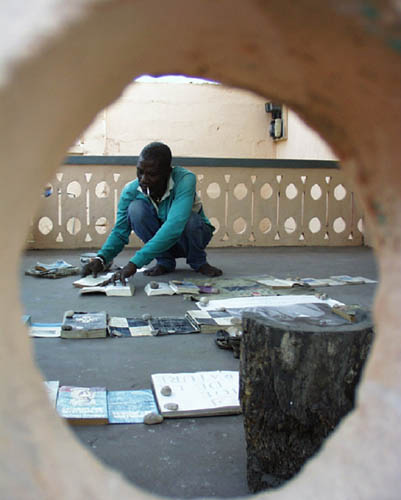
As the eldest of eleven children, Georges left home for university studies against his father’s will…[including] studies in France…Adéagbo was on his way in 1968 to a degree, a secure job, and marriage to his French fiancée, when [he received] news of his father’s death…Having resisted for almost three years the frequent pleas of his family to assume the eldest son’s duties…Adéagbo finally agreed to return to Benin for a short Easter visit. However, a cousin confiscated all his documents, hoping to hold him to the house…Yet Adéagbo did not accept the role he was expected to play…Adéagbo went to the riverbank daily, sat on the same rock, and meditated on the meaning of his destiny and the laws of nature. None of his kin would listen to his insights, and so he began to create constellations to illustrate his discoveries with his own original texts and objects collected from daily life. Regarded by many as a fool, Adéagbo was sent to a mental institution eight times…For 23 years Adéagbo lived on minimum income…daily continuing his philosophical studies, which he visualized in the form of installations. Initially only in his room, his works soon occupied the entire sand-covered court of his home. Finally, in spring 1993, a French curator, who came to meet well-known artists in Cotonou, was brought by mistake to Georges Adéagbo’s home. Astonished by what he saw, the “savior,” as he is referred to by Adéagbo, took…photographs to show his colleagues back in Paris.[1]
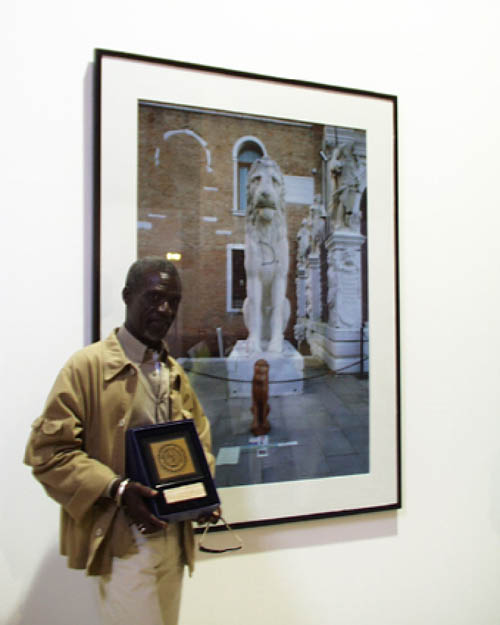
Taken under the wing of Jean Pigozzi and André Magnin, an (infamous) pair of collectors of contemporary African art, Adéagbo won a juried prize at the Venice Biennale in 1999. Adéagbo, however, does not consider himself an artist, but rather someone who makes installations about art. Moving beyond the emic perspective (largely) investigated in the study of Kane Kwei’s coffins, the works of Georges Adéagbo, another contemporary African artist, and an outwardly textbook case of ‘distributed personhood,’ raise larger issues of cross-cultural – and cross-disciplinary – contributions to understanding ‘material culture.’
an archaeology of adéagbo’s art
“I take them as is. When I happen to see an object while walking around, something says to me ‘Take this object to speak about it.’” [2]
“I walk, I think, I pass, I come back, I pick up the objects that attract me, I go home, I read things, I make notes, I learn.” [3] – Adéagbo
Particularly to those familiar with Gell’s theories, Adéagbo’s works act and speak in potentially dense and meaningful ways. He makes installations, meant only for their intended locations, incorporating, among other things: commissioned paintings and carvings; books and articles supporting the work’s “hypothesis”; original texts; found objects relating to the theme from the work’s location; and sculpture and found objects from Benin. In each work, he starts with a theme and “plots what could be called a vector map of the constellation of forces which led to the present conditions of a situation.”[4] Each installation remains a “dense symbolic network of events…[that] illustrates the universality of the laws of nature that govern life everywhere, while at the same time revealing the diversity of conditions that exist within a given location.”[5] While entirely contextually specific, each work nonetheless begins in his walks and courtyards in Benin. With a particular fixation on ‘high’ ideas of ‘History,’ auspicious dates, and ‘great men,’ the installations nevertheless also include “materials bound for commercial sale, detritus, specifically commissioned works by craftsmen, and materials sent by curators or institutions about the future exhibition sites.”[6] Through the use of commissioned pieces and copies of texts (he compiles his original clippings into ‘reference books’ in Benin for each work), Adéagbo’s works present intriguing questions about the role of the artist.
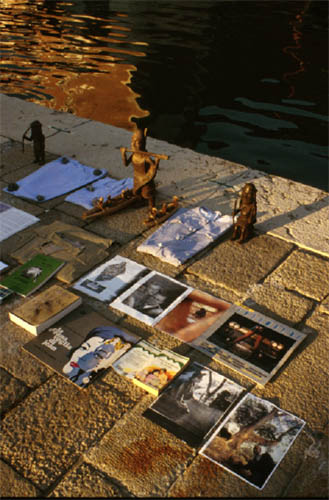
An investigation of two representative works highlights the methodologies, meanings and mind at work in Adéagbo’s œuvre. From Independence to Liberation, a work conceived for Munich’s “The Short Century: Independence and Liberation Movements in Africa, 1945-1994” exhibition in 2001, filled an entire room of the gallery with the full array of Adéagbo’s typical elements. In addition to pieces that specifically referenced modern African history, Adéagbo also alluded to the show’s Bavarian locale. He wryly incorporated “the ‘tribal’ elements of a Jodel-culture, and its particular fashion of leather trousers and felt hats as commodified goods of cultural self-representation, parallel[ing] exoticizing notions of the African everyday mirrored in such pulp novels as…Wild und Wilde im Herzen Afrikas (Wildlife and Savages in the Heart of Africa).”[7] A few years earlier, in the work that brought him to wide international attention, Adéagbo installed The Story of the Lion in the Campo dell’Arsenale, an outdoor courtyard near the main site of the 1999 Venice Biennale. In that work:
Georges calibrated the entire square by carefully arranging the elements of his installation in about fifteen clusters…In the middle of the square, Georges installed two fields of elements…leaving ample space for people to pass through and look at the installation from all sides… Using the photos of the Campo and books on Venice sent to Benin, Georges began to commission paintings, carvings and his texts painted on glass from the craftsmen he works with regularly in his hometown. In addition, he acquired wooden sculptures and more than a dozen old bronzes as well collected related objects on his walks through Cotonou…In spite of professional night guards being hired, two books and four paintings…disappeared. The artist commented: “Fortunately the thieves did not have the intelligence to read my installation and choose the works which are the key to its lecture, such as the painting of Pope Jean Paul II with the text: ‘Could an African be the successor of Jean Paul II?’ What they took can be seen as the city of Venice taking its share to show her acceptance of our work.”…To introduce Georges’ way of thinking and to commemorate this one-day installation, a T-shirt with a philosophical text (“remember that the stars influence, but do not determine and that the free judge allows man to forge his own destiny”)…was given away.[8]
On one level, The Story of the Lion might induce one to think of “the early contacts between European courts and the church, the great kingdoms of West and Central Africa and the Christian kingdom of Ethiopia. These trade networks sent salt, spices, knowledge and other objects to Europe and brought, amongst other items, Venetian glass beads to African societies [which]…became important markers of wealth…and subsequently assumed the status of a quintessential African fashion accoutrement;” or, perhaps, of the local syncretisms of Benin, Brazil and Portugal, created through slavery, displacement, and the creation of a ‘primitized’ Other.[9] The work might also reflect “the long history of exploitation of the continent’s raw materials for imperial purposes and the resulting poverty and impotency of Africa within the global marketplace.”[10] Regardless, Adéagbo offers an intriguing example of captivation; he “manipulates the objects…challenging the viewer to identify and experience multiple narratives.” Thus, one finds “subtle ironies in Adéagbo’s installations, due to the endless possibility of pairing incongruous items, either through juxtaposition by the artist himself or through an ordering and re-ordering in the eye of the beholder.”[11] Much of Adéagbo’s practice, indeed, raises similar, seemingly ‘incongruous’ questions.
artist, philosopher, archaeologist, pharmacist, historian: performing ‘identity’
“Artist? That means nothing to me. I didn’t learn things in an art school, I am only a witness of history…I go for walks as befits a philosopher, who does so in order to relate what is happening in nature and in the world.” [12] – Adéagbo
“He describes his role as that of an archaeologist, who analyses the frequency and the nature of these signs, and interprets their concordance as a whole.” [13]
Adéagbo “sees himself as a pharmacist who mixes up a precisely calibrated drug for each patient…as a “neutral medium between cultures, and not as the advocate of this or that side.” [14]
“One could say that I am a historian because I always got good grades in history…” [15] – Adéagbo
Parallel to the multifarious objects launched into the orbits of his installations, Georges Adéagbo’s work can also be seen as an assemblage of Adéagbos, of pieces of ‘self.’ He clearly rejects the “artist” appellation, referring to himself in the third person, as “my person of Georges.”[16] “For me, art is a message, a life lived which could serve as an experience…to others,” he claimed in a 1998 interview. “Art is in nature,” he stated two years later, “art makes the artist. It is not the artist that makes art. The artist is some kind of missionary who accomplishes the mission coming from the art that is in nature.”[17] At the same time, he added, “we cannot say that an African artist has less worth than a European artist because an African artist is someone who doesn’t deal with subjects, he is someone who works with the goal of getting what he needs to eat.”[18] The last point, however, raises a red flag – clearly, with the (support of his family…or institutions) Adéagbo was not starving for the twenty-some years prior to his discovery by the West.
On a larger level, Adéagbo’s work as performance also merits investigation. In such pointed submissions to the vagaries of the market, and in the invocation of alternatives to ‘artistry’ as praxis that move from the subtly pointed to the incredulously naïve, one wonders the extent to which Adéagbo is ‘performing the primitive,’ the better to situate himself as an African in a Western market. Certainly, “he fascinates Westerners because he has achieved the historical avant-garde dream, to accomplish a union of art and life.”[19] Adéagbo makes no distinction between the public and private, including (for example) communiqués with curators and dealers in his works; for Adéagbo “performance is without end. Life represents itself.”[20] A picture emerges of an individual toiling in his courtyards in Benin until being ‘saved’ by the West, of someone quite possibly dealing with very real ‘demons’ (paranoia, obsession) but who nevertheless all the better fits Western standards of both “artist” (avant-garde) and “African” (‘child-like’), while remaining self-aware enough to attempt to engage and tweak these discourses as well. His works may very literally be demonstrations of “distributed personhood,” but it’s not altogether clear that they are understood – speaking both cross-culturally, and broadly.
messenger or madman?: issues of reception
“My father took me only once, as a child, to a Vodun temple. I immediately recognized and was able to reveal the tricks of the priests, completely ruining the performance, sending the faithful toddling off with their voodoo dolls.” – Adéagbo [21]
“Creez pour vous libérer!” – Adéagbo[22]
Adéagbo’s works have received vastly different receptions in the two worlds that he, both literally, and performatively, straddles – Benin and the West. On one hand, this may reflect the highly localized and specific nature of his works. However, larger issues of cross-cultural reception remain apparent as well.
In Benin, his work has largely induced puzzlement, if not sentiments more dramatically anxious (as his multiple, involuntary visits to mental institutions may attest). In a place where received ideas about art still place great emphasis on the public, socially purposeful nature of artistic practice (indeed, where individual endeavors were long feared as ‘witchcraft’), Adéagbo’s sense of avant-garde artistry appears jarring. That said, Adéagbo may very well be drawing on local practices in his art; certainly Benin has a long history of “artistic assemblage…[that] functioned as a sort of visual piercing together of the very fabric of this ethnically diverse society, which accrued new members over the course of regular wars and slave raids.”[23] In invoking the term “voodoo dolls”, Adéagbo (implicitly, or otherwise) appropriates a Western term that denies the depths of vodun culture. Yet, his artistic practices also reflect the creation of Fon bocios; through metaphor and “textual density,” such objects function like “telephone lines – they carry multiple messages simultaneously.”[24]
In the West, however, Adéagbo’s pieces are received comparatively easily – perhaps, too easily. Superficially, at least, his work harkens to the post-Minimalist, site-specific installation practices of the 1960s and 1970s.[25] At the same time, the words of the curator with whom he worked in Venice – “Adéagbo belongs to the kind of Africans that still want to dream and visualize their dreams”[26] – speak powerfully to the uncomfortably primitivist assumptions through which his oeuvre is all too often read. On a deeper level, however, installations like The Story of the Lion also “discreetly highlight Africa’s relationship to and central role within the larger world and…question pat notions of universalism.”[27] Adéagbo, after all, was among the first wave of Africans admitted to the Venice Biennale (the whole continent has itself only been granted a “country” pavilion in the last decade). On this level, Adéagbo’s installations “about art” underline the difficulties of contemporary African artists, often “muted, conveniently side-lined to the role of mimic men,” and forced into a Manichean choice between a (Western) universalism, or a (‘quaint,’ ‘primitive’) provincialism.[28] For Adéagbo, rather “the global/local paradigm should…be perceived as a nexus of shared experience: one in which all dynamic cultures appropriate, continually transforming and re-inventing cultural and artistic elements in the fabrication of a modern/post-colonial world.”[29] This divide in cross-cultural reception merits further discussion, but the links between Adéagbo and Gell appear too rich to avoid any longer.
anthopological appopriations: adéagbo as a ‘distributed person’
“The object is…in a strict sense of the word a mirror, for the images it reflects can only follow upon one another without ever contradicting one another… For what you really collect is always yourself.” [30] – Baudrillard
The practical and (though the latter would bristle at this term) metaphorical links between Adéagbo and Gell, while apparent, deserve brief elaboration.
In considering the means in which artworks act as persons, Gell remained cognizant of the extent to which “there is seamless continuity between modes of artistic action which involve ‘performance’ and those which are mediated via artifacts…Every artifact is a ‘performance’ in that it motivates the abduction of its coming-into-being in the world.”[31] Likewise, one could argue, there is a strong continuity between the performance of Adéagbo as artiste and the manner in which his installations ‘perform’ through reception and bricolage. “He creates himself as author, subject to himself,” one study concludes.[32] “Social agents can be drawn from categories which are as different as chalk and cheese,” Gell argues, “because ‘social agency’ is not defined in terms of ‘basic’ biological attributes…but is relational – it does not matter, in ascribing ‘social agent’ status, what a thing (or a person) ‘is’ in itself; what matters is where it stands in a network of social relations.”[33] On one level, Adéagbo’s works embody this principle quite literally; the “being-in-the-world of [Adéagbo] is indexically inscribed through the labor-intensive processes of piling, joining, piercing and clustering,” another study adds.[34]
Adéagbo’s installations correspond powerfully to Gell’s descriptions of ‘fractal personhood;’ “any individual person is ‘multiple’ in the sense of being the precipitate of a multitude of genealogical relationships, each of which is instantiated in his/her person,” Gell claims. Finally, Adéagbo’s practices appear to encapsulate Gell’s concept of oeuvre – on both ‘micro’ and ‘macro’ levels. Adéagbo’s “networks of hundreds of objects, traces of events, illustrate life’s tightrope-walk along the thin line dividing humility in the face of fate, and the courage required for self-determination, the strength to make a choice,” one curator writes. “Finding and being found: during his walks in Benin, or at the exhibition location, there are objects – lost or thrown away by others – that catch attention – signs that say something to him…He may then interpret these as arguments for a theory, in the context of his great discourse.”[35] As ‘abductable’ traces of his presence, one sees how Adéagbo’s oeuvre is, in Gell’s terms, “an object which, so to speak, is made out of time.”[36]
the limits of agency
“I view art as a system of action intended to change the world rather than encode symbolic propositions about it.” [37] – Gell
However, if Adéagbo’s installations and practices can be said to embody the useful, or thought-provoking, components of Gell’s theory, they also (as has been implied thus far) speak to the system’s limits. In the spirit of Gell’s intentions (if not in the particular perspectives of his project), these limits, I argue, offer a more fruitful means to understanding the extent to which art history and anthropology, finally, speak across boundaries.
This study concludes with three (brief) points of contention: iconicity, captivation and the nexus of reception and ‘culture.’ Addressing Gell’s strident rejection of semiotic meaning as the only means of understanding art is hardly novel at this point, yet it deserves repetition in this context. Gell opened his polemic by stating that “visual art objects are not a part of language…nor do they constitute an alternative language.”[38] Making a claim about the universality of ‘abduction,’ Gell claims that art – while potentially communicative, in part – is not like language. It is not clear, however, that abduction is universal. Speaking in particular of Adéagbo’s use of ‘traditional’ West African art objects (each of which, in turn, “portrays a ‘book,’ a depiction of oral traditions, a catalyst and illustration for narrating old myths and moral fables”[39]), one analysis notes how “meaning circulates freely in this heterogeneous mass of harmoniously coexisting narratives as the documents become shifters scuffling with their dependence on the overall syntagmatic unit of the installation.”[40] Indeed, “it is the documents’ very silence, their refusal of a transparency of meaning, their address to an ultimate…opacity of biographical as well as historical linkage that make attempts of easy interpretation and/or categorization difficult.”[41] Layton notes that, while “Gell is right to argue that icons and indexes…are not entirely dependent on conventional, cultural structures” they nevertheless “do depend on cultural convention.”[42] Iconicity, in short, “is mediated by cultural convention. Representational styles select which aspects of the world they depict according to cultural tradition, and the chosen aspects are organized in conventional ways.”[43] That’s why changes are considered so shocking – as Adéagbo’s stays in the Cotonou asylum might suggest.
Similarly, Adéagbo’s works challenge Gell’s account of captivation, which he rooted (by way of example) in his own inability to achieve “the necessary congruence between [his] experience of agency and the agency which originated in [Vermeer’s, in this case] painting.”[44] However, given both their performative and entirely local bounds, in Adéagbo’s works, “with increasing amounts of spectators and their individualistic interpretations, the subject of the artist is gradually relegated from first-person status to third. The author, Adéagbo, becomes a derived function of different focal points of power as they advance from a particular mode of site specificity.”[45] Adéagbo’s works lack the technical complexity of a Vermeer painting – they are, superficially, easy to mentally reconstruct and, in this way, they serve as much to point away from the artist as towards him. Capitivation, instead, works by abducting intention, or meaning.
What’s more, our ability to connote art in this manner may not (as indicated in the discussion of iconicity, above) remain as universal as Gell (or Kant, in his oddly parallel account of aesthetics) argues. Gell is not insensitive to this possibility. He notes that, “in the contemporary world, much ‘ethnographic’ art is actually produced for the metropolitan market; in which case there is no possible way of dealing with it except in this specific framework.” But, he adds, “it also remains true that in the past, and still today, art was and is produced for much more limited circulation, independently of any reception…cultural and institutional boundaries.”[46] ‘Pre-’ and ‘post-discovery’ Adéagbo, in theory, straddles this divide, however. So how can his work be approached? Rooted in the Western paradox of approaching non-Western material culture as ‘art’ (without, typically, known ‘artists’), Gell concludes: “style, which is the harmonic principle which unites works of art into groups, into collectivities, corresponds to the anthropological theme of ‘culture.’ Culture is style, really.”[47] Is this meaningful in Adéagbo’s case, however? What is his ‘culture’? As indicated, he is considered neither fully Béninois nor Western. Is he simply the product of the ‘culture’ of the Benin-Europe art-market transactional world? Is one person a culture?
While Western artists are considered in terms of their oeuvres, non-Western artists are lumped into considerations of ‘style’ – “an aggregate of persons, such as a lineage or tribe, is ‘one person’ in consequence of being one genealogy,” Gell writes.[48] It is not at all clear, however, that ‘fractal personhood’ works thus in reverse – particularly when individual artists themselves reject style designations.[49] Indeed, for contemporary non-Western artists, practices of ‘appropriation’ – subverting the supremacy of the ‘original’ with the ‘copy,’ ‘high’ art with ‘low,’ playing with allegory and changes of meaning – remain a central means of overcoming “the imagined holism of primitive culture” while “using it as a strategy for identity construction.”[50] Finally, on a larger, “But, is it art?” level, the differences in reception of Adéagbo observed between Benin and Europe (let alone, between individual, bewildered viewers), points to two key objections to Gell’s approach: (1) that “aesthetic values do vary cross-culturally, and vary radically[51],” and, (2) that it “does not follow that technical complexity counts, in any society, as a reason for valuing something as art.”[52] Agency alone, Gell’s critics conclude, “radically impoverish[es] both art as a cultural phenomenon and the anthropology of art as an intellectual discipline since it prevents anthropologists as anthropologists from exploring a whole range of other issues relating to the social role of art, including “how people understand intellectual creativity.”[53] Gell rejects studies of art outside of their context of production but, as Adéagbo’s case demonstrates, this greatly diminishes the agency of artists, and art, in cases where that context is not entirely obvious. Indeed, it would seem to relegate Adéagbo to a surprisingly, and troublingly, ‘primitive’ understanding of African creativity. His work must be art, though – it was shown at a Biennale, after all.
conclusions: engaging anthropology and art history
This investigation ultimately aims to praise Gell’s theories, not to bury them. His intent, to a find a manner of understanding art more meaningful than structural semiotics, remains not only laudable, but points in a potentially quite useful direction. At the same time, in its analytical faults it speaks to the disciplinary distance between anthropology and art history yet traveled. A recent conference with this aim in mind noted, for example, “anthropology’s ‘iconophobia’ [in which] the visual is still too frequently treated…as something inherently seductive [‘enchanting?’], illusory and uncontrollable.”[54] The specific case of Georges Adéagbo, in turn, suggests that issues of “otherness…lie at the bottom of any appropriation, anthropological or artistic,” and that such considerations “are not only of a cognitive order, but involve an ethical dimension as well.”[55] The potential denial of full agency to non-Western artists – contemporary, or ‘traditional’ – remains a serious concern. At the same time, approaches such as Gell’s prod art history to get past “the central tenet of Zeitgeist that still places blinders on studies that venture beyond narrow period or geographic boundaries,” while simultaneously impelling anthropology to lose “the outdated Hegelian notion of progress, which makes it very difficult to discuss visual culture in a more fully comparative way.”[56] Indeed, both fields “must continue to advance beyond the long-standing self-imprisoning legacy of social Darwinism that early in our disciplines promoted divisions between ‘us’ and ‘them,’ the ‘West’ and the ‘Rest.’”[57]
Adéagbo’s professional trajectory shows how the Western art world “appropriates the other…through its tendency to incorporate (literally, to make of its own body) non-Western artists who come to work and study in the metropolitan centres;”[58] yet, Adéagbo nevertheless finds means to ‘excavate’ and appropriate that world. Likewise, art history and anthropology stand to gain by recognizing the potential of disciplinary appropriations. Gell, and other occasional adherents of ‘thing theory,’ seek to move anthropology, “which is fundamentally concerned with experience,” beyond a reliance on “a separation of body and mind in what it produces.”[59] Joseph Kosuth, perhaps Georges Adéagbo’s most relevant, intellectual brother-in-arms on the Western side of the artificial divide, put it best: “the artist perpetuates his culture by maintaining certain features of it, by ‘using’ them,” he claimed. “The artist is a model of the anthropologist engaged.”[60] “Créez pour vous libérer!,” Adéagbo might add.
bibliography
Baudrillard, Jean. The System of Objects. New York: Verso, 2005.
Blier, Suzanne Preston. African Vodun: Art, Psychology and Power. Chicago: University of Chicago Press, 1995.
———. "Transcending Places: A Hybrid, Multiplex Approach to Visual Culture." In Anthropologies of Art, edited by Mariët Westermann, 89-107. Williamstown, Mass.: Sterling and Francine Clark Art Institute, 2005.
Bowden, Ross. "A Critique of Alfred Gell on Art and Agency." Oceania 74 (2004): 309-24.
Busca, Joëlle. Perspectives sur l'art contemporain africain. Paris: Harmattan, 2000.
Domino, Christophe, and André Magnin. L’art africain contemporain. Paris: Scala, 2005.
Enwezor, Okwui, ed. The Short Century: Independence and Liberation Movements in Africa, 1945-1994. Munich: Prestel, 2001.
Fall, N’Goné, and Jean Loup Pivin, eds. An Anthology of African Art: the Twentieth Century. New York: Distributed Art Publishers, 2002.
Gachnang, Johannes. "The Story of the Lion." In Georges Adéagbo: Archaeology of Motivations - Re-Writing History, edited by Silvia Eiblmayr, 58-59. Innsbruck, Austria: Galerie im Taxispalais, 2001.
Gell, Alfred. Art and Agency: an Anthropological Theory. Oxford: Clarendon Press, 1998.
Harney, Elizabeth. "Contemporary African Art and the Global Marketplace: Situating the Works of Georges Adéagbo." In Georges Adéagbo: Archaeology of Motivations - Re-Writing History, edited by Silvia Eiblmayr, 18-25. Innsbruck, Austria: Galerie im Taxispalais, 2001.
Hoskins, Janet. "Agency, Biography and Objects." In Handbook of Material Culture, edited by Chris Tilley, Webb Keane, Susanne Küchler, Mike Rowlands and Patricia Spyer, 74-84. London: Sage Publications, 2006.
Köhler, Stephan. "Georges Adéagbo: Synchronizing Archaeology - Designation of Events." Joint Adventures Art Projects, http://www.jointadventures.org/adeagbo/adhome.htm.
———. "Rappelez-vous - que les astres influencent, mais ne determinent pas et que le libre arbitre permet à l’homme de forger son destin." In Georges Adéagbo: Archaeology of Motivations - Re-Writing History, edited by Silvia Eiblmayr, 32-35. Innsbruck, Austria: Galerie im Taxispalais, 2001.
Laval-Jeantet, Marion, and Benoît Mangin. "Interview with Georges Adéagbo, Cotonou, Benin, September 6, 1997." In Veilleurs du monde (Gbêdji Kpontolè) - une aventure béninoise, edited by Marion Laval-Jeantet and Benoît Mangin, 122-27. Paris: CQFD, 1998.
Layton, Robert. "Art and Agency: A Reassessment." Journal of the Royal Anthropological Institute 9, no. 3 (2003): 447-64.
n.a. "Georges Adéagbo: Biography." http://caacart.com/html/adeagbo_frameset.html.
Philips, Ruth. "The Value of Disciplinary Difference: Reflections on Art History and Anthropology at the Beginning of the Twenty-First Century." In Anthropologies of Art, edited by Mariët Westermann, 242-59. Williamstown, Mass.: Sterling and Francine Clark Art Institute, 2005.
Rottner, Nadja. "Georges Adéagbo's 'Voices of Silence'." Nka: Journal of Contemporary African Art 19 (2004).
Schneider, Arnd. "Appropriations." In Contemporary Art and Anthropology, edited by Arnd Schneider and Christopher Wright, 29-51. Oxford: Berg, 2006.
Schneider, Arnd, and Christopher Wright. "The Challenge of Practice." In Contemporary Art and Anthropology, edited by Arnd Schneider and Christopher Wright, 1-27. Oxford: Berg, 2006.
Steiner, Christopher B. "Rights of Passage: On the Liminal Identity of Art in the Border Zone." In The Empire of Things: Regimes of Value and Material Culture, edited by Fred R. Myers, 207-32. Oxford: James Currey, 2001.
Szeemann, Harald. "Interview with Georges Adéagbo, Brussels, 2000." In Georges Adéagbo: Archaeology of Motivations - Re-Writing History, edited by Silvia Eiblmayr, 64-65. Innsbruck, Austria: Galerie im Taxispalais, 2001.
Westermann, Mariët. "Introduction: The Objects of Art History and Anthropology." In Anthropologies of Art, edited by Mariët Westermann, vii-xxxi. Williamstown, Mass.: Sterling and Francine Clark Art Institute, 2005.
[1] Stephan Köhler. "Georges Adéagbo: Synchronizing Archaeology - Designation of Events." Joint Adventures Art Projects, http://www.jointadventures.org/adeagbo/adhome.htm.
[2] Marion Laval-Jeantet and Benoît Mangin, "Interview with Georges Adéagbo, Cotonou, Benin, September 6, 1997," in Veilleurs Du Monde (Gbêdji Kpontolè) - Une Aventure Béninoise, ed. Marion Laval-Jeantet and Benoît Mangin (Paris: CQFD, 1998), 122.
[3] n.a. "Georges Adéagbo: Biography." http://caacart.com/html/adeagbo_frameset.html.
[4] Köhler. "Georges Adéagbo: Synchronizing Archaeology.”
[5] Ibid.
[6] Elizabeth Harney. "Contemporary African Art and the Global Marketplace: Situating the Works of Georges Adéagbo." In Georges Adéagbo: Archaeology of Motivations - Re-Writing History, edited by Silvia Eiblmayr. Innsbruck, Austria: Galerie im Taxispalais, 2001, 21.
[7] Nadja Rottner. "Georges Adéagbo's 'Voices of Silence'." Nka: Journal of Contemporary African Art 19 (2004).
[8] Köhler. "Georges Adéagbo: Synchronizing Archaeology.”
[9] Harney, 22.
[10] Ibid.
[11] Ibid., 24.
[12] n.a. "Georges Adéagbo: Biography." http://caacart.com/html/adeagbo_frameset.html.
[13] Stephan Köhler, "Rappelez Vous - Que Les Astres Influencent, Mais Ne Determinent Pas Et Que Le Libre Arbitre Permet À L'homme De Forger Son Destin," in Georges Adéagbo: Archaeology of Motivations - Re-Writing History, ed. Silvia Eiblmayr (Innsbruck, Austria: Galerie im Taxispalais, 2001), 32.
[14] Ibid., 34.
[15] Marion Laval-Jeantet and Benoît Mangin, 122, 124.
[16] Köhler. "Georges Adéagbo: Synchronizing Archaeology.”
[17] Harald Szeemann. "Interview with Georges Adéagbo, Brussels, 2000." In Georges Adéagbo: Archaeology of Motivations - Re-Writing History, edited by Silvia Eiblmayr, 64-65. Innsbruck, Austria: Galerie im Taxispalais, 2001, 64.
[18] Laval-Jeantet and Mangin, 124.
[19] (My translation.) Joëlle Busca. Perspectives sur l'art contemporain africain. Paris: Harmattan, 2000, 80.
[20] Köhler, "Rappelez Vous…” 33. Indeed, “The artist’s personal history of himself being subject to discovery resurfaces self-stylized in his writing and his installations as a core theme in…the mantra of the eternal creator. Within the postmodern notion of the artist as notorious recycler of commodity goods lingers an outmoded, romanticized avant-garde mythology of the creator ex-nihilio, Rottner notes. In his work, “always leading the gaze of the viewer/reader back to the starting point of phenomenological observation – his or her very own body – the performative element…is emphasized.” Rottner.
[21] Ibid., 34.
[22] Köhler. "Georges Adéagbo: Synchronizing Archaeology.”
[23] Suzanne Preston Blier, "Transcending Places: A Hybrid, Multiplex Approach to Visual Culture." In Anthropologies of Art, edited by Mariët Westermann. Williamstown, Mass.: Sterling and Francine Clark Art Institute, 2005, 98.
[24] Suzanne Preston Blier, African Vodun: Art, Psychology and Power. Chicago: University of Chicago Press, 1995, 235.
[25] See Rottner.
[26] Szeemann, 65. “What is the reason for Adéagbo’s success within the global art world?” Harney asks. “There remains a possibility always that he is accepted for his difference, an outsider artist who conveniently shares the preferred profile of a classic avant-gardist: isolated, misunderstood, accursed and brilliant.” Harney, 24.
[27] Ibid., 21.
[28] Ibid., 19-20.
[29] Ibid., 21.
[30] Jean Baudrillard. The System of Objects. New York: Verso, 2005, 97.
[31] Alfred Gell. Art and Agency: an Anthropological Theory. Oxford: Clarendon Press, 1998, 67. Indeed, he added, “what unites drawing, music, and dancing is a certain cognitive indecipherability manifested in performance,” 93.
[32] (My translation.) Busca, 83.
[33] Gell, 123.
[34] Rottner.
[35] Köhler, "Rappelez Vous…” 32.
[36] Gell, 236.
[37] Gell, 6.
[38] Ibid.
[39] Köhler, "Rappelez Vous…” 33.
[40] Rottner.
[41] Ibid.
[42] Robert Layton. "Art and Agency: A Reassessment." Journal of the Royal Anthropological Institute 9, no. 3 (2003), 460.
[43] Ibid., 453.
[44] Gell, 69.
[45] Rottner.
[46] Gell, 8.
[47] Ibid., 163.
[48] Ibid., 140.
[49] Indeed, Adéagbo “is what he does,” Busca writes. “He does not present his oeuvre as detached from himself, but as the result of a quite profound desire for authentic communication…He creates himself as author, subject to himself.” (My translation.) Busca, 83.
[50] Arnd Schneider. "Appropriations." In Contemporary Art and Anthropology, edited by Arnd Schneider and Christopher Wright. Oxford: Berg, 2006, 32, 37.
[51] In the West, one could argue, Adéagbo’s “objects take on an exuberant anti-monumentality, an ephemerality and actuality that is rather distinctive to a Western observer who is traditionally conditioned to look at those objects as cultural artifacts in a timeless, disinterested museological setting.” Rottner.
[52] Ross Bowden. "A Critique of Alfred Gell on Art and Agency." Oceania 74 (2004), 320.
[53] Ibid., 318.
[54] Arnd Schneider and Christopher Wright. "The Challenge of Practice." In Contemporary Art and Anthropology, edited by Arnd Schneider and Christopher Wright. Oxford: Berg, 2006, 16.
[55] Schneider, 48.
[56] Suzanne Preston Blier, "Transcending Places: A Hybrid, Multiplex Approach to Visual Culture." In Anthropologies of Art, edited by Mariët Westermann. Williamstown, Mass.: Sterling and Francine Clark Art Institute, 2005, 103.
[57] Ibid.
[58] Schneider, 50.
[59] Schneider and Wright, 16.
[60] Ibid., 24.