Maurice Godelier has remarked on the way in which certain objects can be transformed from commodities to gifts and finally to treasures within a society.[1] As this transformation takes place, the everyday becomes the sacred and “like human or supernatural persons, they acquire a name, an identity, a history, and powers.”[2] Like the religious object, the aesthetic object too seems capable of a similar transformation, and therefore Godelier’s observation could be extended to an architectural object, even a house.
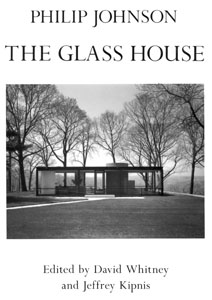
One such house, aptly named “The Glass House” and located in New Canaan, CT is seen here. In fact, the house continues to look exactly as it did when it was constructed in 1949, and it will continue to look this way into far the future thanks to its “gifting” to the National Trust for Historic Preservation in 1986, even though the occupant and creator of the house would continue to reside in it for another 19 years until his death in 2005. It could be argued, based on these images, that in fact no transformation of the object has occurred. That this case the exact opposite. However, as with most gifts, there is an expectation of reciprocity and this “gift” is no exception. For this gift was meant to ensure the progression of the object along that path towards the “sacred,” producing the iconic work of art, the eternal monument, and the autobiographical house all at once.
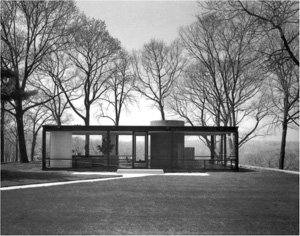
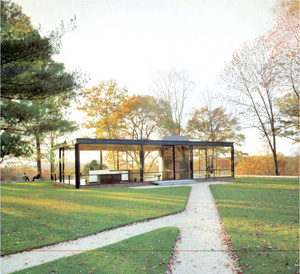
the glass house. left: 1949. right: 2002
As with any intentional monument, permanence constitutes a fundamental quality, whether actual or projected. In this case, change itself was written out of the house’s plans from the beginning, when its physical form was permanently fixed, down to the smallest detail.
.
.
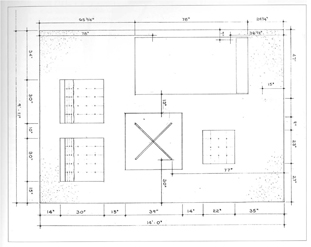
The furniture plan, created at the time the house was designed, continues to define the interior space today. Not one element has been changed, not one rela-tionship between elements has been altered.
.
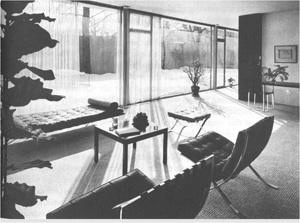
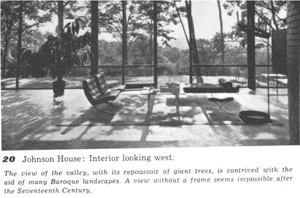
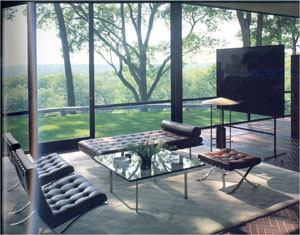
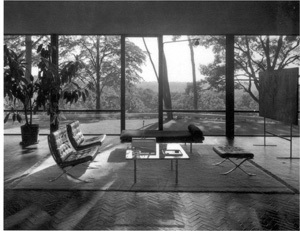
From its inception, it is evident that each element was carefully selected, arranged, and preserved, and the parts that made up the whole were then maintained in accordance with a single aesthetic ideal, resulting in a state of stasis that resisted any adaptations to changing circumstances. Within such a circumscribed realm any alteration would it seems cause the entire composition to unravel, its value to be lost.
Once formed, however, the house exhibited a power of its own as it began to re-form the life of its occupant. The unrelenting aestheticism of the space served to determine how it could be inhabited. To critics who called the house “unlivable” its owner maintained that “It’s very livable, because like anything else, you adapt to it. When it’s too hot you eat or sleep outside. In a house like this, you live in the weather – it’s a changing shoal.” A visitor once had this to say about the daily constraints imposed on the occupant by the house:
One thing that I was about to experience in the guest house I was already experiencing here [in the Glass House]. It didn’t affect my esthetic pleasure, nor do I mean the noting of it to detract in any way from my tribute to what Johnson has produced as a work of art; but I’d be less than honest if I neglected to mention it. I was beginning to experience a variety of discomforts. My back was already aching from the leather chairs designed by Mies, which offer meager support. I took care of this by putting a heavy photograph album behind me to fill the gap between top and bottom. Then my eyes began to trouble me. “How do you read?” I asked. “There is only one way,” he laughed apologetically; “I lie down on this couch, which is also my bed, and hold the book over my head.” We tried to hook up one of the upthrusting floor lamps so that its beam would fall on my book, but it was no use. Finally I sat on the floor, used the edge of the couch as a backrest, and laid the lamp on its side. [3]
In light of such obvious shortcomings, the furnishings, both in their arrangement and their design, might seem to be the product of a concern with “form over function” and to a certain extent this would be correct. However, this would be only a partial explanation, for in a very material sense the furnishings represented the personal history of the occupant and the continuation of a series of other, formally and biographically, related “objects.”
.
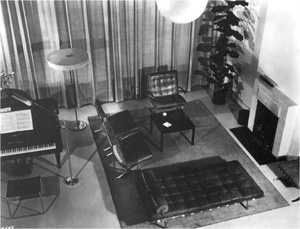
An early prototype for the Glass House interior can be seen here, in New York City apartment designed for the subject by the architect Mies van der Rohe in 1930; a design included in the International Style exhibition at MoMA in 1932.
.
Later, these identical furnishings would appear in a very similar formation in the subject’s design for his first house, built in Cambridge, MA in 1946. Finally they appear yet again in the Glass House in New Canaan in 1949. This moving “exhibition” would finally come to rest within the confines of the house/museum that would ensure that the composition would be preserved in perpetuity.
Signs of temporality, intentionally denied to the object, would be recorded not through changes brought about by the aging effects inscribed on inert matter, but through the physical transformation of the human body that inhabited it. Through a series of images that were recorded, tracing the life of both the subject and the object, it is the human subject rather than the object that provides information as to the place of the image in the chronological sequence of its history.
.
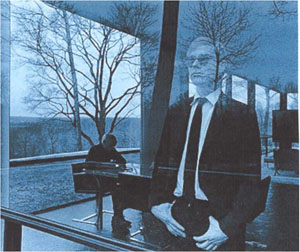
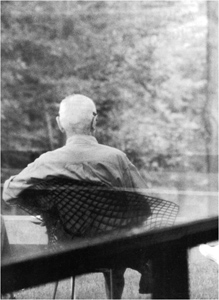
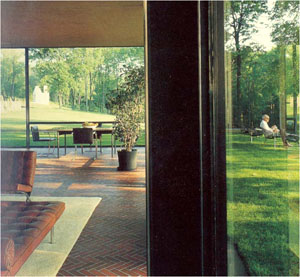
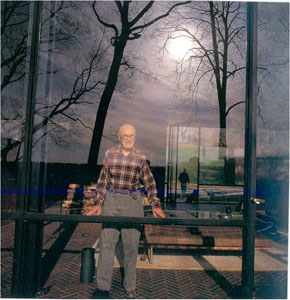
.
The photographic image had other functions as well. Its synthesizing capacity was utilized in order to merge subject and object together in time and space. As a result of the proliferation of such images, the increasing prominence and iconicity of the object served to simultaneously increase the visibility and prominence of the subject.
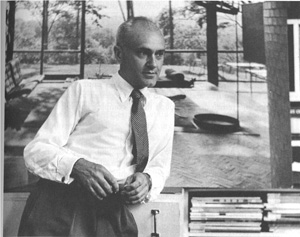
.
This merging was not unproblematic, however. To extend an observation made by W. J. T. Mitchell, objects, like images, can say more than one thing, in fact, they are promiscuous when it come to interpretation – for they enable a multiplicity of possible readings at any one time. They are ambiguous with respect to any particular meaning attached to them, always capable of incorporating a number of alternative readings that seem to be consistent with the material object and its formal and empirical qualities. For a subject seeking to control both his image and his legacy through a set of relations with an object, this aspect of the object would prove to be particularly problematic.
The house made a somewhat inauspicious entrance, and while not exactly situated among the class of ordinary objects, it had not yet established itself as among the “sacred” either. Upon the official birth of the house, its presence was barely remarked upon, save for a few small reviews. In those that did appear, the house is noted mainly for its derivative qualities, being a close approximation of the Farnsworth House by Mies, which, while not yet built has been prominently exhibited in 1947.
.
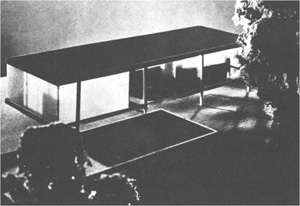 .
. 
.
In addition, a prototype for the design can be found in 1931 design for the Berlin Building Exhibition. Both of these designs were well known to the subject.
Besides the association with Mies and the formal qualities of it as prototype, one aspect of the house to drew the attention of the critics was the house’s material qualities, notably the large expanses of glass and the technical aspects of the design that made such an all-glass enclosure possible. To amend this situation, and invest the house with a richer, more “autobiographical” reading beyond the mere materiality of the house and a reading of it as a technological object, the house’s creator and inhabitant did something unprecedented. A narrative of the house appeared, written by the subject, identifying the various “sources” from which the design for the house had been derived, and tracing a geneology that distinguished it both from other similar objects, as well as from the object that had been described by the critics up to that time. The essay appeared in 1950 in one of the most prestigious architectural journals of the time, The Architectural Review.
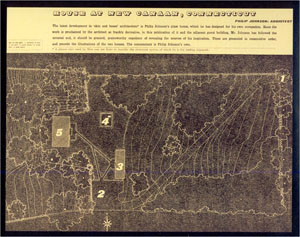
The House at New Canaan (1950)
.
While explicitly referencing the house’s obvious debt to both Mies and the Farnsworth House, a number of other references made an appearance, ranging from such eminent architects as Karl Friedrich Schinkel and Le Corbusier, to the Suprematist painter Kasimir Malevitch. Not only did it invest the house with the prestige of the sources cited, raising it above discussions of technology and prototypes, but it allowed the house to be situated within a historical narrative that defined the canonical and classical objects of the field and offered a richer and more complex reading of the house as art object.
.
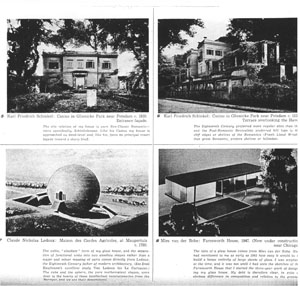
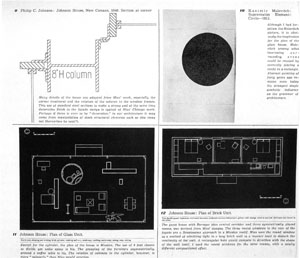
"House at New Canaan", Architectural Review (1950)
.
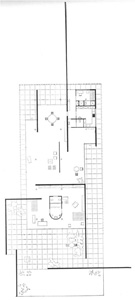
Beyond the more typological and formal references, the house was said to incorporate the subject’s own personal memories. Despite the Miesian prototypes, the chimney was depicted as a most “un-Miesian” element, serving as a point of distinction between Farnsworth and the Glass House. Instead, the Malevitch painting “Suprematist Element: Circle – 1913” was cited as the source, even though it was identified only after the house has been completed. The citation reads:
“Although I had forgotten the Malevitch picture, it is obviously the inspiration for the plan of the Glass House.”
The success of this maneuver can be measured by the number of succeeding critical essays that unquestioningly incorporate the Malevitch reference, declaring it to be “un-Miesian,” while ignoring the existence of Mies’ earlier use of the same element. The subject has seemingly succeeded in speaking for the object, silencing what the object might otherwise say. Yet this control is an illusion, for despite the intentions of the subject. With regard to the same cylindrical brick element, another reference was made, this one evoking personal memories tied to the formal characteristics of the chimney:
The cylinder made of the same brick as the platform from which it springs. Forming the main motif of the house, was not derived from Mies, but rather from a burnt wooden village I saw once where nothing was left but foundations and chimneys of brick. Over the chimney I slipped a steel cage with a glass skin. The chimney forms the anchor.
This seemingly innocuous narrative would contain the seeds of an autobiographical reference that would later be written out, for what the caption omits is any reference to the context of that memory, one formed while traveling as an enthusiastic guest of the German military command in 1939 on an escorted tour through Nazi-occupied Poland, where the chimney in question was the sole remains of a small Polish village the German’s had recently burnt to the ground. When the context became known, the narrative was re-edited, editing the autobiographical reference as well, and thus editing the subject. In this re-edited version, Frank Lloyd Wright and the traditional New England brick hearth become the original inspiration for this form.[4] If indeed forms and objects can “say anything,” it is equally true that there is a danger attached to this ambiguity, for control over what they say is never assured, and what they say can be used against them.
.
 .
. 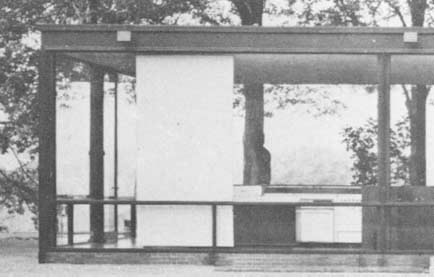
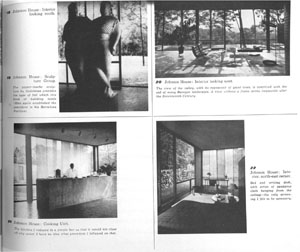
Left: "Johnson House: Cooking Unit" (1950). Right: "Johnson House: Cooking Unit" (1979)
.
Similarly, The image captioned “Johnson House: Cooking Unit” in 1950 is eliminated in 1979 when the essay is reprinted in a collection of writings by the subject. Given the racial implications of the image, again it is easy to see why, once again, history and autobiography would need to be revised.
.
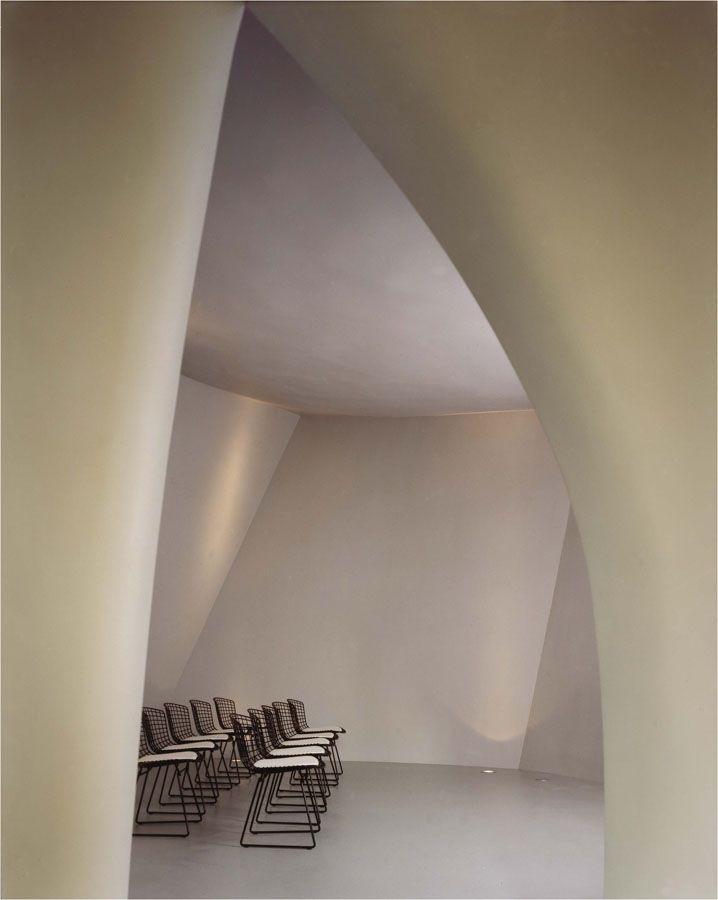 .
. 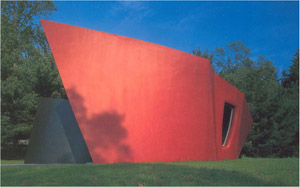
the glass house visitor’s center and interior
.
With the design and addition of a visitor’s center for the site, and the production of a “narrated tour” by the subject intended to interpret the house and its site for future visitors, another attempt to gain control over the object is again asserted.
For it had become only too obvious that once the process of conflation between subject and object had begun the ability to define the object translated into an ability to define the subject. The Glass House and Philip Johnson had become mirror reflections of each other. Thus Johnson felt compelled to proscribe the possible meanings of the object, restricting its ambiguity or “content.” According to the way images and objects operate, what Mitchell describes as their ability to be “always saying (or showing) something more than any verbal message can capture – even something directly opposite to what they seem to say”[5] Johnson was forced to continually revise the narrative of the Glass House in order to revise his own history, reigning in the possible interpretations that the house could generate.
Mitchell likens the image to “a ventriliquist’s dummy,” an empty vessel “into which we project our own voice” and which then takes on a life of its own.[6] But in the case of the Glass House neither the object, and its formal references, not the subject with his personal aspirations, can contain what the object says within a single determinative “voice.”
Nor could the object be prevented from proliferating over the site as a response to the stasis imposed upon it by the subject. In fact, the more strictly the object is constrained, the more prolific its generation of these periferal objects becomes.
.
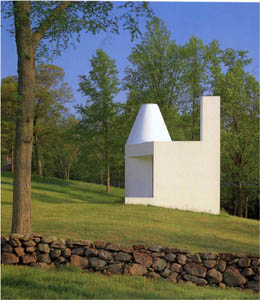
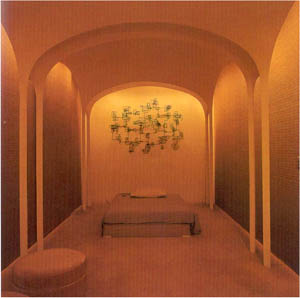
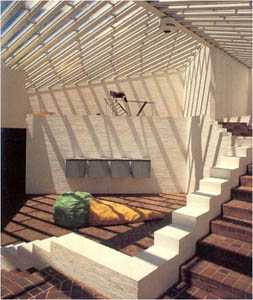
architectural additions to the glass house property
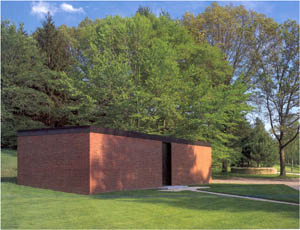
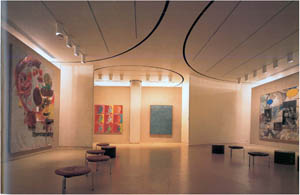
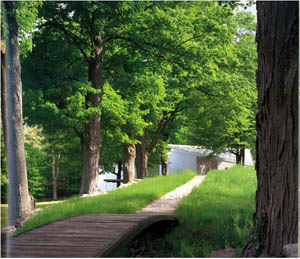
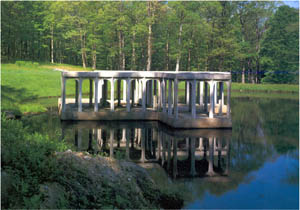
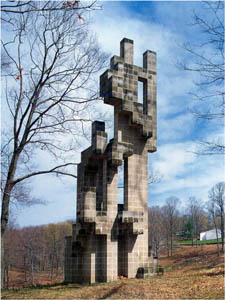
As each new object appears, it alters the previous narrative that binds the parts together into one coherent whole. It would soon become unclear whether the name “The Glass House” referred to a single object or to an entire collection of objects, to the site as a whole or to one particular building. The clear distinctions that seemed to provide the foundation of the project, the carefully delineated form, the distinct roles of the producing subject and the object produced, and the perfectly preserved moment of origin, begin to blur. It becomes impossible to entirely separate the object from the subject and vice versa, nor to clearly differentiate the name, identity, history and powers of one without reference to the other.
With the death of the subject in 2005 and the subsequent preservation of the house as a historic monument a process came to an end, but another would replace it, though a qualitatively different one to be sure.