Modern anthropology is often said to be borne of humanism. According to Wikipedia, humanism is "a broad category of ethical philosophies that affirm the dignity and worth of all people, based on the ability to determine right and wrong by appeal to universal human qualities—particularly rationalism". Anthropologists have long sought after universal truths and morals that apply to all people, and have been responsible for a leftist turn in the social sciences and humanities recognizing that that there are many perspectives all over the world and, therefore, many means of approaching truth (see Benedict, Mead, Boas). In addition, many anthropologists were central to expanding the scientific threshold for how we talk about race and cultural differences. However, a critique of anthropological humanism – aside from some of its naïve associations with colonialism – could be that it is too human-centered, that it holds humans responsible for higher truths that are constructed to be somehow oppositional to, or transcendent above, nature and the world of "things".
Although cultural anthropology has recently become more preoccupied with the world of things, many of its major texts – Baudrillard and Bataille among them – utilize in their models dichotomies between humans and things, subjects and objects, and so reinforce that habitus of scientific discourses that only legitimizes the scientific approach to things in relation to their relevance to people. It is debatable whether or not this is a bad thing, but one interesting way to illuminate the questionable nature of these dichotomies is to look at the way we discuss animals in media and in science. Animals, according to Baudrillard and Bataille, exist somewhere between the planes of subject and object (Baudrillard 2005:95), and so are somewhat problematic to this conception of the world. These particular theorists say between, but treat animals as if they belong squarely in the object category (95):
The pathos-laden presence of a dog, cat, a tortoise or a canary is a testimonial to a failure of the interhuman relationship and an attendant recourse to a narcissistic domestic universe where subjectivity finds fulfilment in the most quietistic way … The object is in fact the finest of domestic animals … They all converge submissively upon me and accumulate with the greatest of ease in my consciousness.
However, a quick look at discourses concerning animals shows that the relationship between humans and animals, including domestic ones, is far more complex than this. One useful way to begin to look at this issue is by examining the way the boundaries between human and animals are portrayed in media, themselves objects through which we converse and exchange, and whose subtle use of images and "given truths" reveal a great deal about the way we have constructed ourselves as beings with spirit, with choice, and therefore in a realm apart from those things that are assumed to be devoid of consciousness, such as rocks, cows, monsters and mice.
In literature, movies and common characters of folklore, a fear of "monsters" is often expressed, beings that are otherworldly or subhuman, and which often exhibit animalistic traits and behaviors or which are human-animal hybrids. A ready example is of course the Werewolf, who often appears as a good-natured human afraid of, but unable to control the wild instincts brought about by nature.
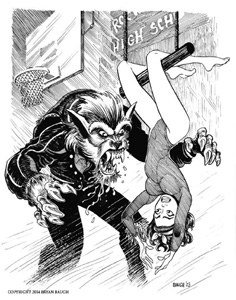
Werewolves represent madness, violence, and sometimes lust, as we see in the above illustration. They often seem to revel in animalistic pleasures, and are associated with the "profane" and uncivilized behaviors brought on by reckless abandon. Humans become victims of those humans who have werewolves within them, much in the same way that many religions teach us that we are prey to our own desires (Engelke discusses this in Materiality 2005:118-139). Among most of these stories there is a common theme having to do with an irrepressible nature, a desire to behave like an animal who, as Bataille says, lives in a world without meaning, of "immanence", an inability to differentiate between self and other – essentially, a state devoid of morals. Stories such as those about werewolves reflect a fear of this state as an external imposition upon ourselves and what it means to be human.
Our fear of the animal-human hybrid, or perhaps the animal nature of humans, can be attributed to the assumption often reflected in science that humans alone possess consciousness and subjectivity, while the world of animals and objects is somehow wild, alien, guided only by instinct. This assumption is described (and endorsed) by Bataille (20):
Nothing, as a matter of fact, is more closed to us than this animal life from which we are descended. Nothing is more foreign to our way of thinking than the earth in the middle of the silent universe and having neither the meaning that man gives things, nor the meaninglessness of things as soon as we try to imagine them without a consciousness that reflects them. In reality, we can never imagine things without consciousness except arbitrarily, since we and imagine imply consciousness ...
However, the assumption that humans alone possess consciousness and that monsters and animals don't share some sense of the social is, according to some, only an assumption. Mary Shelley brought this up in Frankenstein, when she takes up the banner carried by the likes of John Milton and Danté, and gives a voice to the lost, and to the monster. In the end of the book, the monster, who has been characterized as a murderer, and who is referred to as a "wretch" and unpalatably ugly by the narrator, explains his story. Shelley's novel is different from most monster stories, which are about the good killing the evil guy, or a hero overcoming his own vices, or some version thereof. In Frankenstein, we are forced to feel some compassion for the monster who is in the end driven to defeat not by his own nature but by the neglect and derision he has experienced in the world of humans (Shelley 1996:154):
No sympathy may I ever find. When I first sought it, it was the love of virtue, the feelings of happiness and affection with which my whole being overflowed, that I wished to be participated. But now, that virtue has become to me a shadow, and that happiness and affection are turned into bitter and loathing despair, in what should I seek for sympathy? I am content to suffer alone, while my sufferings shall endure … Once my fancy was soothed with dreams of virtue, of fame, and of enjoyment. Once I falsely hoped to meet with beings who, pardoning my outward form, would love me for the excellent qualities which I was capable of bringing forth… But now vice has degraded me beneath the meanest animal.
The Cow, an Iranian film by Dariush Mehrjui that is acclaimed as a landmark in international cinema, is about a man who lives in a rural village and happens to be the only person who owns a cow, and therefore is a wealthy and respected man in the village. He is attached to the cow, and treats her like a person, even more so than his wife. After we meet Hassan and the cow, we see that he has decided to sleep in the shed, in order to guard the cow from night marauders. The other villagers do not seem to regard this as strange since the cow is very valuable and so it makes sense that he would covet her. When the cow suddenly and mysteriously dies while Hassan is away, the villagers decide that they will hide the news from him by claiming that the cow ran away. They bury her and all agree to keep the secret, even hiding a townsman in order to be able to proclaim that he went off in search of her. Indeed, Hassan does not take the news well, nor does he believe the villagers. He begins to assume the identity of the cow, until in every manner he behaves like a wretched, threatened cow. The villagers try to help him, but he treats them as enemies. In the end, they decide to bind him and lead him, in driving rain, far away to the city to obtain medical help. In the process, they resort to treating him like an animal. There is then a poignant moment when we see the shame of the village leader Eslam who, driven to his own madness, resorts to whipping Hassan, transforming the formerly well respected member of the community, a fellow human being who had great influence, to a disobedient animal. The other men stop and gaze at Eslam, trapped in the same realization, and the onus of the burden of transgression of human/animal boundaries lies not on the sick mad man, but on Eslam himself.
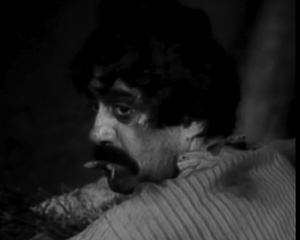
Aside from the political implications of the film, which have to do with the national politics of Iran at the time the film was made, it portrays a rare sensitivity toward the man who becomes an animal to avoid the realm of the human social world where he only meets threats and deception, even from those who mean well. It is also interesting that consciousness is not lost by Hassan's transgression, but in the transgression of the villagers when they reach the point where they no longer see him as a fellow human being and so do violence upon his person.
Interestingly, this kind of transgression occurs often in science, not only in the talk of social science but in the hard sciences as well, especially where human medicine is involved. Shelley's critique of the scientist is not far off base in a world where technology now invites the possibility of the creation of hybrids. As the Frankenstein monster has become a popular figure in pop culture, he has lost his voice and become largely just another representation of that which we fear, a hybrid that comes close enough to being human that the ultimate transgression is made by all humankind in the creation of such a being, and therefore something for which we must atone. Such a theme can be found in the movie Aliens: Resurrection, in which we see dozens of test tubes full of grotesque living animal-alien hybrids, results of science gone wrong and unregulated. Sigourney Weaver, the heroine and herself a hybrid, kills them all.
Yet despite this fear, scientific experiments having to do with hybrids is sanctioned, as long as the resulting hybrid is on the side of animal rather than human. Only when the creature becomes too human, does the act become inhumane. In 2005, the National Geographic Magazine published an article announcing that a researcher would be allowed to go ahead with his research plan to create a mouse and human hybrid "as long as it remains more mouse than human" (Mott:1-2). This precaution is imposed as a result of the fear of the Frankenstein monster, a fear that something would be too human. Only then would the project become too "inhumane". Such projects follow the experiments conducted in the nineties and early Millenium in which scientists grew human-like ears in the spines of living mice who were implanted with cartilage cells (incidentally, cells derived from cow cartilage rather than human). In a PBS article on the subject, a picture of the ear-toting mouse is captioned as follows: "After this human ear is removed, the mouse will remain healthy" as if to suggest to the liberal readers of PBS that despite the unnerving transgression of human/animal boundaries, the use of mice as human organ factories can be a "humane" practice.
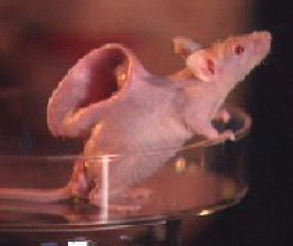
Underlying this practice of defining humane practice as that which is applied to humans (or hypothetical hybrids that are too human), and so limiting the amount and types of transgressions which we are allowed, is the assumption that humans own consciousness and subjectivity. The issue goes beyond sentience, since nearly everyone would agree that despite animals' subhuman status, they are indeed sentient; however, to be humane to a being that is only sentient is completely different than being humane to one that is subjective.
To the likes of Latour, observing people – the realm of the social – as an entity to be explored separately from other fields, from the so-called "natural sciences", is detrimental to the social sciences. Rather, people exist embedded within a constructed world of things and institutions, and as such we are things in our own right. Animals, too, are members of these complex "sociotechnological networks" to which he refers.
As we see in films like Charlotte's Web and Babe, the animals are imbued with human characteristics, especially speech, so that they have the ability to speak for themselves. By anthropomorphizing the animal, we are able to imagine what it would be like for an item of livestock, such as a pig, to be raised for the purpose of human consumption and an industry with little regard for animal welfare. As part of this type of portrayal however, these characters or caricatures are removed from the animal world and classified in a way as creatures to be understood, in our imaginations, to be on the same level of humans. As idols in a sense, taking on human attributes, these cartoons inhabit the realm of the sacred – to the point where they become fable-bearers, messengers of "human" morals and values in relation to other humans, or to life in general, not to nonhuman animals.
Baudrillard reduces the human preoccupation with domestication of animals as pets to a behavior akin to collecting antiques. Aside from being shortsighted, Baudrillard overlooks the fact that animals are often more than just objects, or commodities, and themselves enter the realm of the social as companions, guides, etc. Perhaps it is that we feel an affinity with animals beyond the capabilities of speech, but are not quite able to explain this affinity without admitting to ourselves the degree to which we are animals ourselves and so embedded in natural and social worlds between which the distinctions we draw might not be so clear.
Fundamentally, it is difficult if not impossible for anthropology to divorce itself from its humanistic origins. Humans are at the center of our debates, and we study humans as something essentially apart from the rest of the world, governed by social laws as opposed to natural laws. This is the central tenet which we are beginning to question in Thing Theory, as we question whether we humans are at the center of the universe, or if that is simply a construction of the sciences as we know them.
works cited
Bataille, Georges. 1992. Theory of Religion. New York, New York: Zone Books.
Baudrillard, Jean. 2005 [1996]. The System of Objects. New York, New York: 2005.
Engelke, Matthew. 2005. Sticky Subjects and Sticky Objects: the Substance of African Christian Healing. In Materiality (Politics, History and Culture). Ed. Daniel Miller, pp. 118-139. Duke University Press.
Latour, Bruno. 2006. We Have Never Been Modern. Prentice Hall.
Mott, Maryann. 2005. Animal-Human Hybrids Spark Controversy. In National Geographic News. January 25, 2005.
PBS. 2005. The Bionic Body. In Scientific American Frontiers. http://www.pbs.org/saf/1107/features/body.htm
Shelley, Mary. 1996. Frankenstein. New York, New York: W.W. Norton and Company.