performance: materials, surfaces
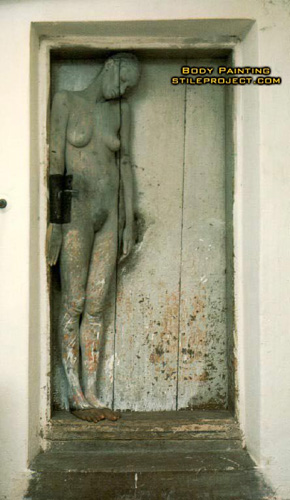
Unlike a painting, photograph, or religious statue, performance artists often create characters by altering their own bodies through the use of materials, such as makeup and costuming. It is primarily through these materials that performances become agents, if an ability to “act” upon audiences is the primary measure of agency, as suggested by Bennett (2005). I further posit that it is through this embeddedness, and interaction with materials, that performances “mirror” ourselves in a way -- that they are descriptive accounts of what it is like to be what Braidotti (2006) might refer to as a “cyborg” living in a constant flux of engaging materials. As reflections or portraits of ourselves, performances say something about the many lives led by each of us, not just within the social sphere as friends, parents, employees -- but also as people who “distribute our personhoods”, to use Gell’s terms, through materials. But it is not as simple as this. Things, too, distribute themselves through us, through our performances -- since they come equipped with a history apart from us, and a composite made up of even more materials. A single lipstick, which one human might use to convey passion, or eclecticism, or vibrance, or professionalism, may contain ingredients that were derived from fossils.
The topic is broad, so this paper remains a sketch of associations. To start, I take the position that characters displayed by performance artists are in many instances objectified; they become material objects in the sense that they are something which we must encounter or deal with as fictional characters, and which, much like other forms of art, are “worshipped” in various ways. Characters inspire awe, fear, and controversy of various kinds, yet live and die on screen and on stage in ways that transcend the physical and real life capacities of the performers themselves. Often characters are interpreted completely differently than would be the person, the “agent” actually doing the performance. In addition, it is interesting how performers are so often confused with their characters. Such is the case when people confuse actors on the street with the characters they play in Law and Order. In these instances, characters become so associated with the performers’ visages that the characters themselves and the mythologies surrounding them transform the perception of the artist herself.
The second season of “Twin Peaks” was recently released on DVD, with some extra features including present-day interviews with some of the actors. Kimmy Robertson, who plays the daffy secretary Lucy, said in an interview that outside of the show many people would later ask her about her character’s fictional pregnancy as if Robertson herself were the same person. In the next-to-last episode, Lucy performs a dance number which ends with her doing a full split. According to Robertson, several people later expressed concern about the acrobatic act, asking her: “Weren’t you worried about the baby?” Humorously, Robertson said that she responded to these queries in different ways, acting as if the fictional baby were real.
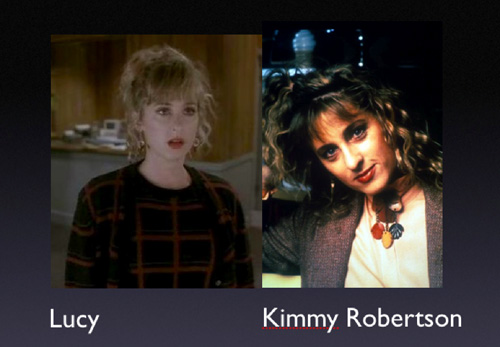
This is an example of how Lucy, a fictional character and an image, a material thing requiring encounter, becomes confused with the subject, just as a religious icon becomes associated with its human counterpart. One can see a sort of magical thinking similar to that in Gell’s depiction of the common belief that by doing harm to an image, it is possible to harm the person associated with that image. In this case, several people held the belief that if Kimmy Robertson did harm to her Twin Peaks image, she must have risked injuring herself as well.
In providing an anthropological theory of art, Alfred Gell explicitly lays out his concepts in relation to “art objects”, then proceeds to name a kind of primary and secondary agency, the first attributed to the “agent” in any given relationship and the latter attributed to what he calls the “patient”. This seems to be a useful way of analyzing how people interact with selected works of art and, furthermore, demonstrates the religiosity and worship inherent in the manner in which we regard many artifacts.
However, as we continue to look at performance art, it becomes more difficult to isolate the various shifting instances of cause and effect. In the case of performance art, Gell’s theory becomes unsatisfactory for explaining how materials and settings are able to transform a person into an image, to be objectified and worshipped as something at once the same as, and different from, the performer herself. If we are to speak of a primary agency, the artist would only be a source for it insofar as her choice to put on her clothes and her makeup just so, and act a certain way. But the nonhuman materials themselves come with a history; they impart messages to the audience because the materials themselves are associated with those messages, due to that history and also due to physical and material attributes that are derived not from human agency, but from the very ingredients themselves.
It might be more enlightening to consider the artist/body/material substances and alterations/character and everything else that is involved in a single work of performance art not as a case of distributed personhood, so much as an example of Ingold’s conception of materials in flux and transition; or in Haraway’s and Braidotti’s terms, a performance can be seen as an organism meant to exemplify the nomadic state and hybridity which we all experience, as we are constantly engaged with the material and at once a part of it.
As I go about my life, things continue to act upon me. As I sat writing this paper, the grilled cheese sandwich I had placed on the stove burned because, though I had put it there, I failed to monitor the temperature of the flame, and so together the flame and the pan and the bread created a charred sandwich, all of their own accord. They did not need personhood in order to do that, nor can the event be entirely reduced to a chain of cause and effect relationships; we can call their action agency if we like; or, like Tim Ingold with his wet stone and his dry stone, we can surmise that this is just another daily example of how material beings, whether organisms or not, live as, live within, and interact with materials and the material world. I would say that art thrives on this interaction and embeddedness.
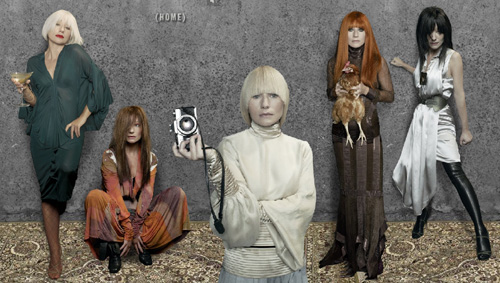
Tori Amos, a popular pianist and singer with a large cult following around the world, has just released a new CD entitled, “American Doll Posse”. Always a feminist, she is again commenting on what it is like to be a woman fighting for position and self in a patriarchal society. The posse of American dolls displayed on the cover are all various representations of herself with variations in hair color, clothes, and makeup -- all of which together seem to alter even the shape of her body. Suddenly Tori is many different people, each of whom we can interact with in different ways. Each song on the album is led by one of the characters on the cover, or is a collaboration between two or more characters. Tori fans, or at least those on the mailing list, are being introduced to each character one by one. Santa, the character on the left, “relates to Aphrodite and is the sensualist of the quintet. ‘Santa is somebody who's a girl's girl,’ Tori says. ‘She understands her fellow sisters and she believes that there is enough love and passion out there for everyone. But she won’t accept that there is something perverted about being very sensual and she won't drink shame with her sensuality.’” Pip, on the other hand, is a warrior likened to Athena, and confronts issues with energy and fervor. Tori, waxing more political over the years, has had this to say about the album (Wikipedia 2007):
The main message of my new album is: the political is personal. This as opposed to the feminist statement from years ago that the personal is political. I know it has been said that it goes both ways, but we have to turn it around. We have to think like that. I’m now taking on subjects that I could not have been able to take on in my twenties. With Little Earthquakes I took on more personal things. But if you are going to be an American woman in 2007 with a real view on what is going on, you need to be brave, and you need to know that some people won’t want to look at it.
Tori’s doll posse depicts not only that a woman can make of herself whatever she wants (implicitly, through materials), but that she already has many faces. Each character says something about aspects of Tori, but in addition, they speak of certain themes and ideas that can be related with the manner in which her body is displayed in various attire.
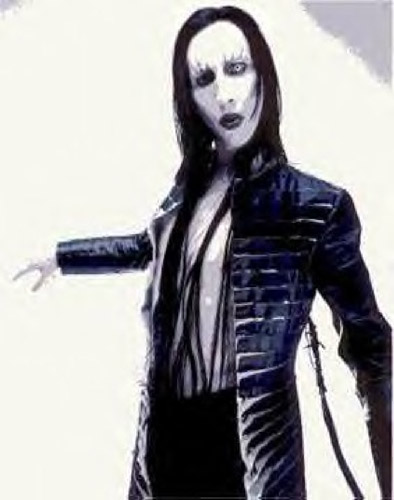
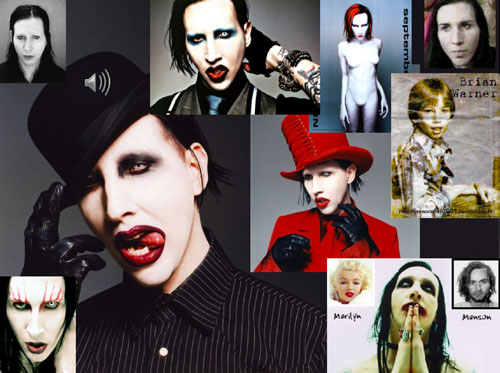
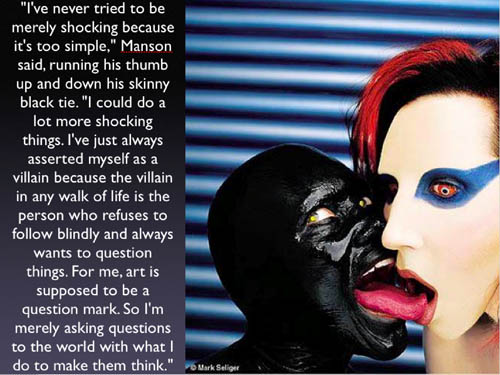
Marilyn Manson is a character lived and created by Brian Warner, a man who is often described as having grown up in a troubled religious home. He attended a Christian school during his formative years and, after entering public school, became exposed not only to sex drugs and rock and roll, but also philosophy like Nietzsche. The name Marilyn Manson is a combination of two American icons (some might say we worship them both in similarly iconic ways): actress and model Marilyn Monroe and serial killer Charles Manson. Some accounts suggest that Manson represents what is depraved about America and and the hypocrisy of religion in a country where we effectively worship “false idols” in the religious sense. Writing for Rolling Stone in response to accusations that he was responsible for the Columbine shootings and that he is a murderer, Manson said, “A lot of people forget or never realize that I started my band as a criticism of these very issues of despair and hypocrisy. The name Marilyn Manson has never celebrated the sad fact that America puts killers on the cover of Time magazine, giving them as much notoriety as our favorite movie stars. From Jesse James to Charles Manson, the media, since their inception, have turned criminals into folk heroes.” Paradoxically, Manson himself is a folk hero precisely because of his media stunts, a fact that both corroborates his act and makes it more ironic. Interestingly, very little is known about the man behind the act; a great deal of mythology is built up around Marilyn Manson and why Brian Warner became him, but the man himself has become virtually inseparable from the performance.
According to an MTV interviewer, Manson is a “true artist”, living his art, and never breaking out of character except for when he acts in films. Even during interviews, Manson “speaks slowly, pausing for effect” (Wiederhorn 2003). Manson seems to be quite aware of the dramatic effect this has on audiences, fans and opponents alike, and speaks of having become America’s “Antichrist”. As Gell points out, “We have neutralized our idols by reclassifying them as art; but we perform obeisences before them every bit as deep as those of the most committed idolater before his wooden god” (97). Marilyn Manson fans have been known to pay extravagant forms of homage to his persona; one account (and who knows if it is true, or mythology) tells of two teenage girls who would follow Manson and carve “Marilyn” and “Manson” into one another’s chests at concerts. Yet if this act is true, it is every bit an obeisance to Manson’s image as Johnny Lee Clary’s website, “The Truth About Marilyn Manson”, which blames Manson for the Columbine murders and refers to him as an evil Satanist, a “transvestite homosexual”, and so on. Indeed, Manson himself has said that he looks forward to being the subject of rants by the likes of Pat Robertson. One could see such rants as a sort of act of worship, at least as much as one might sacrifice to a frightening god.
Björk, too, is another artist who relies heavily on costumes and makeup as part of her performance. Unlike Manson, she does not play one fairly consistent character or draw on similar themes, but herself appears to metamorphose from one shifting role to another, at times occupying the hybrid form of a human and animal, or human and plant, or human and machine, or human and goddess, and sometimes a mix of these elements.
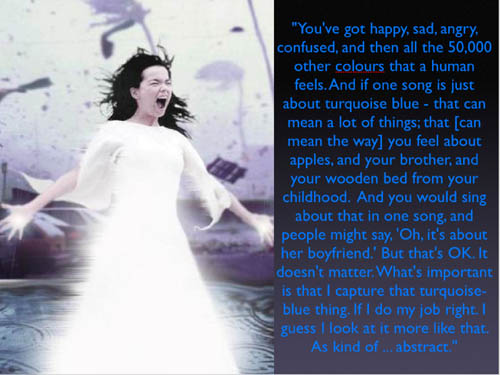
What these performances have in common -- The American Doll Posse, Marilyn Manson, and Björk -- is that their acts depend on an interaction with materials and the generation of a materiality. This is done by altering their own bodies, using their bodies as components in material demonstrations. For Manson, most of the act lies in the cosmetics and dress and the way he drawls, all as one character dressed up in different outfits. Our fascination with Manson has nothing to do with Brian Warner, who would be hard put to assume the title of Antichrist all by himself. What enabled him to do it was the gender bending, which was accomplished by applying bright and outlandish paints to his face and body, and dressing in garb that associated him with common ideas of nihilism and the macabre.
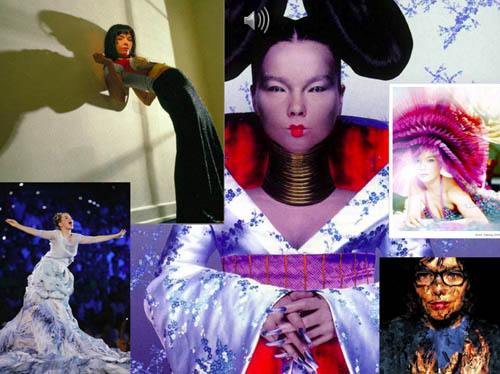
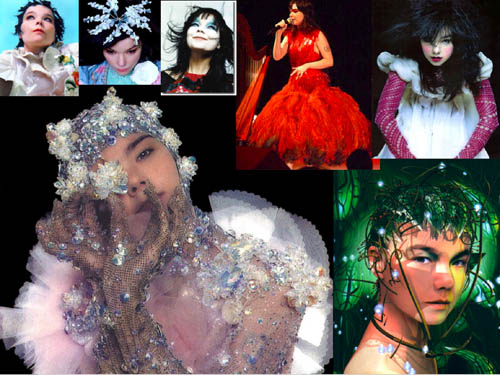
Björk incurs fascination by stretching the limits of what performers are supposed to wear, by incorporating eclectic dress and stances and cosmetics into her performance. As we enter into conversations with these entertainers, as we respond to them, what we are really responding to is the way in which they display their bodies -- and we are confronted, bodily, with the materiality not just of their bodies, but also of the material things adorning them, and beneath that, the ingredients bubbling up through the surfaces of the material things. As Ingold points out (2007:12):
Things are alive and active not because they are possessed of spirit – whether in or of matter – but because the substances which they comprise continue to be swept up in circulations of the surrounding media that alternately portend their dissolution or – characteristically with animate beings – ensure their regeneration. Spirit is the regenerative power of these circulatory flows which, in living organisms, are bound into tightly woven bundles or tissues of extraordinary complexity. All organisms are bundles of this kind. Stripped of the veneer of materiality they are revealed not as quiescent objects but as hives of activity, pulsing with the flows of materials that keep them alive. And in this respect human beings are no exception. They are, in the first place, organisms, not blobs of solid matter with an added whiff of mentality or agency to liven them up. As such, they are born and grow within the current of materials, and participate from within in their further transformation.
To add to the long line of material culture theorists critiquing other material culture theorists, I propose that one mistake commonly made when looking at materiality, or materials, is that theorists continue to focus on objects, on things, that are considered nonhuman, while at the same time trying to break down the subject/object and human/nature dualities. What if we were to take the radical approach of addressing people as we might address things -- or of exploring the ways in which people themselves are composed of, and engage with, materials? Some might argue that this would be returning to colonial anthropology -- but the colonialism lay in describing whole peoples as “other” and in pretending to be objective while imposing our own subjectivities. If we use the opportunity to look locally as well as broadly, internally as well as externally, we might arrive at a kind of posthumanistic stance that explores our lives -- as one creature in Star Trek, Next Generation described what it means to be human -- as “bags of mostly water”. To add to that, we might say that as bags of mostly water, we wear many different masks, and hats too.
Works Cited
Bennett, Jane. 2005. The Agency of Assemblages and the North American Blackout. In Public Culture 17 (3): 445-465.
Björk. 2006. The Emma Brockes Interview. In The Guardian, February 13.
Braidotti, Rosi. 2006. Posthuman, All Too Human: Towards a New Process Ontology. In Theory, Culture, and Society Vol 23 (7-8), 197-208.
Gell, Alfred. 1998. Art and Agency: an Anthropological Theory. Clarendon Press.
Ingold, Tim. 2007. Materials Against Materiality. In Archaeological Dialogues 14 (1): 1-16. Cambridge University Press.
Manson, Marilyn. 1999. Columbine: Whose Fault Is It? In Rolling Stone Magazine, May 28.
Wiederhorn, Jon. 2003. The Argument: Marilyn Manson is the Only True Artist Today. MTV.com.
Wikipedia. 2007. American Doll Posse. Wikipedia.org.