on identity and materiality
While the readings we have concentrated on this semester have taken “things” in some form as their focus, they have also generally done so less in order to reference things in their pure “thingness” and rather more for what they say about us. I aim, in this paper, to attempt to return from talking about “us” to a discussion of the materiality of things themselves, a materiality that our bodies must also share. After beginning with a short discussion of how various approaches to things melt into questions of identity, I move into a closer look at two instances of signatures as forms of identification and thus of abducted identity. The conclusion then explores the differences between these forms of identifying people, taking them as clues to developing a tentative definition of materiality.
using things to find ourselves
In Appadurai's conception of “methodological fetishism,” he speaks of understanding the “social biographies” of things, a project which, conceivably, could focus entirely on the thing as the end itself. Yet, returning to identity, he refers to this method as the only way to “interpret the human transactions and calculation that enlivens things” (Appadurai 1986: 5 quoted in Hoskins 2006: 75). Kopytoff (1986) builds on this idea of a social biography of a thing, but also does so in order to bring new attention instead to issues of humanity. He challenges the difference between non-humans and humans by instead proposing that all of us go through similar processes of singularization and commoditization throughout our own biographies. In the conclusion of his article, Kopytoff makes use of the insights and questions he gained from things to address issues of reproductive technologies and, therefore, of human identity.
Besides such biographical techniques which investigate human trajectories in relation to (or in comparison with) non-human trajectories, there is also a tradition of investigating things in terms of the effects that they have on the human mind and our desires. Baudrillard, speaking of collecting objects, sees the always retreating “last” or “next” element in the set as the collector herself:
... no object ever opposes the process of narcissistic projection to an unlimited number of other objects; on the contrary, the object imposes that very tendency, thereby contributing to the creation of a total environment, to that totalization of images of the self that is the basis of the miracle of collecting. [This makes it easier to understand the structure of the system of possession: any collection comprises a succession of items, but the last in the set is the person of the collector.] For what you really collect is always yourself. (Baudrillard 2005:97)
Stewart expands on this by zeroing in on the “lack” that a collection creates through the imagination of its next piece. She also explains how, for the identity of the collector, it is essential never to complete the collection: “the fetishist's impulse toward accumulation and privacy, hoarding and the secret, serves both to give integrity to the self and at the same time to overload the self with signification [which, ...] can, in fact, saturate the collector” (Stewart 1993: 162-163). Stewart lends this saturation concept substance by analogy with a man who, in viewing a collection of objects in a mirror, recognizes himself “as no bigger than a handful of dust, a museum piece among museum pieces, detached and remote” (ibid.: 163). I find these psychological approaches intriguing because, although they speak to the drive (or almost, compulsion) to surround ourselves with things, they do not see humans as locating themselves within the things at all. Instead, they see our identity as lying simultaneously in the incomplete collection as a whole and in its subsequent missing piece. Such insights highlight the degree to which we as humans need and use non-human things psychologically and, in turn, how such things gain indirect purchase over us.
Of course, there are many ways to get at identity and to discuss identity through things. Even in the “radical symmetry” of Latour (1994), though there is an emphasis on seeing every link as an “actant” regardless of its human or non-human qualities, the point he seeks to make is one tied up with agency and, ultimately, with how we as humans can act in the world:
[E]very activity suspends the easy commonsense idea that humans speak and act. Every activity implies a generalized principle of symmetry or, at the least, offers an ambiguous mythology that disputes the unique position of humans. [...] So who eventually is responsible for the action? Both. The responsibility has to be shared, symmetry restored, and the role of humanity shifted sideways from being the sole transcendent cause to that of mediating mediators. (Latour 1994: 794)
In seeking to speak about the equality of people and things due to their hopelessly intertwined agency, Latour, in stark contrast to the psychological approaches above, does shift the position of the human “sideways.” At the same time, however, it cannot be denied that, even after this radical move, he too continues to inhabit questions of our identity, of what it means to be human.
In pointing this out, I do not mean to say that our selfish focus on “the human” is necessarily unmerited: if we are honest with ourselves, I believe that, in the end, we as humans (as well as as social scientists) desperately want to understand who we ourselves are. I am also uncertain that such a focus is at all avoidable: due to our inherent Subjectivity, we may indeed be crippled with an inability to go beyond the limits of Appadurai's methodological fetishism, beyond the limits of the “objects,” to approach the Heideggerian thing in itself. What I do want to point out here, however, is the centrality of the concept of identity, both individual and social, that lurks in the shadows of all the pieces we have explored. In a way, then, much of this semester has been spent circling around things as a way to talk less about their materiality or agency and more to talk about how our identity is wrapped up in things. In this paper I aim to circle in the opposite direction starting with a different perspective on identity and working my way “backwards” to see if such an approach might lead us more deeply into the materiality of things themselves.
on identity and identification
As there are many ways to talk about identity (as can, perhaps, be seen in the shifting usages above), before I go into a discussion of signatures as a form of identity, I need to clarify what exactly I mean by the term. Identity in its incarnation related to individuals can be seen as being composed of two somewhat distinct parts: an internal, subjectively defined, one that can only be known by the Subject and one that is internal instead to an Other (or a set of Others), constituted about the Subject through the Other's interpretation of the signs presented by the Subject. I see these two interacting components of identity as somewhat analogous to Hegel's distinction between consciousness and self-consciousness in that self-consciousness is dependent on interaction with another. In this paper, I will concentrate on this second, external to the Subject, aspect of identity.
Identity for Others is, by its nature, intimately entangled in a continual process of (re)presentation and (re)interpretation and thus it is not by accident that identity often seems to melt away into identification. Following Goffman (1959), I see the connection between the internal view of identity (Identity for Self) and that of Identity for Others as a matter of self-presentation. We each, in our interactions with others, seek to make use of or play off of pre-existing (thus social) roles and symbols that, through our mannerisms, dressing styles, and ways of speech, are meant to present an identity to the Other. At the same time, there is no way to assure that the Other's interpretation of such symbols will leave them with a representation of us that is at all similar to our own internal one. It is because of the fact that the Other receives simultaneously from us (and our surroundings) a large number of such signs (many of which we will not have meant to send) and interprets those signs independently of our own interpretation of them, that there is a constant struggle to redefine and reclarify signals. Furthermore, due to the vast number of possible signs and our limited contact with the Other, there is also a constant tendency to reduce a person to an identity that is based on only a select few signs.[1]
While the process of identification by Others necessarily involves over-, under-, and mis-interpretations,[2] this also leaves room for the Subject to play with identity, to be someone in one situation while being someone else in another. In short, is the act of reduction and misidentification that gives us the freedom to play with Goffman's roles. From this, then, it follows that I am something different to people depending on the information (taken in a wide sense) that they have about me, the relative weight they give to different aspects of the information, and, finally, on their interpretations of that information. Referring to Kaeten's presentation on flagging, for instance, someone who understands what having a green handkerchief in one's back pocket means will identify you differently than someone without that knowledge. To complicate things even further, the Other may herself have a different view of what this sign means (based on her own previous experiences) that will probably will not match the personality which the Subject sought to project.
signatures, exuvia, and our distributed personhood
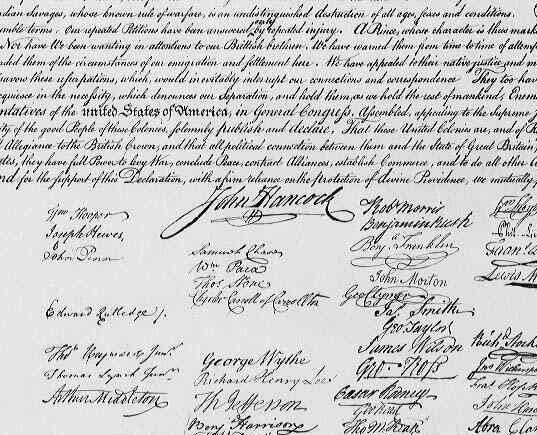
To begin my circling back towards the thing in itself, then, I will look at some of the signs we use in the process of identification that occur in our limited interactions with government and economic institutions. In this context, one of the primary methods of abducting the whole of who “you” are (or at least as much of you as they care to abduct) is through your signature. Signatures are signs that we use explicitly to put our authorization on something or to certify our presence somewhere. They are seen also as capturing some sort of essence of the person or thing they signify. It is thus that the signature can be a form of identification as well as a branding technique that implies such and such a product or series is the representative product of a particular company. The names Van Ness Signature Series motorcycles and Greg Norman Signature Series golf vests are both meant to invoke the authority of the company or the person by claiming that they have signed the product, authorizing it and authenticating it as the best. Signatures are also caught up with identity in another way. The signature of something can refer to the traces that that thing leaves behind or transmits that signify its presence. It is in this way that the military can speak of something like infrared signature analysis techniques. The signature is seen in a real sense then not simply as a sign apart from the person or thing it signifies, but as an integral part of that thing's identity.
One of the most explicit articulations of a theory of the connections between the person and their identifying traces or signs comes in the form of Gell's (1998) work on distribution of identity or personhood. Gell describes the importance of exuvia,[3] pieces of the Subject that have been detached from them and cast out into the outside world, to capture the nature of the person as unbounded and distributed. In a similar fashion, Gel also changes our notion of mind by extending it and decentering it from our brains.[4] Instead, using the example of the Kula, he focuses on how the,
... 'mind' can exist objectively as well as subjectively; that is as a pattern of transacable objects—indexes of personhood [...]—as well as a fleeting succession of 'thoughts,' 'intentions,' 'mental states' etc. The Kula system as a whole is a form of cognition, which takes place outside the body, which is diffused in space and time, and which is carried on through the medium of physical indexes and transactions involving them. (Gell 1998: 232)
Gell's concept of art as the material remains of performance, the traces of the painter's skill or the sculptor's touch, also provides an interesting inlet into the signature as one part of our identity. The signature, seen in this way, is a performance captured onto paper (onto a credit card reading machine, or other recording technology). It is an extension of ourselves and, in our relations with the world, it has a metonymic way of representing us—the signature, a part of our extended selves, is fetishized in our contractual relations as the entirety of us. We perform the signature and our performance itself is what testifies to our presence and, indeed, the signature is merely the trace that was left behind.
After performing our stylistic curves of the pen, the image is detached from us and yet continues to remain as us in representational form. It is this continued representation and our inherent understanding of its dangers that accounts for our worries over people faking our signature or using our picture (another of our exuvia) without our permission. A central issue with exuvia of this kind (just as it was in the example of Volt sorcery in Gell's work) is that once they are detached from the body, though they continue to represent the person, they gradually shift further and further out of the person's immediate control. A signature of yours could be copied and placed onto a document you had no reason to sign, but your own performance of the signature could not be detached from you in the same way. A picture of you with someone whom you only just met could be used by that person to claim a long lasting friendship with you to others.[5]
In framing art (and signatures I maintain) as traces of performance, however, Gell deftly sidesteps the question of their materiality. Although the material version is what we deal with and is what the audience or patron is moved by, the process by which this movement takes place, to Gell is intimately tied up in its creation as performance. In his elaboration of the notion of captivation, Gell explains that one's ability to appreciate the standard of labor that went into a master piece, linked, he posits, to one's own amateur dappling in the same field, is what allows one to be captivated. Thus while the masterpiece is what we look at, it is the performance that signifies and it is this that acts upon us.
While analyzing signatures in terms of Gell's theory of distributed personhood and extended mind is useful, it runs into some problems once we look at relative concentrations of mind in the system. While the signature is simply one of many exuvia that we might produce during our lifetimes, it is an extension of ourselves that carries particular import in certain legal situations. This exuvia (or these exuviae, as individual signatures can also be seen as different instances of an ideal performance) in relation to a bank teller, for instance, is more central to our identity than our paintings, writings, or other productions and this is where Gell's theory of the distributed person begins to lose some of its traction. Because it is so centered on the individual, it fails to provide an understanding of how important the reading, communication, and reinterpretation of these exuviae by Others are to the definition and delimitation of who we are. We joke that my father, for instance, would have difficulty passing a check because, since they got married some 30 odd years ago, my mother has been the one to sign his name for all of the banking books and many legal documents. In a sense, without his signature (which is now considered correct in the way that my mother writes it) and despite his being present, he can no longer attest to that presence. In the eyes of the bank or the state he is no longer “himself.” Signatures are thus not more central to defining who we are because of anything in ourselves, they are important because of a larger society and a larger system in which we are embedded.
chops, assemblages, and the berlin keymaker
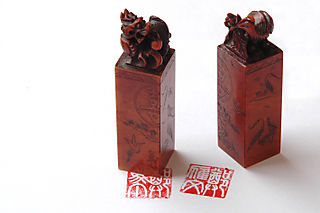
To point out the importance of this larger system, I now turn to a second type of identification, one that serves the same purpose in Chinese society (and others?) as the signature does in the United States: the chop. A friend of mine from Hong Kong explained his frustration with the banking system there. On his way back from shopping one afternoon, he remembered that there were some affairs he had to take care of at the bank. At the banking window he dually showed the clerk his identification card and quickly set about signing the papers. When he attempted to pass them on to the clerk, however, she informed him that they were not valid because he had not stamped them with his official chop. She had no problem ascertaining his identity by herself as an individual, the problem was that, for the institution, the chop is the only recognized way establishing one's identity. Since my friend had not brought his chop with him, he had to take the papers and return the following day.
In this example there is a clear question of agency. Within these situations is it the human that has the agency or is it the chop? When taken in terms of actually getting the papers accepted, the chop that has the decisive acting potential and my friend merely serves to bring it where it needs to go. Yet, to get to this point in examining how the chop functions (or misfunctions), we must step out of a single extended mind and into a larger Latourian network of actants. As with Latour's example of the Berlin key (2000), we must remember that there are people using the chop (or the signature, for that matter) and that they do so enmeshed in a world with social structures that pre-date themselves. To understand why the signature or chop is more a part of our identity in such situations than other exuvia we must take this network (with its multiple subjects) seriously.
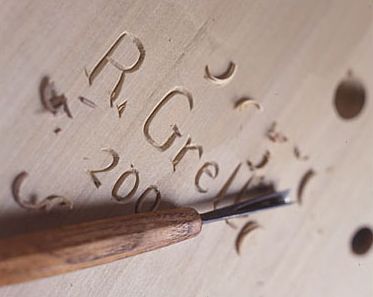
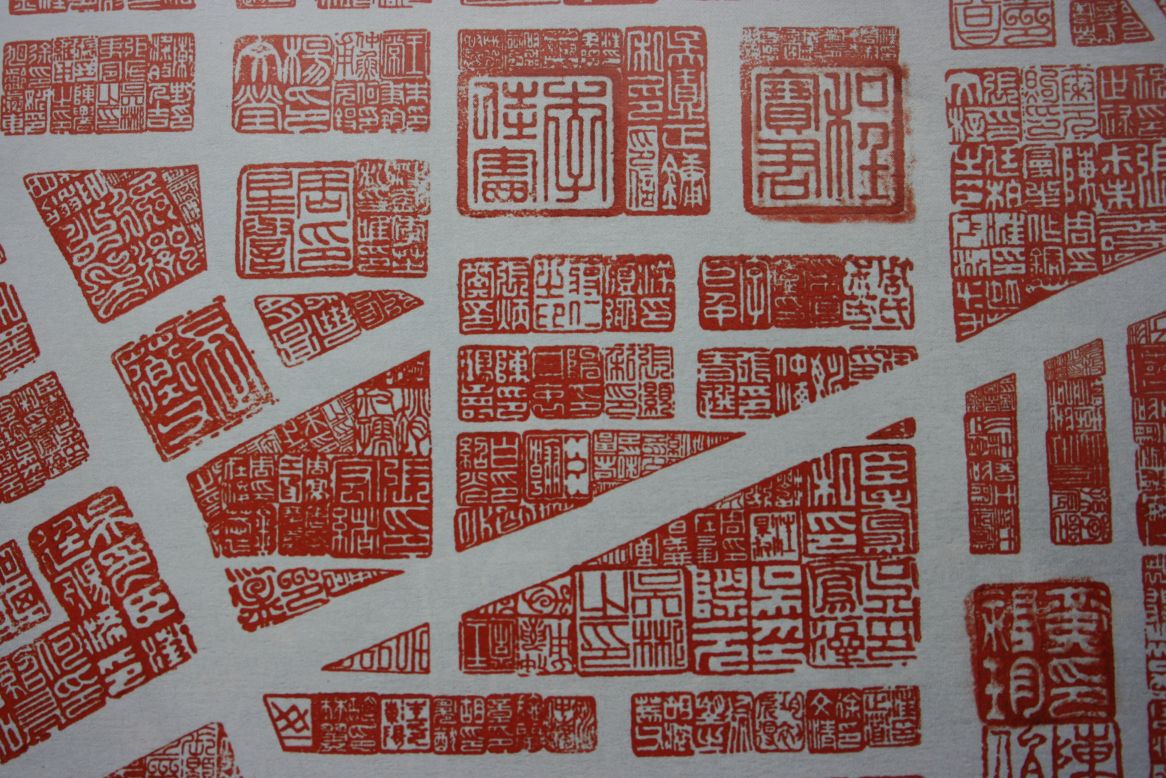
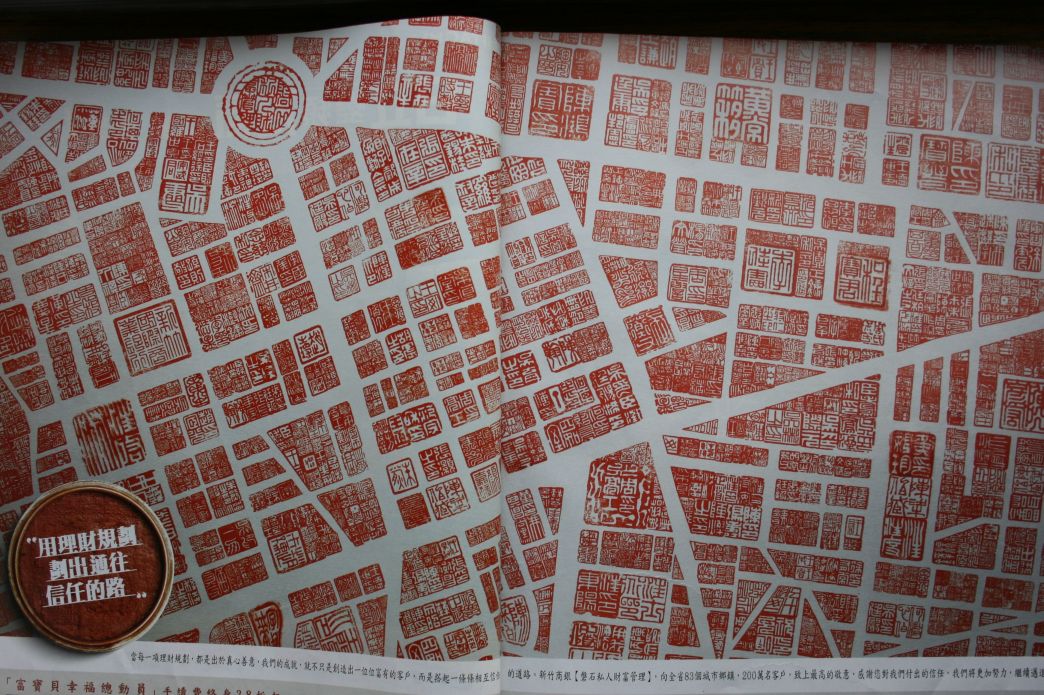
While so far the chop and the signature similarly are embedded in networks, there is more to the story of the chop. The chop, although working as a signature, is also inherently different. A chop is a kind of stamp. To make one, the bottom of a piece of jade (or other material) is carved with the name of the person (this could be an individual, family, or business) such that when dipped in an inky paste and stamped onto paper it will leave that “person's” mark. The chop, then is the performance of the signature embodied in a material form much like one's fingers serve as material embodiments of one's fingerprints. In the process of making a stamp, the performance of signing is split into two parts, one in the carving of the material and the other in the action of stamping the page with it.
Yet, the chop's difference does not necessarily lie in its being more material than the signature, but rather in that the performance it embodies is NOT that of the person it identifies. Lurking not so deep in the shadows, then, we see the equivalent of Latour's dreaded Berlin keymaker (2000). Here we could speak of alienation, of someone being represented by the work of another, or, conversely of one's own work, one's extended self, being taken over and owned by another. The identification of the Subject depends on the material chop, that chop, in turn, depends on the carving of the Berlin chop-carver, the use of the chop depends on the willingness of the bank to recognize it as proof of identity, and, before we know it we have solidly entered the world of Actor Network Theory (ANT).
The congealing of a portion of the performance of signing into the materiality of the chop gives it a mobility (or portability) the signature does not easily have.[6] By encasing such identification in a material form, like the creation of exuvia, it follows that it is further detached from the subject and thus is further from her control. The problem with this view, however, is that while the chop clearly identifies the Subject, it would be odd to categorize it as an exuvia of anyone but the carver. From this perspective, then, the chop was never really in the Subject's control despite its being a representation of her. Its very design was meant to allow it to represent the identity of a family or company independent of the individual who performs the stamping. Thus a chop can be used by a husband or a wife when doing the banking just as easily as it could be used by a thief to do the same.
Although viewing the chop in terms of actor network theory illuminates these issues of control, mobility, and how much both human and non-human agency are mutually dependent on one another, the network it describes seems to be a very local, immediate one. Even remaining at the local level the chain of actants describe by Latour seems to work best with single chain connections. It works well moving from the carver's scripting of the chop to the person using the chop to the imprint that the chop leave son the paper. Yet, when we actually look at the contingency of the performance itself we start to need a conceptual apparatus that allows us to take into account multiple strands of agency and interaction. Although the chop is pre-carved and, thus, each use of it will appear roughly the same, there will still be differences depending on the type of ink and its moistness, the absorbing potential of the paper, the hardness of the surface the paper is placed on, and even the stamping technique of the Subject. Of course, in the process of the carving too, there are many factors that work together, not simply as structural constraints, but as actors in shaping the final outcome. These aspects of chance introduced in the performance are a direct result of the interaction of the materials. Furthermore, this variability will seem to increase when the entire performance, which was divided in two in the case of the chop, is performed at once with the signature. To prove to yourself that this is so, you might try writing your signature on various different surfaces with various different pens and compare them. Doing the same signature on a credit card screen or with arms exhausted from working out can result in something that even you would not recognize as your own mark.[7]
Bennett's (2005) concept of the assemblage of humans and non-humans of many kinds extends the ideas in ANT to talk about the potential actancy of a situation as a whole rather than of any of its individual parts. This concept becomes even more relevant as we move away from the immediate local set of actors in Latour's example. Again, in order to understand the full import of various ways of signing we must look not only at the intended performance (the ideal signature or chop) and the sign itself (the finished material mark), but also its interpretation. The interpretation in this case involves not only the clerks who accept the identification and the machines that read, record, or copy the trace, but also the banking and government regulations which prescribe how and what kind of mark will be accepted. Adding to this, all of the other aspects of nation, borders, police, and legal regimes all of which condition the way that a particular mark might be received and interpreted and we see how important the concept of assemblages are to understanding human identity.
conclusion: materials, identity, and materiality
Despite the general flow of the paper, I have not meant to necessarily privilege Bennett's approach over those of Latour and Gel as I see each providing different vantage points on which to understand more about how people and things interact to create the kind of human identity that bases itself in Others. Unfortunately, it seems that rather than circling into the materiality, I have instead circled seemingly inexorably outward from the individual into global interfaces—the enmeshedness of us in assemblages of things, people, habits (protocols and laws), and history (structure and accumulated particularities). Just as identity cannot be confined to a Subjective feeling but must also take into account the representations others read onto us, understanding identity cannot simply deal with the person as a distributed individual (no matter how much room as made for overlap between such persons). It is not a question of whether humans are or are not able to act independently of things because such a situation is a pure impossibility. We are and always have been enmeshed, from the first, in a system and therefore agency can only come through assemblages in the system.
This recognition then brings us back again to the importance of materiality. Identity for Others is a matter of abducting from the signs given (voluntarily or involuntarily) by the Subject into a representation of that Subject. In the case of these two kinds of signatures, however, we can see that the process of creating the sign itself is wrapped up in the interaction of various materials by which an ideal (or general) sign is detached from the self as a particular material thing. It is this very particularity, something inherent in all material things (bodies, signatures, water, electricity, chairs, animals, dirt etc.), that begins to afford its astonishing ability to do what we didn't want it to do.[8] Although materiality's internal particularity is key, it is the interaction of materials within various assemblages (whose limits and exact composition are equally unknowable) that provides materiality with its full particularity, its inherent potential for chance.
Materiality is thus not simply that which we must deal with, but is, more simply, that which interacts. This is not, of course, to say that all materials interact in the same way. What it is to say, is that the definition of materiality is bound up in relationships between things rather than just in any one individual thing's inherent qualities. A thing cannot be known as itself, separated from other things because its nature, its materiality is wrapped up in and discovered through its interaction with other materials. Of course, following Gell's distributed person logic, every “thing” could be broken down into small component “things” which are in relation to one another. One might study materiality by trying to break these “things” down ever further (as physicists often do), but I suspect that though the process may yield a significant advance in our understanding of the world, it will get us no closer to the bottom (I suspect it is elephants all the way down).
This question of origins, however, distracts us. Instead, by focusing on this idea of relationships and interaction we can come to a further defining of materiality. Materiality, being that which interacts and which is defined through that interaction, is also the home of chance—try as we might to learn about an object's properties through our experience with similar objects in the past, there will always be an aspect to the object that resists our classification, scripting, and defining of it, the fact that it is particular. Its embedding in its own internal assemblage as well as external assemblage, provides it its particularity and thus its contingency and chance. Returning to the signature, the performance (as an ideal type or a plan in the mind or nerves) may be thought of as somewhat universal in a way and thus immaterial, yet the trace that is left by the performance in each instance is particular and will change based on the stress of the situation, the type of surface, the qualities of the pen, the angle of the surface, the size of the space to write in, and so on ad infinitum. Thus where the immaterial can be universal, the materiality of the signature is a testimony to chance and contingency.
Using the examples I presented here of the handwritten signature and the chop, one might object to these definitions of materiality being wound up in chance because, while the chop is more material (Latour's congealing), the signature exhibits more variation. Yet, the chop is not, in actuality, any more material than the signature as both involve interactions between human bodies and various other material things. The essential difference between the two is that the use of a chop represents an interruption of the performance in time, separating the time that the chop itself was made from when it actually is used to mark a document. As a result, we focus on the second half of the performance and thereby miss part of the variation. On the other hand, even taking into account the full process in both cases, the signature may indeed present more variability due to the fact that, to make the mark, the chop need only interact once with the paper.
To a large extent the definition of materiality, bound up as it is with particular situations, materials, and interactions, is like the concept of identity that we started with. Just as there are two kinds of human identity, that internal to the Subject and that abducted by us (the Others) based on our interaction with the Subject and his signs, so to it is beneficial to see two kinds of materiality. There is the a particular materiality that is determined in definite terms by the materials within the assemblage. Unfortunately, there is no way for us to understand, calculate, and master all of the signs (or qualities) of this assemblage and thus we must instead rely on our abductions from those signs we do grasp. Our inability to grasp the entirety of the assemblage's materiality is based in three main obstacles. The first is that the assemblage is constantly changing as conditions in the environment around the interaction change or as the individual things (remember these could be both large and infinitesimally small) change each other. The second obstacle is that our knowledge of things comes only through interaction with them, a process which itself introduces changes to the assemblage we sought to understand. Finally, the biggest obstacle to full knowledge is that no matter how many signs or qualities we can ascertain, our interpretation of them will always rely on our own past experiences and thus will always be different from the sign as it was originally presented.
To finish off, I see materiality as a quality of things only as they interact with other things.[9] As with Identity for Self, materiality cannot ever be fully grasped by Others. It is only by abducting from the signs or qualities of things, correcting them as they are proven faulty, and thus accumulating a notion of Identity for Others that we can hope to approach the reality of the Subject/Thing. Such material things, as opposed to the immateriality of thoughts or abstract ideas, are particular, have duration and mobility (they can be detached from their original location or context and put into another though perhaps not without a change in their internal or interactive qualities), and are the springs from which chance challenges human attempts to order the world.
references
Appadurai, Arjun. 1986. “Introduction: commodities and the politics of value.” In Arjun Appadurai ed., The Social Life of Things: Commodities in Cultural Perspective. Pp. 3-63. Cambridge: Cambridge University Press.
Baudrillard, Jean. 2005 [1968]. The System of Objects. Verso, New York.
Bennett, Jane. 2005. “The agency of assemblages and the North American blackout.” Public Culture 17(3):445-65.
Gell, Alfred. 1998. Art and Agency: An Anthropological Theory. New York: Clarendon Press.
Goffman, Erving. 1959. The Presentation of Self in Everyday Life. London: Penguin.
Hoskins, Janet. 2006. “Agency, biography and objects.” In Chris Tilley, Webb Keane, Susanne Küchler, Mike Rowlands, and Patricia Spyer ed., Handbook of Material Culture. Pp. 74-84. London: Sage Publications.
Ingold, Tim. 2000. The Perception of the Environment: Essays in Livelihood, Dwelling and Skill. London: Routledge.
Kopytoff, Igor. 1986. “The cultural biography of things: commoditization as process.” In Arjun Appadurai ed., The Social Life of Things: Commodities in Cultural Perspective. Pp. 64-94. Cambridge: Cambridge University Press.
Latour, Bruno. 1994. “Pragmatogonies: a mythical account of how humans and nonhumans swap properties.” American Behavioral Scientist 37(6):791-808.
Latour, Bruno. 2000. “The Berlin key or how to do words with things.” In Paul Graves-Brown ed., Matter, Materiality and Modern Culture. Pp. 10-21. New York: Routledge.
Peirce, Charles S. 1992a [1868]. “Some Consequences of the Four Incapacities.” In Nathan Houser and Christian Kloesel eds., The Essential Peirce: Selected Philosophical Writings, Vol. 1. Pp. 28-55. Bloomington, Indiana: Indiana University Press.
Peirce, Charles S. 1992b [1878]. “Deduction, Induction, and Hypothesis.” In Nathan Houser and Christian Kloesel eds., The Essential Peirce: Selected Philosophical Writings, Vol. 1. Pp. 186-199. Bloomington, Indiana: Indiana University Press.
Peirce, Charles S. 1992c [1894]. “What is a Sign.” In Nathan Houser and Christian Kloesel eds., The Essential Peirce: Selected Philosophical Writings, Vol. 2. Pp. 4-10. Bloomington, Indiana: Indiana University Press. Online at http://www.iupui.edu/~peirce/ep/ep2/ep2book/ch02/ep2ch2.htm.
Stewart, Susan. 1993. “Objects of desire.” In On Longing: Narratives of the miniature, the gigantic, the souvenir, the collection. Pp. 132-170. Durham, North Carolina: Duke University Press.
[1] One obvious instance of this extrapolation of a whole person's identity from only a limited number of signs is stereotyping. In fact, however, because we can never (as outsiders) know the whole of a person's subjective identity, all of our interpretations involve these kinds of reductions. Though they might be relatively closer the more one knows about a person, all processes of identification can be implicated in the same mistake made in stereotyping. This poses interesting questions for the role of essentialization and anthropology, as well as explaining one reason why people see identity (as in both individual and group identities) as a very real, political, struggle.
[2] I see the process of identification, therefore, as a process of abduction in Peirce's (see 1992a, 1992b, here “abduction” is referred to as “hypothesis”) sense of the word. Abduction is set apart from both deduction and induction. Where both processes of deduction and induction involve reasoning from what one knows to something that automatically follows from that, abduction involves a certain leap of faith, based on educated hypotheses to something one did not know before. In this way, Peirce explains that while abduction will often leads us to make mistakes, it is only through abduction that we can hope to expand our knowledge of the world. I would maintain that abduction (and then the subsequent dialectical conversation) is the only way to increase our knowledge about other people's identities and, perhaps also, about the materiality of things. My hope is that my discussion of a continuous stream of representations, sign, and interpretation will also be reminiscent of Peirce's system of tri-signs (see 1992c).
[3] Gell (1998:111-115) takes exuvia in a broad metaphorical sense (as when he deals with an artist's oeuvre) as well as in its literal sense (as in fingernails, hair, dry skin flakes etc).
[4] In reflecting on Gell's concept of the oeuvre as the person (1998: Chapter 9), the person's extended mind, I felt that he may be conflating two very different kinds of identity. On the one hand, from an etic perspective in both time and space, it makes sense to see a person's identity as the sum of all that they have been. On other other hand saying that this is all that the person “is” seems to be a dangerous denial of the possibility for a person's identity to change over time. If we “are” the accumulation of all that we have been, then there can be no radical break from the past. To a certain extent this makes sense, there is indeed a continuity between the person I was at 13 and the person I am now, both from an outsider's perspective (someone who might have seen me growing and changing minutely over time), as well as from an inside perspective where I, myself, can conceive of no break between myself now and me then. Yet, although I would maintain that who I am now grew out of who I was then, the two of us are NOT the same. I am me, now, and that is it.
It is especially interesting that Gell takes this extremely etic perspective (something perhaps having to do with the knowledge of his impending death and his desire for a legacy that would live on) when throughout the rest of the book he errs on the side of an extremely emic one, evaluating efficacy on believed rather than “real” effects (Gel 1998:32). I believe that Gell's mistake here is that he defines this extended persona as the “person” rather than using a different term. It is not that his idea is wrong, it is merely that he is describing something different than identity or who this person is.
To get a handle on this difference I will resort to an analogy with mathematics and calculus. Were we to draw a line on a graph that could be represented by an equation such that for all values of x there is only one corresponding value of y, what you would have is an analogy to a person's life passing through time. At any point in time who the person thinks they are is reflected by the position of the line at that value of x. Their position is contiguous with the point before that time as well as with that directly after that time, but they are different. It is only by tracing the line as a line rather than as an infinite stretch of contiguous points that you gain a sense of the person living at all. This is the type of identity that I take to be relatively common sense, the kind that allowed Prince to claim he was no longer Prince and Cat Stevens to disown his musical creations. Gell, on the other hand discusses something different. By combining each point on the line with all of those earlier he, in a sense, is taking the integral of our identity. This integral also represents the line, but it does so in a very different way, from a very different perspective, and thus provides a very different sense of identity.
Taking this essential difference in mind, this critique could also apply to archeology. The origins of Gell's problem lies in his abstraction of life from time by looking only at what has been left behind, the oeuvre, the exuvia. While he might grant that this type of a perspective is always incomplete (since no one could take into account all of the exuvia), I would claim that it is not only incomplete, but that even if it were complete, it would not necessarily get one that much closer to understanding the person's identity as such. Archeology, too, in its search for meaning and a sense of group identity (who “were” the people who lived here), also are in danger of coming up with only an accumulated view of the group. To attempt to get closer to the identity of the group as the group might have perceived it over time, one must push our methods attempting to parse out this identity into smaller and smaller increments of time. It is only thus that we can appreciate the changing nature of identity in a relatively more emic light.
[5] There are numerous examples of influence peddling cases where someone claims to have a close relationship with someone in power. “Proof” of this relationship can be provided by pictures taken on numerous occasions with that influential person. Of course, such a collection of photos could easily be obtained without the two people ever having spoken to one another simply through aggressively planning chance meetings.
[6] While Latour (2000) lead us to think of the Berlin key as the congealing of a norm of social performance (proving to the doorman that you are allowed to enter) or script (the door must stay locked in the night and unlocked in the day) into material form, this is not always the directionality of the flow. It seems to me that in the case of signatures the situation was reversed, a performative action congealed out of a formerly material method. In Europe, a system of seals and rings (belonging to families rather than individuals in most cases) was used long before individual signatures were accepted. Similarly in China the chop was around earlier and remains far more accepted than the signature.
[7] Even fingerprints, though they were “grown” rather than carved (see Ingold 2000 for why this distinction may not be as commonsensical as we might think), can produce very different marks depending on how they are performed. It is for this very reason that police have clear regulations on the type of paper, ink, and printing movements that must be done to create a legitimate identifying mark.
[8] I have not talked in the language of affordances in this description because I find that I would rather emphasize interaction and contingency rather than inner potential. At the same time, the concept is not all that different from that I outline here. The idea of things having multiple (or infinite?) affordances resists the notion that we can script them successfully and points to the importance of the moments where objects fail or breakdown as points where their materiality reveals itself to us. While these could be chances for us to learn and re-assess our previous abductions, we generally dismiss them as rather being due to either “an accident” or some kind of “mis-scripting.” It is this hit and miss type of abduction that allows knowledge to advance at all, its side effect however, is to downplay the extent to which even our new and improved scripts will never completely enslave the thing. One slight deviation that I find between my sketch of materiality and that offered by the idea of affordances (at least by my understanding of this idea) is that affordances seem to anchor themselves in the thing itself, while I would instead seek to place the potential between things (both between the thing and Others as well as between the things within the “thing”).
[9] Although I have not been able to fit his work into this piece, Ingold's (2000: Chapter 18) conceptual use of basket weaving to show how materials (including the human body) interact to create the resulting product. In this way he uses something analogous to the assemblage as well as introducing an element of chance (the inability to determine the exact outcome except through the process itself) into the production. Conceptually he thus challenges the separation that we tend to make between the “growing” of living things and the “making” of other things. Both involve complex interactions and depend on the assemblages in which they currently take part.