context
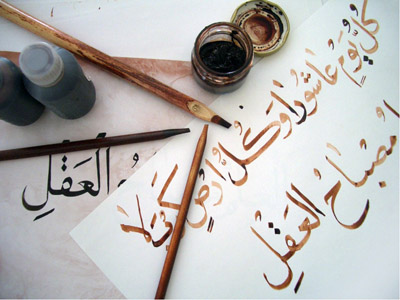
A crucial area of thought in all the social sciences is the relationship between people and things. The material objects, in many disciplines receive little attention and are often seen as functional items vital to the social process but seldom as informing and even determining. In the modern societies with the appearance of modern institutions, new communication technology and media, the commodity exchange, to a large extent, determines the social relation, cultural and even national identity, I would like to argue that in certain societies, words characterized by highly developed artistic and rhythmic composition, which I would call poetry, remain a crucial but little analyzed part of understanding of how social relations and identity are established. These societies specifically have characteristics such as being less commoditized and/or influenced by current wave of globalization process. This in turn can partly be attributed to their deep historical and cultural background, resistance against colonial powers and their subsequent rejection of the values brought forth by colonization. In these societies, the rhythmic words, or poems, define and give color to the material world. Whilst the latter maintain its material nature, poems emerge as strong influential, active and living factor in determining the human relation with his surroundings.
In the final paper, as the previous one, my main focus remains on poetry, particularly Persian Poetry. The main theme of the paper is to discuss poetry as an independent object and its role in the process of identification.
Persian literature spans two and a half millennia, though much of the pre-Islamic material has been lost. Its sources often come from far-flung regions beyond the borders of present-day Iran, as the Persian language flourished and survived across wide swaths of Central Asia, Afghanistan and Indian sub continent. For instance, Rumi and Islam's most admired poets who were born in modern day Afghanistan in early 13 century wrote in Persian but lived in Konya, now in Turkey and then the capital of the Seljuks.[1]
So strong has been the Persian aptitude for versifying everyday expressions that one can encounter poetry in almost every classical work, whether from Persian literature, science, or metaphysics. In short, the ability to write in verse form was a pre-requisite for any scholar. For example, almost half of Avicenna’s [2]medical writings are in poetic verse.
In this paper I will talk about what rhythmic words or poems can do and mean in terms of determining the social relations of individuals and communities and producing images. Poems can establish influence that very few other phenomena can. Poems can combine individuals to each other to create the meaning and image for feelings, bring vivacity to movement while endowing individuals with aura of light. Besides, poems can veil things, feelings, reshape them, reveal them, explain them, represent them and link them to emotional expressions.
.
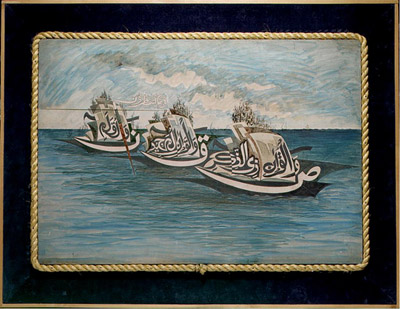
As Malinowski asserted, the lines between persons and things are culturally variable. In certain contexts persons take the attribute of things, and things as Janet Hoskins says, seem to act almost as persons. As far as words are concerned, the question remains that how these meanings, represented in the material forms, could produce bonds that connect the individuals to what is called social relations and national identity?
Before I comment further on the possible significance of rhythmic words/poetry as an object that has its own agency, I want to make some observations about the terms of the analysis I have initiated here, in order to bring to light certain assumptions that are characteristic generally of the analysis of material culture.
Nothing in my introductory remarks suggests any reason to doubt the coherence of these artifacts as material phenomena. This is to say that I do not call into question the material substance of things I have been examining.
In this essay I am concerned essentially with the role of poetry or rhythmic words as an object with its own materiality and what it holds a particular significance for the history of human relations.
The sciences continue to be puzzled by distinctions between ponderable and imponderable bodies or, more precisely, by the coexistence of these properties in a single entity. What the intuitive properties of an object have in common with the invisible foundation of material substance?
Real bodies appear to be composed of unreal substance, and the substance of things- the insensible foundation of material bodies- possesses intuitive reality solely in the form of images and meaning. Substance, in this, sense is the solution to the conundrum posed by things that speak when they are put in rhythmic form. Or when an object speaks in rhythmic form, it reveals its true “substance”
We look at objects to see through history, society, nature, or culture-above all what they disclose about us. But we only catch a glimpse of things. We look through objects, because there are codes by which our interpretive attention makes them meaningful. By turning away from the problem of matter, and away from the object/thing dialectic, historians, sociologists and anthropologists have been able to turn their attention to things, to the social life of things.
Arjun Appadurai states that, such work depends on a certain methodological fetishism that refuses to begin with a formal “truth” that cannot, despite its truth, illuminate the concrete, historical circulation of things. In the social life of things, he argues that even from a theoretical point of view human actors encode things with significance, from methodological point of view it is the thing – in –motion that illuminates their human and social context.
As Bourdieu explains, the social world becomes objectified and manifests itself through material forms. The production of social life, order and understanding of environment in which a person lives requires belief and a legitimizing factor, either an ideological or mythical.
Considering the importance of language in the explanation of the material culture, it remains one of the most important spheres of embodiment of public performances and their relation with social practices. Social relation and self identification are strongly bound to the objectifying powers of words as Christopher Tilley explains, goes beyond being as simply expression of meaning.
The perception of things, for an individual from one society for instance, will be the perception of things inhabited and animated for an individual from another society. This discrepancy between perceptions has been a central topic of anthropology at least since the work of Marcel Mauss. However materially stable objects may seem, they are, let us say, different things in different scenes. But when you ask “what things are for a given society or how societies have taken the place of things as the given” surely the inquiry should include attention to those artistic and philosophical texts that would become sources, then for discovering not epistemological or phenomenological truth but the truth about what force things or the question of things might exert on each society.
The nature of representation by words depends on vicissitude of social interaction and cultural understanding between the members of the society, which in turn has intended or unintended social, political and cultural consequences. Another way to understand the relationship between the individuals and things, or language and material things, including the daily realities, is to consider rhythmic words, poems, as metaphors central to the manner in which particular meanings and realities are communicated in order to establish links between social and material domain. These material entities, rhythmic words, as embodiment or objectification of the social realities communicate with the subjects in a way, which is difficult to apprehend in ordinary speech or discourse. This powerful metaphorical medium, according to Miller, is the way in which individuals and communities establish the link with world and environment, to their past and present.
To discuss the poetry, it is an art to be distinguished from other arts, according to Lessing, Kant and Heidegger, by its freedom from intuition and its disavowal of imitation. As Daniel Tiffany says, poetry renders the world effectively by making illusory and even impossible images of things- by rendering the world as what it is not. For example, Kant states, “poetry fortifies the mind: for it lets the mind feel its ability-free, spontaneous and independent of natural determination to contemplate and judge phenomenal nature as having aspect that nature does not on its own offer in experience either to sense or to understanding.”
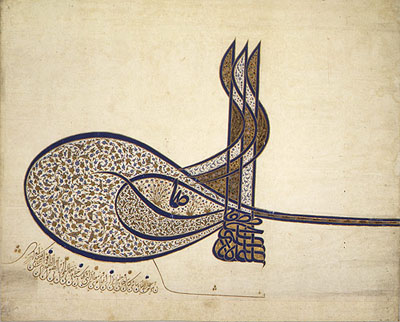
This artifact (object or poem), according to Tilly, may convey different messages simultaneously and look ambiguous but nevertheless remains a powerful and unshakable medium untouched by time and space. They remain eternally youthful and find new interpretation though the passing of time.
As it is explained in this poem, written by Ferdowsi[3], a thousand years ago:
Great buildings suffer destruction
From the drop of rain and the ray of sunlight.
Notwithstanding, I have created a great palace of verse
That is impervious to the wind and the rain
For thirty years, I endured much pain and strife,
with Persian I gave the Ajam (East) verve and life.
I shall not pass after I have lived,
For I have spread the seeds of words
Human beings with the emergence of the modern interpretation of freedom lost the benefit of their being embedded in communities of other human beings. Besides globalization, migration and several other factors speeded the process of disembodiment of individuals from their historical communities.
In case of Afghanistan, due to three decades of wars (1980s Russian invasion and 1990s Taliban and Al Qaida invasion), millions of Afghans had to leave their homeland and migrate to neighboring countries, in order to refuse cooperating with the occupying forces and also an opportunity to continue to fight for the freedom. As they begin to return after many years of migration, many of them, especially the younger generation who grown up in foreign countries find themselves isolated from the rest of society because of different education and way of life that they have experienced during Diaspora. This left many of them to their own to construct identity and form togetherness for themselves.
As in the absence of sufficient economical and social opportunities, it requires constant effort to sustain a certain amount of emotional oscillation and social creativity. It creates havoc in the transitional generation not adapted to them. It results in widespread role failure implying that individual resources in coping with current patterns which are by and large inadequate. This is here that cultural heritage, in this case, in the forms of rhythmic words/poems, emerge in order to repair the damage and inform choice and revitalize bonds, connection and self-introduction.
This artifact (object or poem) acts as a replacement of the ancestral heritage, and image of self-identification or as Webb Keane puts, a sign, mark and trace. As all formal exchanges between living humans are through words, expressing it through words characterized in poetry requires that they be grounded in objects and objects given direction by them.
The poems/objects serves as a convenient gloss on the entire range of social forms that are governed or mediated by objects. For example, it serves as centralizing and integrating device for communities, which are disillusioned because of social disintegration and separation from native land. It creates the collective conventions and the moral order for communitarians.
The poems/ words, when studied in an ideological framework and its incarnation as moral system, can be understood to shape what individuals do and say, and perhaps even feel, or represent a medium that leads into the intimate realm of personal life and remains unshakable and stable. Put it differently, it acts as a medium to perform the cultural work of connecting oneself, the individual to the broader realm of society and culture and divinity.
Based on this argument, the question arises that what make the poem as an object appear in the cultural context of (particularly the Persian world) and how it developed to this level. In order to answer this question we need to refer to historical changes occurred in the Persian world after the spread of Islam in modern Iran, Afghanistan and Central Asia. When Zoroastrian/ Buddhist rituals of using fire and other material objects, as a mediator between divinity and earthly (humans) were banned, words/ poems emerged as the main mediator between the humans in the visible world and the agents of invisible. The poetry, as Webb Keane describes in his essay on Calvin in the tropics, “Seem to promise a way to stabilize the distinction between subjects and object.” The words, which arise from the true, spiritual locus of the will, become the spirit made manifest (Niesel).
The poems served to stimulate the emotional and social responses that are invested in the mentality and intentionality of their creators, poets. They actively constitute a new social – cultural domain in which new ways are established to explain the different features of social life and behavior. Its evolution in the course of a thousand years, happened, in Gell’s words “to act upon the world” and embody complex intentionalities and mediate social agency.
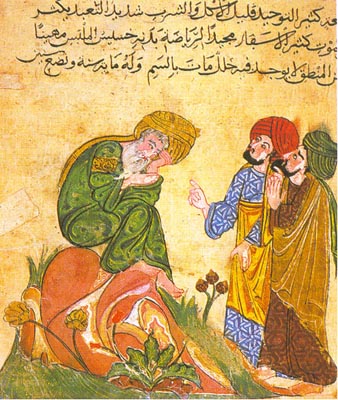
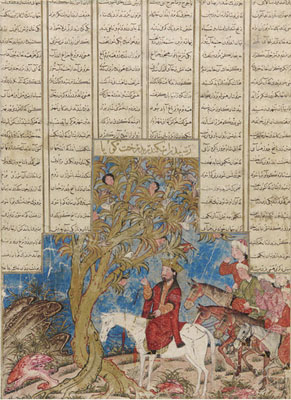
To gain a fuller sense of the way imagination and personalities are shaped by poems, and of the significance of the poems for the origin of self-identity and life in Persian world, there are several historical moments that discuss the agency of rhythmic words/poems in ancient Iran and Afghanistan. The most interesting example was the famous Fatwa[4] by Jami[5] in 15th Century AD to legitimize the painting of Behzad[6]. Painting, like sculpting, remained forbidden in Islam for fear of compromising Islam’s strict monotheism. But Jami, the senior cleric of his time, understanding the skill and art of Behzad, issued a Fatwa, justifying painting as a reflection of the meaning of words/ poems rather than a representation of the divine in material form. In light of the banning of painting in Islam, the explanation of nature and life in poetry, allowed other modes of expression, visual arts, to find a chance of emerging from obscurity to the foreground. The issue of obscurity, conceived as an allegory of materialism in poems, offers a glimpse of the tenuous materiality of poems themselves.
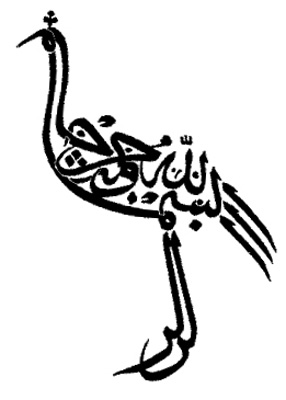
Rhythmic words enshrined in miniature, function as a poetic device, inviting one to regard poems as objects with their own agency that function through ages as a speaking characters to define the boundaries of life and humanity. The features and lyrics we encounter in the poems turn out to be a phenomenon common to most people’s experience of life and understanding of environment. This emerges not as metaphysical entity but rather as objects and beings with their own agency. The iconography of rhythmic words expounded through painting provides a framework- remarkably stable throughout literary history for depicting correspondence between poem’s body and amorphous bodies in nature.
The ability of poems to verbalize or materialize the highly personal and often confusing world of personal/spiritual growth and mysticism in a very forward and direct fashion played a significant role in definition of subject-object relations. Their semantic content makes them materialize what is immaterial. Poems function as the material and social exteriority of language to respond to the problems of presence and bridging the gap posed by communiation with invisible addressees. The following poem composed by Jalal u din Rumi[7] in 13 century explain how the rhythmic words address the problem of presense immaterial in material:
Why should I seek? I am the same as he.
His essence speaks through me.
I have been looking for myself!
The concept of agency of rhythmic words/poetry shows that material objects have meaning that is engrained in our social setting, especially in distinguishing and maintaining social structure. Materiality of words is tied up to our everyday concerns, the procession of activities that sustain not only individual life but also social life.
According to Latourian analysis, the study of technology demonstrates that material objects are not “discovered” like unexplored islands, but rather they are constructed through sets of social processes that include the capacities of objects themselves. While artificial material objects are literally inanimate they are imbued and embedded with the social meanings spanned by them, or capacities and extensions of human action incorporated within them. The incorporation of verbal identities by these objects reveal-- even in the case of the most fundamental inscription – important details about their social and imaginative identities. Unlike the phenomenon of the modern commodity fetish, which come to life only at the moment of exchange, these artifacts (rhythmic words) speak on the occasion of their manufacture.
Poems on one hand may be considered as merely “decorative artifact for feelings” but on the other hand they are understood as serious objects linking individuals through materialzing and symbolizing personal feelings and individual connection to its environment. But emphasizing the role of poetry with regards to individual sensation still leave a gap for understanding of poems/ rythmic words in social practice and even may create a qualia that cannot structure things and cannot be knowing. To explore it in modern context, poems stand for something beyond representation. Poetry is a system that shows how individuals act through objects, express themselves, and in Gell’s words, in Art and Agency, distributes parts of their personhood into things.
As in case of other objects such as computer or telephone, poems/rhythmic words, connect us with more people.
Secondly these objects/poems, with which ordinary people engage, demonstrate an increasing autonomy of action. Once the words are put in rhythm they regulate and pattern social behavior. And through this interaction, its agency that is “congealed” within is unlocked.
conclusion
The poems as objects act like an agent to materialize the invisible. It is an artifact through which an individual produce his own image and link it with the wider realm of society. They remained as tools for self-identification through time and space.
As in every society, there are things that are publicly precluded from being commoditized and remained as signs of identification. In this case (Persian context) poetry remained a strong object through which individuals have tried to establish connection with the past.
As culture serves the mind by imposing a collectively shared cognitive order upon the world, the poems beside their power on bridging with the invisible, represent a life force connecting the individual with his history and culture through time and space. In certain ways, the poems, on their own, can have personality to show volition and thus agency. It functions as a way to make something through producing images that cannot be represented by definition. The thoughts, images and feelings that can no longer find ways to be represented through rituals, find a new way of representation by means of rhythmic words, poems. Its development over the course of a thousand years has proved its strength on effecting imagination. In the societies whose long held values and traditions come under question due to rapid spread of mass media, internet and new technology, the poems remained a strong cultural tool while satisfying individual cognitive needs for preserving social identities.
work cited
Keane, Webb. 1998. Calvin in the Tropics.
Tilley, Christopher. 2006. Objectification.
Kopytoff, Igor Kopytoff. 1986. The cultural biography of things
Hoskins, Janet Hoskins. 2006. Agency, Biography and Objects
Abul Qasim Ferdowsi. Book of the kings.
Jalal u Din Balkhi Rumi. Mathnawi Maanwi
[1] Seljuk Sultanate in modern Turkey: 1086 – 1300 AD
[2] Avicenna or Ibn Sina, 980 – 1037, Persian poet, Physician, and Philosopher
[3] Abul Qasim Fedowsi 935- 1020: the most revered poet in the Persian world.
[4] Religious decree
[5] Nurudin Abd Rahman Jami 1414 – 1492: Persian Poet and Sufi philosopher
[6] Kamaludin Behzad: 1450 – 1535 Persian Painter and miniaturist
[7] Jalal ad Din Mohammad Balkhi Rumi: 1207 – 1273: Jurist, Poet and Theologian