introduction
In this presentation, I am going to talk about a criminal network of humans and nonhumans.[1] By following Bruno Latour’s actor-network-theory (ANT)[2] whose aim is directed toward reassembling the social, I will refer to the characters of this true story as actors and actants, depending on the role they play. My intention here is to try out a Latourian exercise and consider a chain along which competences and actions are distributed. My purpose is to show that in order to understand the dynamics of this criminal network, nonhumans are to be accounted for as much as humans.
I’d like to begin by referring to von Kempelen’s chess player in the 18th C, mentioned in Jessica Riskin’s article “The Defecating Duck.”[3] This machine displayed the ability not only to simulate life through mechanics: the chess-player machine, but also to dissimulate, since the nonhuman motions were in fact, directed by human actors concealed in the pedestal. In the story that follows, we don’t find one piece of equipment but various intertwined local networks that together play out the mechanics of a global and voracious capitalist market machine. The simulation becomes real dissimulation that as Von Kempelen’s friend, von Windisch, commented in relation to the chess-player “was ‘a deception’ and… as such, it did ‘honor to human nature.”[4]
The two characters I will highlight here are the following:
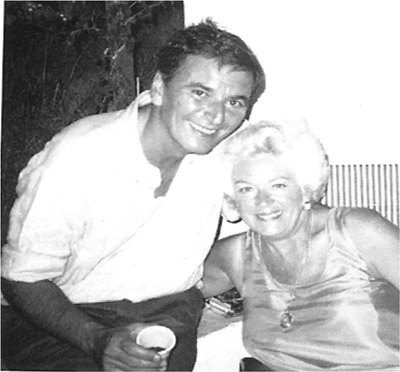
Marion True, a 57 year-old Harvard graduate, well-known and respected ex-curator from the John Paul Getty Museum in Los Angeles and...
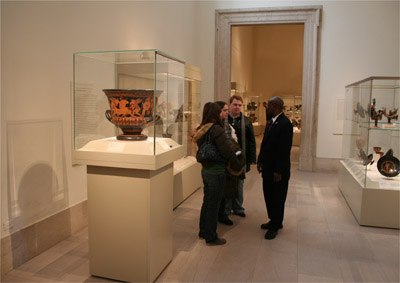
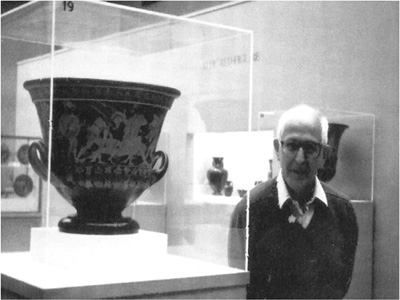
... the Etruscan Krater from the Metropolitan Museum of Art, a two-handle bowl from 510 B.C., designed to hold seven gallons of liquid with a drawing by Euphronios, one of the greatest artists of Ancient Greece.
Ms. True is being tried for “criminal association and receipt of stolen property in connection with the Getty’s acquisition of antiquities said to have been illegally unearthed in Italy and smuggled out of the country,”[5] writes Slayman in Archaeology. The New York Review of Books, notes:
So important is the trial of Marion True-the first criminal indictment of its kind against an American curator - that the defense has enlisted the services of Franco Coppi, a man who is widely regarded as one of Italy's best trial lawyers and has defended, among others, Giulio Andreotti, the former prime minister.[6]
It is hoped that True will mark a positive turning point in the history of illicit trade in antiquities which includes an already negotiated repatriation of the Euphronios Krater, generally described as “the single most perfect work of art,” and sold for $1 million dollars (insured for $2 million) in 1972 after having been looted somewhere north of Rome.
the story
My story begins with an accident caused by a beige Renault 21 that Mr. Camera, a 400-pound man, was driving north from Naples on the Autostrada A1, on his way to his apartment in Rome. After a heavy lunch on Thursday, August 31, 1995, around 3:00 P.M., just as he was approaching the exit sign to Cassino, Camera’s Renault overturned and was smashed into bits. This is the point at which the police begin to piece the evidence together and the criminal network starts to break down.
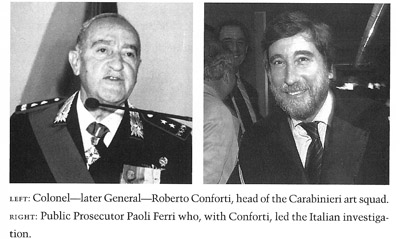
It so happened that the commander of the police in Cassino had been a member of the Art Squad. On being told by the Highway Patrol that the glove compartment was full of photographs of archaeological objects, he immediately telephoned his former colleague: Roberto Conforti, head of the Art Squad since 1990. Within an hour Colonel Conforti obtained a search warrant in order to raid Camera’s apartment in Rome. This is when “the organigram” was found.
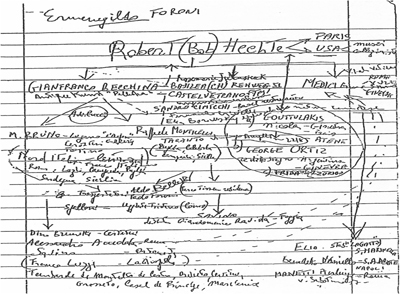
It consists of a piece of paper hand-written in blue ball-point pen with a diagram of the organizational hierarchy of the illicit antiquities network throughout Italy and Switzerland, all pointing to one name on the page, the head of the organization: Robert (Bob) Hecht (with an Italian “e” at the end, added by Mr. Camera.)
The “Organigram” shows the links of the “cordate”, the Italian word for mountaineers strung together on a rope for safety. The cordate includes the “tombaroli” or tomb robbers, the “capo zona” who coordinate a specific region, the actual smugglers or middle men, the sophisticated “Swiss” dealers, the auction houses with link-men like Robert Hecht and the private collectors.
There is yet another element that is not explicit in this diagram but can nevertheless be read in-between the lines of the “cordate”: the higher up the hierarchy the more access there is to powerful nonhuman agents which Latour calls an “actant,”[7] and in turn, the more powerful the actant the further up the ladder of the network, all the way to the international arena of private collectors and museum collections.
Following the ANTs, constituted by authors such as John Law and Michel Callon,[8] in order to understand the dynamics of this network it is necessary to acknowledge its degree of autonomy, a “negotiation space” in which it can use resources within its own time and space. The humans and nonhumans of both local and global networks can wait for a whole decade or more if it is necessary until the right conditions are given to emerge in public circulation and mobilize a whole chain of actors and actants. This is clearly illustrated in the story of the Euphronios Cup, another of the agents in this network. Giacomo Medici, described as the “mastermind” of this criminal organization, was the last person to buy the cup from Sotheby’s and it was found in one of his warehouses in Geneva.
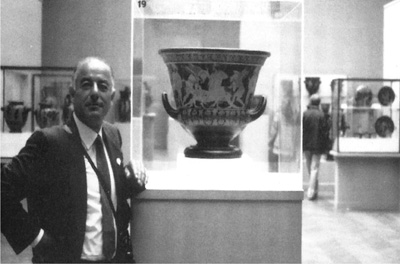
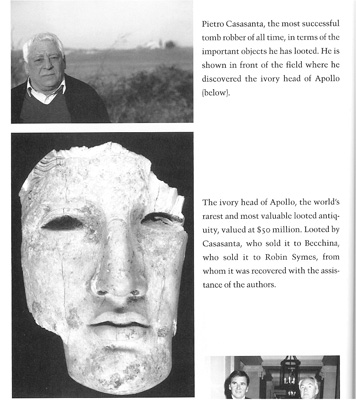
Mr. Medici initially sold it to Mr. Hecht after having looted it from a necropolis near Rome. Mr. Hecht then sold the cup to a middle man who in turn sold it to a well-known collector, Mr. Hunt. Meanwhile, the piece was exhibited in the Kimbell Art Museum in Texas where the well-known Greek and Roman curator from the Metropolitan Museum of Art, Dietrich von Bothmer, praised it. This was in turn cited in the Sotheby’s catalogue, lot #6, when the cup was sold to an anonymous “European buyer” for $742,000 in the Sotheby’s-Hunt auction which took place in 1990. As Peter Watson points out, it seems that Medici’s tactic as the buyer was to buy “back his own objects, laundering them in the process, to show they had been through a reputable auction house.”[9]
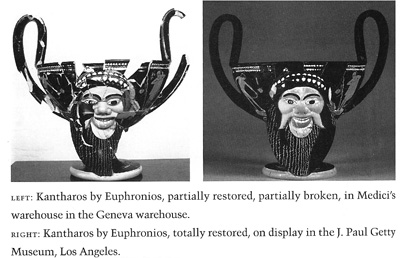
This piece was shattered during the police raid, yet Medici claims it is still worth $5 million today. It is very easy to fabricate a provenance, Ms. True herself admitted in an interview with The Art Newspaper in 1995: "A lot of material enters museums' collections with documents that are trotted out when people need them, and have been completely manufactured."[10] Once the provenance has been “cleaned” by its circulation in the market, it is easy to lawfully acquire the pieces.
When the police broke into Medici’s warehouse in Geneva they seized 10,000 antiquities and several thousand Polaroid pictures.
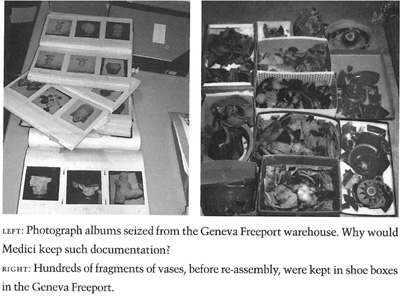
According to Boston University's Elia:
such pictures may be taken so that dealers can show prospective buyers that their wares are genuine - the obvious conclusion being that any buyer who saw such a photograph would have to realize that the piece in question had been looted. [11]
Thus the very evidence that makes the nonhuman agents so valuable in the market is what now, in the hands of the law, incriminates the human agents.
Law and Callon describe a process of “mutual shaping” by which actors are not simply shaped by the networks in which they are located but they also influence the actors with which they interact, who are themselves located in and shaped by a global network. As the nonhuman actors enter local networks they begin to acquire human-like qualities and in turn there is a process of mutual shaping which occurs at a more global level. I will illustrate this point by trying to explain what I mean by “human-like” in this context.
When the artifact comes out of the underground, it belongs to another time and space, almost like another realm which we cannot fully know in the present. Many times they almost look like out-of-space-things, unrecognizable from a human’s perspective. However, as they enter the dynamics of the network they are made recognizable and given an identity as the artifacts are literally and figuratively “cleaned.”
One of the cross-border police raids in 1994 for example, involved the house of a middle man of the network, Antonio Savoca, who lived in Munich. The police are described as having been dumbfounded when they entered his three-story villa and saw a 5ft deep, 6ft long and 30 ft wide pool full of chemicals to remove the blemishes of ancient vases and jars that were standing in rows like giant chess pieces in the water. Alongside the pool there were more of them in “a very clean state.” In another raid in 2001, the Police entered Hecht’s apartment in Paris, and the first impression that they got was that of soil. The two Carabinieri there had often joked about how in the movies, police searching an apartment always look first under the bed. In real life, however, no one ever hides anything there, they commented.
On this occasion-at the very moment they entered the bedroom, they could see some white plastic shopping bags wedged under the bed. They placed them on top of the covers, and reached inside. The first things they took out were some ancient vases… full of earth. Then they found a bronze helmet, and a bronze belt, both dusted in soil. Next they came across a number of vase fragments, in the same dirty condition.[12]
The words dirty and clean keep reappearing in this investigation: the clean provenance, the dirty object, the clean investigation, the dirt behind the evidence. The contradiction is that whilst the law tries to “clean” the crime by punishing the circulation of illicit trade, the market “cleans” the illicit trade by stimulating its circulation.
After both the physical body and the commodity form of the artifact has been “cleaned” with artificial chemicals and constructed provenances, it is ready to step into the dynamics of the antiquities trade, and as an agent, play out its role in social gatherings, intellectual venues, special dinners, cocktails and invitations, important hosts and spaces that are assembled around it as it is turned into a celebrity.
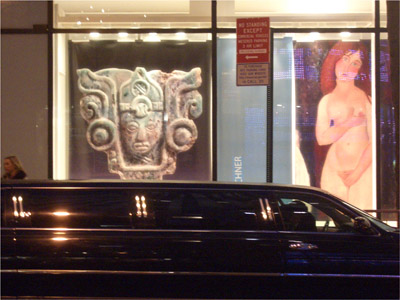
Christie’s Auction House in New York
The irony is that the more human-like the artifact becomes the more acknowledged and demanded it is as object of attention, not just by private collectors but by wider networks of people who identify with it, as it transforms into the famous piece in the museum, the catalogue or the book. These actants become human-like things enclosed under controlled environments of light, humidity and security, with other actors and actants such as guards and alarms.
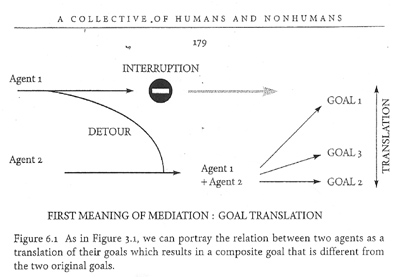
If we examine Latour’s chart from his article on “A Collective of Humans and Nonhumans,”[13] we see how goals are modified in the process of interaction between actors and actants. Latour uses the example of a citizen, Agent 1 and a gun, Agent 2. If Agent 1 has an intention, for example he or she is angry, he or she may fall back on Agent 2, the gun. From this fusion of human and nonhuman, emerges a third agent. Latour thus considers the goals that this new agent might pursue. If Agent 1 sticks to its initial Goal 1, then Agent 2 is merely a tool used to achieve this. If Agent 1 attains Goal 2 because he or she once having the gun in hand is instructed to follow the artifact’s script, then human action is merely intermediary. However, a third option may arise, Goal 3, which does not correspond to any of the agents’ initial program of action. Latour notes by asking and answering at once: “Which of them, then, the gun or the citizen, is the actor in this situation? Someone else (a citizen-gun, a gun-citizen)”[14] This shift of goals is wholly symmetrical, points out Latour, for just as you are different with a gun in your hand, the gun is different with you holding it. “They become ‘someone, something’ else.”[15] Thus, agents can be human or nonhuman and each can have goals. Nevertheless, since the term agent is uncommon for non-humans Latour chooses to call them actants instead.
It is not easy to establish how human actors are mutually shaped within the negotiation space of the local networks and global network. However, it is tempting to look back at Ms. True’s transformation from a successful and expert curator at the Getty Museum to a human-like thing, without voice or freedom, and like an actant, centre of attention of the world of antiquities, enclosed under a controlled environment with guards and security alarms.
Furthermore, there is the interesting case of Giacomo Medici who is now using an actant to be his place-holder, or if we want to replace this with Latour’s term, to be his “lieu-tenant”[16] before the law. The Public Prosecutor Paoli Ferri observes that the network hasn’t collapsed and that Medici is “continuing to traffic.”[17] In fact, the proof is that Medici can still negotiate with the help of an actant and in turn, “dissimulate” the power of the market machine. He was being tried separately and was found guilty in 2005 of illegally buying and selling stolen Italian artifacts. He was sentenced to ten years in prison and fined $13 million. He thus offered an “Object X” in exchange for his penalty and jail time. He tempts the law by pointing out: “… equivalent objects have been valued at more than 10 million Euros in the international antiquities market.”[18] The police who have searched everywhere in his homes and warehouses are curious about what this could be for they never found such a thing. “It could be a flight from Australia or three hours by train from Naples,”[19] points out Giacomo Medici. According to him, “Object X” was created by a famous artist from the ancient world that is only comparable to Michelangelo or Leonardo da Vinci. In another article he mentions: “It’s something they could only dream about, and only I can bring it to them.”[20]
On September 20, 2006, Prosecutor Ferri seemed to be willing to negotiate with the Criminal Medici. He offered to reduce Medici's sentence to six years and to use Object X to offset the fine, though he wouldn't guarantee that it would wipe out the whole debt. However, he wanted to see the artifact before making any promises. “It could be a bluff,” comments Ferri, who says he'd rather lose Medici's masterpiece than get duped. “I'm sorry if it's important”[21] he adds, as he thinks about what the Object’s identity could be. Thus Agent 1, Prosecutor Ferri could easily end up displacing his initial intention to capture Medici under the law, as he obtains Object X, Agent 2, in his hands. If Object X on the other hand, is what Medici describes, then its initial script to circulate in the market with an enormous value would also change in the hands of Agent 1. Hence, we would have a new “someone-something” in the network. However, what is really interesting in this case is that at this point, Object X is a potential actant of anything and anyone who has the desire to imagine it and as such, holds the power to expand the network.
conclusion
As Ms. True becomes human-like thing in prison, an unknown human-like thing: “Object X,” potentially becomes a place-holder for Mr. Medici, and would allow him to keep circulating within the network as the network continues. Furthermore, another actant, the Euphronios Krater travels back to its country of origin, as the Metropolitan Museum of Art becomes object of attention in the shifts and displacements involving the network. We could have described this as the classical example of fetishism where humans become object-like and objects become human-like, but Latour quickly dismisses these theories by pointing out that it is no longer possible to separate objects and humans, for both make apparatuses and institutions. What is worth highlighting here is not only that, as Latour says, “humans are no longer by themselves”, but the enormous complexity of the network of humans and non-humans. Latour writes:
The name of the game is not to extend subjectivity to things, to treat humans like objects… but to avoid using the subject-object distinction at all in order to talk about the folding of humans and nonhumans. What the new picture seeks to capture are the moves by which any given collective extends its social fabric to other entities.[22]
The immediate debate that the authorities are facing in this investigation is how to solve the problem of repatriation with respect to the actants. The Euphronios Krater will now leave the MET and return to Italy, but is that really the origin of this actant? Perhaps origin is no longer the question in this recombination of actants. What are we tracing here? And who is tracing who?
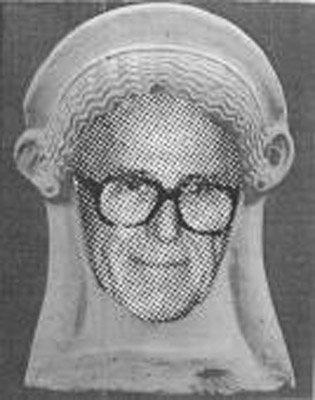
When the police raided Hecht’s apartment in Paris for example, they found his memoirs recorded in his journal. Hecht is supposed to have threatened other members of the network with exposure there, but the notes also contain a second, “clean” version of the Euphronios krater story, and it is unclear how reliable they are (Hecht himself insists that he is working on a novel, mixing fact and fiction, based on his career.) Nevertheless, this did form part of the evidence that helped to persuade the Metropolitan Museum of Art to return the Euphronios krater.[23] So it is not just the human-nonhuman detectives that write the truth, but the human-nonhuman criminals as well. Peter Watson says in an interview:
In my experience, criminals always put things in writing. Since they are criminals, they distrust each other and putting things in writing becomes necessary.[24]
However, Watson is saying this as he writes his own book. In this respect, he is tracking down the names of the criminals, not just to serve the police and authorities of the law, but also to write the next art dealing crime thriller. This is not about what humans have to say about nonhumans but what is shown in the reassembly of humans and nonhumans within a particular dynamic of time and space.
Whether in good faith or for unlawful reasons, repatriation is hard when it comes to the private holders of capital. The Italian police have linked nine pieces of the Levy-White private collection to Giacomo Medici. Ms. White is being asked to return the pieces to Italy, but without an actant, there is no way to enter the “negotiation space” and access the network of transactions that include private collectors, such as her and her husband, nor is it possible for the law to force them to return the actant that by now has become part of the family ties. In this way, when looking at issues such as repatriation and doing the craft of an archaeologist that goes beyond the confines of written evidence, it becomes necessary to consider both the past and future of a “world-in-formation” (to borrow Tim Ingold’s term[25]) and acknowledge the various interfaces, sides, layers and intricacies of a world of human and non-human interaction.
[1]This is mainly based on Peter Watson and Cecilia Todeschini’s book: The Medici Conspiracy. New York: Public Affairs, 2006
[2]Latour, Bruno. Reassembling the Social, An Introduction to Actor-Network-Theory. Oxford: Oxford University Press, 2005.
[3]Riskin, Jessica. “The Defecating Duck, or, the Ambiguous Origins of Artificial Life.” In: Things. Ed. Bill Brown. Chicago: The University of Chicago Press, 2004
[4] Op. cit., pp. 120-121
[5]Slayman, Andrew L. “The Trial in Rome” In: Archaeology, February 6, 2006.
[6] Eakin, Hugh. Op. cit.
[7]Bruno, Latour. “A Collective of Humans and Nonhumans.” In: Pandora’s Hope: Essays on the Reality of Science Studies. Cambridge: Harvard University Press, 1999, p. 180
[8]Law, John and Callon, Michel. “The Life and Death of an Aircraft: A Network Analysis of Technical Change.” In: Shaping Technology/Building Society: Studies in Sociotechnical Change. Ed. Wiebe E. Bijker and John Law. Cambridge: MIT Press, 1992
[9]Mazur, Susan. “Suzan Mazur: Sotheby’s and the Signed Euphronios” In: Scoop Independent News, December1,2005
[10] Slayman, Andrew L. Op. cit.
[11] Slayman, Andrew L. Op. cit.
[12]“Raiding the Tomb Raiders” In: Archaeology, Volume 59, Number 4, July/August, 2006
[13]Bruno, Latour. “A Collective of Humans and Nonhumans.” In: Pandora’s Hope: Essays on the Reality of Science Studies. Cambridge: Harvard University Press, 1999.
[14] Op. cit., p. 179
[15] Op. cit., p. 180
[16] “From the French ‘lieu’ ‘tenant.’ i.e. holding the place of, for, someone else.” Latour, Bruno as Johnson, Jim. “Mixing Humans and Nonhumans Together: The Sociology of a Door-Closer” In: Social Problems, Vol. 35, No. 3, Special Issue: The Sociology of Science and Technology (June, 1988) , pp. 298-310
[17] Silver, Vernon. Op. cit.
[18] Silver, Vernon. Op. cit.
[19] “Smuggled Antiques Keep Cops Busy” In: The Financial Express, Sept. 26, 2006
[20] Silver, Vernon. “Art Smuggler Offers Italy Mystery Masterpiece ‘X’ To End Trial” In: Bloomberg.com, Sept. 25, 2006
[21]“Smuggled Antiques Keep Cops Busy” In: The Financial Express, Sept. 26, 2006
[22]Latour, Bruno. “A Collective of Humans and Nonhumans.” In: Pandora’s Hope: Essays on the Reality of Science Studies. Cambridge: Harvard University Press, 1999, p. 194
[23] Eakin, Hugh. Op. cit.
[24]Archaeological Institute of America. “Exposing the culture thieves,” June 14, 2006.
[25]Ingold, Tim. “Materials against materiality.” In: Archaeological Dialogues 14 (1), Cambridge University Press, 2007, pp. 1-16.