
portrait of
adele bloch-bauer I
lesley schorpp
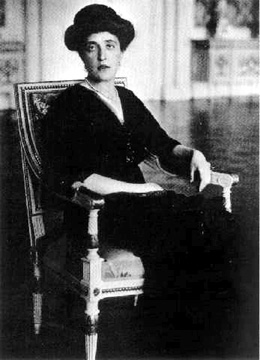
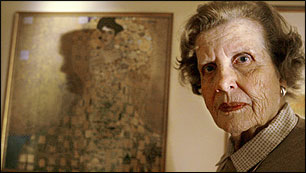
The portrait depicts a striking woman with dark hair, fair skin, and an intricate evening gown posed against a sumptuous, gold-patterned background. The painting Adele Bloch-Bauer I by Gustav Klimt is one of the Austrian artist’s most famous works. Upon her death, Adele Bloch-Bauer left the portrait to her husband but included a clause in her will indicating that she wanted the painting to be given to an Austrian museum following his death. When the Nazis invaded Austria in 1938, they seized the gold-flecked portrait from Altmann’s husband and subsequently made the Belvedere Gallery, a state organization, the formal owner of the portrait. In the past sixty-five years, the painting has attracted hundreds of thousands of visitors to the museum. However, on February 6, 2006, the Belvedere reluctantly deinstalled the portrait and began to pack it, along with four other Klimt paintings, for shipment to Maria Altmann, Bloch-Bauers’ niece living in California. The repatriation of the paintings to Altmann fulfills an arbitration court’s ruling that obligated Austria to return the paintings under laws requiring the restitution of art objects to Holocaust victims. Upon their return, Altmann plans to sell the portrait and the other paintings for the highest price, turning what has been called a priceless, national treasure into a commodity. However, it is an investigation of an object’s movements through time and space, or its cultural biography as Kopytoff describes it, that illuminates the political, social, and economic relationships that both affect the painting’s status and are also altered by it.
While the Austrian government was able to negotiate a right to buy the portrait and the other four works back from Altmann, it was ultimately unable to afford the estimated three hundred million dollar price of the paintings. In response to the government’s decision not to purchase the repatriated works, various individuals within Austria and around the world have joined together in an effort to keep the paintings at the Belvedere Gallery. Several art historians have created a website, www.proklimtbilder.at, to collect electronic signatures and monetary pledges towards purchasing the Klimt works. The site describes the Klimts as national treasures that should remain in Austria, accessible to the public, stating that “if no effort is made to keep the paintings in the country, it would amount to depriving Austria of these paradigmatic treasures testifying to its contemporary history.”
Similarly, the subsequent exhibition of Adele Bloch-Bauer I in the Belvedere Gallery both increased the prestige of the state’s art collection and reaffirmed the portrait’s centrality in Austrian cultural history. The museum’s collection of Klimts, including Adele Bloch-Bauer I, drew large crowds of Austrians and tourists to the museum and signified not only the power of the state to gather such high-quality works but also exemplified the importance of Austrian artists in art history. In the two days prior to the paintings’ removal from the Belvedere, over 8,000 people lined up to view the portrait. One Austrian art dealer describes the painting as an embodiment of “the history and spirit of one of the most important eras of the country” (Wabl.2006).
Weiner describes the inalienability of an object as “its exclusive and cumulative identity with a particular series of owners through time…” (33). The painting certainly represents aspects of both the identity of Adele Bloch-Bauer and Austrian cultural heritage. As part of the state’s art collection, Austrian society singularized the portrait as a representation of Austrian cultural identity, an object that resists commoditization. When in her possession, Adele Bloch-Bauer viewed the portrait as an inalienable object to be passed to her husband and then donated to her country. Therefore, Altmann’s decision to sell the painting stands in stark contrast to her aunt’s desire to present the painting to the Austrian museum as a gift and the viewpoint of the majority of contemporary Austrians that the painting is an irreplaceable, priceless national treasure.
How did the portrait shift from that of a singular, inalienable object, a priceless item above exchange to that of a commodity, a luxury good to be purchased by anyone with the available funds? As Kopytoff describes, objects do not possess a fixed status as a commodity or a singular, inalienable object, rather an object’s status changes throughout time. Additionally, an object may be viewed differently by various segments of society at any given moment and in pluralistic societies, perceptions of an object's status often conflict. In the case of the portrait, the Austrian government and many Austrians view the portrait as an inalienable object while Altmann recognizes the painting as a commodity to be exchanged for money.
While Altmann indicates that she recognizes the singularity of the portrait and wishes it to remain on view to the public, she has chosen for unstated reasons to sell the painting to the highest bidder. The conflict that accompanies the sale of this work is described by Kopytoff as an effect of the trading downward in status, as “things called ‘art’ or ‘historical objects’ are superior to the world of commerce” (82). It is a demotion for them to be sold as commodities. Presumably, the painting will not remain in the marketplace but move out of its status as a commodity and again become a singular, inalienable object.
Preliminary news reports regarding the sale of Adele Bloch-Bauer I have focused on the high market value of the object. Many reports speculate that the portrait could break the record for the most expensive painting sold at auction. In the instant when the portrait is exchanged for money, it changes from an inalienable, singular object to a commodity, “the very fact of exchange indicating that the counterpart has, in the immediate context, an equivalent value” (Kopytoff.68). In the case of Adele Bloch-Bauer I, the fact that the portrait is seen as a priceless piece of Austrian heritage has contributed to its extraordinarily high auction estimate. The immense estimate for the portrait ironically serves to confirm its singularity and pricelessness. If the individuals organizing through the “Proklimtbilder” website manage to raise sufficient funds, they will be purchasing that which they have defined as priceless and inalienable. “As one makes them more singular and worthy of being collected, one makes them valuable; and if they are valuable, they acquire a price and become a commodity and their singularity is to that extent undermined” (Kopytoff.81).
As the portrait’s significance is tied directly to the people and events to which it is connected, the outcome of its sale will effect its place in Austrian heritage and history. While Altmann indicates that she would prefer that the work remain accessible to the public, she refuses to offer the Belvedere a special price as the Austrian government did not cooperate with her request for repatriation until the ruling of the arbitration court. Even though Altmann describes the painting as a singular object with personal significance, visually and spiritually embodying her aunt, her decision to sell the painting indicates that it may be the act of repatriation that most interests her. The portrait’s removal from the museum contradicts her aunt’s original intent for the painting to be displayed in an Austrian museum; however, as the cultural and political relationships surrounding the portrait have changed throughout history, the painting has become a trophy in the battle fought between Altmann and the state. Altmann’s decision to sell the painting for market value expresses her power as owner over the state to determine where the portrait will go.
The cultural biography of Klimt’s Adele Bloch-Bauer I traces the movement of the portrait from that of a commodity, commissioned for a finite sum of money, to that of a singular object within the home of the Bloch-Bauers. The portrait was then seized by the Nazis and given over to the state-run Belvedere Gallery and displayed as a symbol of Austrian cultural heritage. The object now leaves the museum to enter the marketplace as a commodity to be purchased by an institution or collector that in all probability will display it again as a singular, priceless object, removed from commodification. “[A]n eventful biography of a thing becomes the story of the various singularizations of it, classifications and reclassifications in an uncertain world of categories whose importance shifts with every minor change in context” (Kopytoff.90). The biography of the portrait reflects the changes in economic, political, and personal relationships that occur around it, but as the repatriation of the object to Altmann displays, the object also plays an active role in the political relationships that its movement creates.
Works Cited:
Kopytoff, Igor. “The Cultural Biography of Things: Commoditization as process” in The Social Life of Things: Commodities in Cultural Perspective edited by Arjun Appadurai. pp. 64-94. Cambridge University Press, Cambridge. 1986.
Wabl, Matthias. “Klimt Could Top Picasso Price” in The Globe and Mail. 28 January 2006.
Weiner, Annette. Inalienable Possessions: The Paradox of Keeping-While-Giving. University of California Press, Berkeley. 1992.