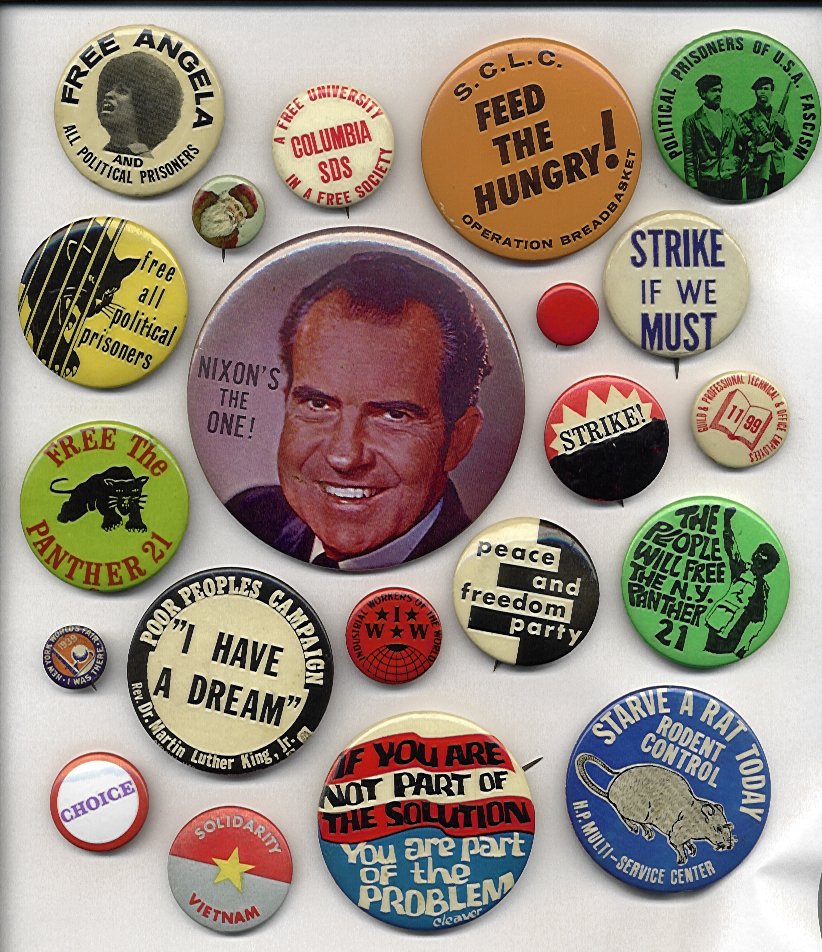

The button with the black ink over the rest of the wording (white and red color) only showing "Strike" is a Vietnam Peace button issued by the Student Mobilization Committee (SMC) for the April 26th Strike held in 1968 around the U.S. against the Vietnam War.The little red button was issued in Dec. 1967 for the "Stop The Draft Week" protests at the Whitehall Induction Center. It was issued by the YSA [Young Socialists Alliance] in response to the NYC Police Department having a larger red button made to identify the many hundreds of plain clothes police around that week of daily protests to "shut down the induction center". There was a later larger version made that was sold by the YSA in 1970-1973.
Other buttons shown... Yes, that's a genuine IWW (Industrial Workers of the World, "Wobblies") button below Nixon's chin. The Panther 21 were the local counterpart of the Chicago 7: 21 Black Panthers accused of plotting to blow up Macy's, eventually acquitted; shown on the button at upper right are Panther founders Bobby Seale and Huey P. Newton ("Free Huey!"). The Panthers were a regular fixture at the Columbia gate (as were the Young Lords), selling literature and recruiting. Angela Davis was accused of complicity in the 1970 courtoom escape attempt of George Jackson (author of Soledad Brother: The Prison Letters of George Jackson) in which the judge was killed; she was acquitted too and is now on the faculty at UC Santa Cruz ("the only professor who was once on the FBI's 10 Most Wanted list"). George Jackson was killed in prison in 1971. Huey P Newton was killed in 1989. Malcom X, by the way, was killed in 1965 in the Audubon Ballroom in Harlem, now a Columbia biotech research building (Columbia restored and preserved the historic facade and built the new facility behind it).
The Strike If We Must button appeared after the first arrest, while talks went on in various forums over what would be done about the students' demands, punishing the students, gym construction, and so on. It was worn by moderates sympathetic to those already striking. Eventually there was a second building occupation and mass arrests.

Free Bobby Seale (Black Panther Party); They Shall Be Served; March on Washington (button union made!... Allied Printing Trades Council, New York), Create 2-3 Many Columbias, Warmth, May Day, District 65.
The "They Shall Be Served" button was worn in the early 60s in support of the black students who sat in at Southern lunch counters. The Warmth button was passed out by people who wanted everybody to “don't worry, be happy”, which for some of us was not on the menu because of the war and other atrocious things going on. District 65 was another union that was organizing on campus.
Frank da Cruz / Columbia University 1968 / Jun 2001 / Links updated Jan 2008 / New buttons Nov 2013