The Editors
Thinkers as different as Sir Karl Popper, C. P. Snow, Thomas Kuhn, and Robert Merton have focused on the
scientific process as a distinct way of viewing the world-rational, secular, and skeptical. Yet
science has always coexisted with other views that incorporate nonrational elements; to the
scientist, the Age of Reason is unending, but to the historian or 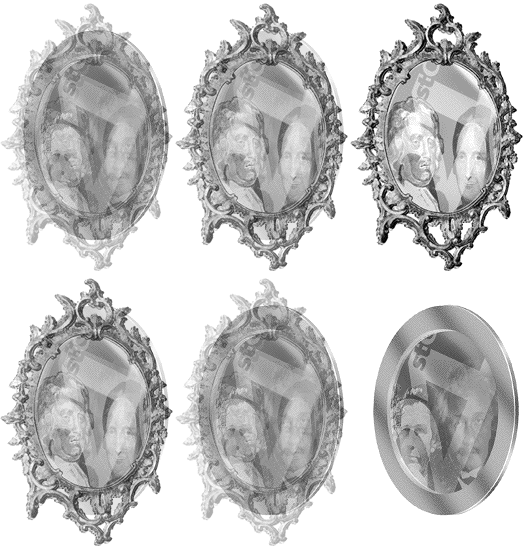 literary scholar, it was a finite period, succeeded in the late
18th century by the mysticism and mythos of the Romantic era.
literary scholar, it was a finite period, succeeded in the late
18th century by the mysticism and mythos of the Romantic era.
The "Two Cultures" of the sciences and humanities that Snow identified in his famous 1959
Rede Lecture have hardened in this century, and even become to some degree antagonistic,
but the dialectic between them endures. Some readings of history suggest that neither of the
two cultures stays dominant for long. Novelist/essayist Thomas Pynchon suggests, in a brief history of
Luddism,1 that this anti-technology backlash
arose as one of several "sectors on a broad front of resistance to the Age of Reason," and that
the two sides of what he dubs "the Snovian Disjunction" have long danced an uneasy pas de
deux, with neither partner consistently leading.
If the 18th through 20th centuries witnessed the formation of "a 'scientific culture,' objective
and hard-nosed, contrasted with a 'humane culture,' which consisted (presumably) of
everything else, and was characterized by a regard for subjective feelings and values,"2 where do we stand as the 21st approaches? From some
angles, as the panelists in this issue's Conversation describe, science looks victorious.
Biomedical research explains our maladies and extends our lives; advances in communication
shrink distances and puncture borders; technology in general has transformed the planet,
though not always for the better. Still, allegiance to the unscientific and the frankly
 counter-rational proves resilient. In fact, if the public's appetite for supernatural belief systems, "alternative"
medical treatments (biologically plausible or otherwise), UFOlogy, ad infinitum is any indication, irrationalism
is on the rise. One might ask, with no certainty as to the answer, whether the 21st century will
be an Age of Logic or an Age of Luddites.
counter-rational proves resilient. In fact, if the public's appetite for supernatural belief systems, "alternative"
medical treatments (biologically plausible or otherwise), UFOlogy, ad infinitum is any indication, irrationalism
is on the rise. One might ask, with no certainty as to the answer, whether the 21st century will
be an Age of Logic or an Age of Luddites.
Some researchers have a clear interest in promoting one or the other of these imaginable
futures; others find that the intellectual conversations that can take place across the
Disjunction are themselves a source of fascination. The articles in this Special Section strive to
convey some of the excitement that scholars generate as they map the often-mysterious border
zone between the humanities and the sciences. Columbia literary scholar Ursula Heise,
examining contemporary literature's uses of science, observes a healthy hybridizing influence
as writers replace a Romantic-era dread of dehumanization with an active, even optimistic,
embrace of ideas derived from the sciences. Historian Roger Bagnall discusses efforts to
introduce the methods of the sciences into an unlikely realm, the study of ancient cultures. As
journalist Valerie Brown reports, scientists have taken steps to improve communications
across the Disjunction, recognizing that fields such as religion, literary criticism, and women's
studies have much to gain from such dialogues and much to offer science in return.
As the humanities strive to incorporate science, they also examine and redefine science in
their own languages. Columbia scholars, particularly Robert Merton, Professor Emeritus of
Sociology, have been pioneers in the study of science from other perspectives. To borrow one
of Merton's own title phrases, every scholar working in the sociology of science (or its
controversial newer offshoot, Science and Technology Studies or STS) looks implicitly to
Morningside Heights to "stand on the shoulders of a giant." Following some of Prof. Merton's
insights, STS scholar Marianne de Laet clarifies this discipline's principles and methods, and
Janet Atkinson-Grosjean looks at its evolution in response to the onslaught of criticism it has
received. And in a related article, this issue's Conversation feature, members of divergent fields
examine the comparative truth claims of philosophy and physical science.
The departmental structure of any university delineates and reinforces the Snovian
Disjunction, but scholars have long recognized that disconnection has its disadvantages and
that interdisciplinary efforts toward dialogue (of which 21stC is one) have vital
purposes. There are things to do with boundaries besides guard them; a border area can also
be the site of mind-boggling intellectual fertility.
Related links...
James O'Donnell, U. of
Pennsylvania, "Humanities in the 21st Century." Interview by NEH Chairman Sheldon
Hackney, Humanities Sept.-Oct. 1995
Vaclav Havel on transcendence
and science, Physics and Society 23(4), October 1995
Kirkpatrick Sale,
"Lessons from the Luddites," The Nation, June 5, 1995
New Luddite
newsletter, York University, UK
Science and Culture section of
Serendip, Bryn Mawr College
Sheila Tobias,
"The Two Cultures Revisited: Science And Mathematics As The New Liberal Arts,"
address to 1994 meeting of undergraduate program directors, Howard Hughes Medical
Institute
NSF Director Neal Lane,
"The Dream of a Common Language: Making the Science -- Non-science Bridge,"
Scientia lecture, Rice University, 1996
W. W. Cobern, "The Nature of
Science and the Claims of Reason, Faith, and Relativism," symposium paper, National
Association for Research in Science Teaching, St. Louis, 1996
1 "Is It O.K. to Be a Luddite?" New York Times Book Review, October 28,
1984, pp. 1, 40-41.
2 David Edge, "Reinventing the Wheel," in Jasanoff et al. (eds.) Handbook of Science
and Technology Studies (Sage, 1995).
Illustration: Antique Mirror: (L to R) Isaac Newton, Mary Shelley; (Modern Mirror) John Cage, Albert Einstein
ILLUSTRATION: Mirror: Howard Roberts, with animation by Justin Kim.
Soldiers: adapted by Howard Roberts from "The Blue & the Gray" by
Mort Künstler; © 1982 Mort Künstler , Inc.