s most of us have noticed, with joy and some dread, we now live in an information-rich era, with
health "facts" endlessly spread across pages and screens. Some of it is credible, perhaps even true, but
how is one to tell the difference?
That torrent of data includes a special flow dealing with personal health, the product of billions of
dollars of research findings that have been printed either in peer-reviewed medical journals or
released without any real review. Such material is often given to the general public via the conduit we
call the science journalist, whose job is to evaluate that informational mess and translate it into
user-friendly language appropriately balanced with what is and isn't true, as far as known. That skill
is critical because we have become a rather health-conscious audience devoted to some level of self-
care, given the proper information.
This hybrid communicator, part journalist and part technologist, can be self-trained or trained in a
journalism school's science writing curriculum. Columbia's Graduate School  of Journalism has been fine-tuning a
science/health/environment/technology program for half a century, though the history of
professional science writing goes back much further, to 1934, when a dozen veteran science
journalists formed the National Association of Science Writers
(NASW), now over 2,000 members strong.
of Journalism has been fine-tuning a
science/health/environment/technology program for half a century, though the history of
professional science writing goes back much further, to 1934, when a dozen veteran science
journalists formed the National Association of Science Writers
(NASW), now over 2,000 members strong.
Science writing became a part of Columbia in the mid-1940s with the arrival of John Foster, Jr., who
quit his job as editor of Aviation
magazine to develop more focused science writers. His method was to stuff students with both
science information and writing skills, emphasizing deep reporting at the scene of the story. After
Sputnik's space flight, he went a significant step further and dug up funding for a professional science
writing program, a fellowship group for people already in the field, called the Advanced Science
Writing Program (ASWP).
Each Fellow would spend two linked semesters at Columbia taking courses in fields such as biology
or physics at the main campus and gross human anatomy at Columbia's medical school. They also
traveled around the country to places where research was conducted and began a longer work,
perhaps a series of stories or a book about one subject. Prof. Foster's ASWP trained over 100 Fellows
over an 11-year period before it ran out of funding. My connection with Columbia began as a Fellow
in that program, 1965-66, on leave from WCBS-TV News, where I was, variously, a writer, editor,
producer, and science specialist. A few years later, Prof. Foster brought me back to Columbia to be
Acting Director of the professional and master's level programs, 1968-69, during his sabbatical. He
retired a year later, and I was hired to take his place in the science program for the next 28 years.
Interest in the environment blossomed in that period and became one of the important parts of the
curriculum, along with biomedicine and the science/society interface, as discoveries such as genetic
engineering raised new ethical questions. During the 1970s,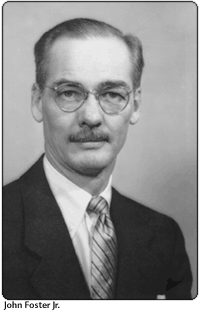 Columbia's program also paid more
attention to the fascinating growth of the population segment 80 to 100 years old in America and
other countries; new departments of geriatrics and gerontology arose, spurred by Dr. Robert Butler, the first director
of the National Institute of Aging, who started such a department at the Mount Sinai
Hospital. By the year 2025, it is estimated,1 perhaps 20
percent of the U.S. population will be over 65 years old, making it a virtual certainty that medical
news will continually be a central public concern.
Columbia's program also paid more
attention to the fascinating growth of the population segment 80 to 100 years old in America and
other countries; new departments of geriatrics and gerontology arose, spurred by Dr. Robert Butler, the first director
of the National Institute of Aging, who started such a department at the Mount Sinai
Hospital. By the year 2025, it is estimated,1 perhaps 20
percent of the U.S. population will be over 65 years old, making it a virtual certainty that medical
news will continually be a central public concern.
Those developments have given medical news higher visibility in magazines, radio, television, and
newspapers, particularly with the advent of science and/or health sections, as in the New York
Times and Washington Post, and the flurry of health newsletters from medical centers
and universities targeting the general population. Major health centers also beefed up their public
relations departments in the search for prominence and the need for more patients that good
reputations could satisfy. Those releases created new challenges for the science writer, who had to
filter through them for bits of real news. The World Wide Web has also posed both opportunities and
problems: Health information is available on legitimate sites, such as that of the National Institutes of Health, but other health "hints" have
appeared, many specious and dangerous, or
at least with insufficient verification. In addition, alternative therapies now attract more attention,
giving the science writer still one more area to scrutinize.
Because drug research is a particularly difficult area in which to sort out useful news from wishful
thinking, Columbia's program has also stressed the need for a practical knowledge of the
pharmaceutical industry. The process of introducing new medications -- research and development,
four phases of clinical trials to determine toxicity and effectiveness, then manufacturing, marketing,
and monitoring for unexpected hazards, since side effects can take years to crop up after a product
appears -- takes an average of 15 years and costs up to $500 million (pretax) per new drug
developed.2 With this much money at stake, pharmaceutical
firms have a huge interest in focusing public opinion in ways they consider favorable. A working
reporter must be able to recognize the interests embedded in each news item. Consequently,
Columbia sends its science journalism students directly into pharmaceutical laboratories and other
institutions for firsthand knowledge of these processes.
Who goes into this profession? Quite a few science writers start as practicing scientists but find that
laboratory work holds less fascination than the chance to consider research from an outsider's vantage
point. (The traffic sometimes moves the other way: About half a dozen of the biomedical writers I
have trained have gone back to medical school and are now practicing physicians.) However, there is
often an expertise gap between professional researchers and journalists without advanced scientific
training. The journalist cannot always expect to grasp technical topics on the same level as the
specialist, but being a layperson also carries a practical advantage: Journalists can be more fluent
than scientists in communicating to the general public. (I often advise my students that after they've
done their background work on a topic, they should pick a favorite elderly relative, someone with no
scientific expertise, as an imaginary test reader. If you can make an idea clear to Aunt Minnie, you're
doing your job.)
Whatever field a science journalist is covering, a familiarity with basic statistics is now indispensable.
It's easy for data to be presented in misleading ways; consciously or unconsciously, readers rely on
the journalist to interpret the significance of findings, whether or not the journalist is trained in
quantitative reasoning. A comparison between the relative risks associated with different treatments
or practices, for example, may look artificially informative if the size of the sampled population or the
absolute risk figures -- indicating the real-world likelihood that an event or outcome will occur -- are
left out. As Prof. Alan
Weinberg of Columbia's Mailman School
of Public Health pointed out at the "Breakthrough?" conference, much that commonly passes
for research news looks newsworthy only in the absence of statistical context; an innumerate reporter
is an unwitting accomplice in misinformation.
Uncertainty, probability, and change are inherent
aspects of science. Other activities, particularly politics and business, call for quick and definitive
answers. This tension may be irreducible. (There's an old story about a politician who said, "I could
get a lot of things done by talking to scientists, but I would like to find a one-handed scientist." When
asked why, he replied, "Well, the scientist says, 'On the one hand, this is true, and on the other hand,
it's not.'") Scientists are generally more patient with the progress of knowledge -- continually
self-correcting, but never absolute -- than nonscientists. The journalist is often in the position of
posing questions to which the research world can offer no authoritative answer, just a cautious
account of the current state of informed belief. Inevitably, some members of the public will ignore all
the caveats ("this is just a preliminary study," "the sample isn't representative of the population," "we
won't know for at least two more years," or "it's only been tested on mice") and believe whatever they
want to believe. Sensationalism will always build an audience in the short run; responsible journalists
recognize this tendency and resist the temptation to abet it.
One area where medicine and journalism can act together to great social benefit is in reaching
medically underserved populations with accurate information. The 43 million Americans whom
current health insurance arrangements leave uncovered are often also outside the range of modern
medical communications. They get most of their care at emergency departments (often too late in the
course of illness, and at unreasonable cost); their understanding of modern medicine is often impeded
by language barriers; they get much of their medical information from casual, often unreliable
sources. This information-free subset of society faces exaggerated health risks that could be at least
partially reduced if journalists and physicians devoted some effort to establishing public health
communication outposts -- ideally, in this population's own neighborhoods and languages, staffed by
people they trust.
The medical information complex has grown powerful, and this power can be used either for
beneficial or venal purposes. As certain notorious instances have borne out, a distorted science story
can do a great deal of harm to the public, to the scientists involved, or to other parties unjustly
accused of irresponsible conduct. The science writer is part translator to and part guardian of the
public welfare. In the end, no matter how much specialized information, no matter how complex the
jargon, science writers need the skills of traditional journalism: a nose for informed sources, an ability
to place a source's comments in context by exploring the range of expert opinion in the area, a
healthy skepticism toward even the most attractive of claims, and a reliable ethical compass. The
best way to protect the public is to protect oneself as a journalist, confirming any piece of information
and determining what interests it may serve.