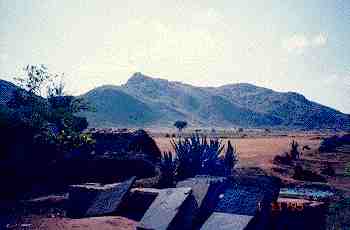
A view of the hills surrounding Chennekothapalli village

The Collective is based in Chennekothapalli village, roughly one hour by bus from Anantapur town. The region is described as semi-arid tropics as there is very little rainfall.
A view of the hills surrounding Chennekothapalli village
The economy of this region revolves around agriculture. Many of the villages in this region are poor because of the traditionally unreliable rainy season, exacerbated by the degradation of the land as a result of abusive agricultural techniques.
The objective of the timbaktu collective is to make a lasting improvement in the lives of the farmers. They encourage the practice of permaculture- a sustainable and eco-friendly form of agriculture which eschews the use of artificial fertilizers and chemical pesticides. They organize women's sangams (informal unions of sorts) to deal with problems faced by women and to encourage them to save money. Lastly, they run an alternative education program as a part of which they operate a day school in each of six villages and a residential school in 'timbaktu', the land they bought to practice permaculture on. These schools are meant for children who have dropped out of the local government schools.
The driving philosophy of the group with respect to education is that it should be a joyful experience for children. They believe that children drop out of conventional government run schools because they are beaten and taught in an unimaginative manner and not because of economic pressures (to drop out and work so as to earn). They believe that the villagers realize the importance of education, and would like their children to be educated.
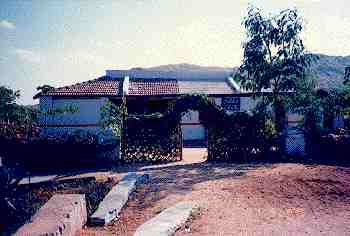
The school in Chennekothapalli village, the first school set up by the collective
The type of education they offer is 'alternative' in the sense that it does not resemble the conventional form of education. For instance, there are no rigid grades for the children. Instead, the children belong to broad groups (named for animals) consisting of children of various ages but of similar capabilities. There is a great amount of interaction between the children and their teachers, and the children learn through participation, questioning and doing things and not through rote learning. A strong sense of identity with the village is inculcated in the children. They are taught traditional songs and dances and village lore in the schools. What is most striking about the children is how very happy and self-assured they are. girls are given special attention because traditionally, it has been the girl child who has been most neglected, and saddled with burdensome responsibilities early in life.
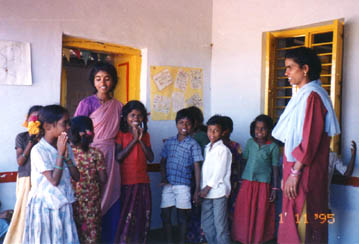
A few of the children at the Chennekothapalli school
In addition to education, the collective also provides health care to the children and the villagers. The various activities of the timbaktu collective are neatly integrated to spark self respect and pride among the village community. The collective works with the adult to encourage the use of traditional,sustainable agricultural methods. It runs schools where the children are taught traditional crafts and lore. The women's sangams it runs in the various villages encourage the women folk to save some petty cash every month, so that the families are not prey to moneylenders.
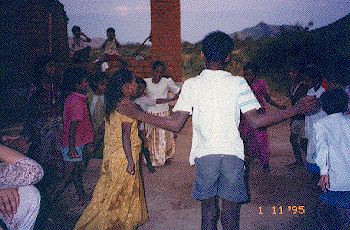
Children dancing at the residential school in Timbaktu
These funds go towards sustaining the operation of the village schools, including the purchase of books and other learning aids for the children.
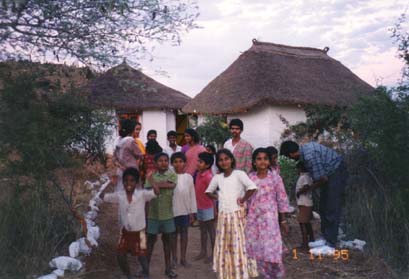
Some of the children of the residential school, outside their hostel
