C2005/F2401 '09 Recitation Problems #3
1. You have a protein. Its molecular weight is 144,000. If you treat the native protein with either mercaptoethanol or urea, the molecular weight is unchanged. If you treat the native protein with both mercaptoethanol and urea, you get what appears to be a single type of component with a molecular weight of 18,000. After treatment with both reagents, only one band is detected on SDS gels or starch gel electrophoresis without SDS [large pores], and in the ultracentrifuge. (After treatment, the mercaptoethanol and/or urea are removed by dialysis, and the protein is kept in dilute solution.)
A. The quaternary structure of the native protein is held together by (weak bonds) (covalent bonds) (both) (neither) (can't tell from info given).
B. Suppose you suspect that there is more than one type of subunit in the native molecule. So you treat the native molecule with mercaptoethanol and urea and try to separate the denatured protein into several components. If there really are 2 (or more) different types of subunits, which of the following methods is most likely to separate them? (dialysis) (gel filtration) (paper chromatography) (column chromatography based on solubility) (gel electrophoresis) (hydrolysis) (any of these should work)
C. The native protein has 16 free SH groups per molecule. If you treat the native molecule with urea and mercaptoethanol, the 18,000 molecular weight component that you get has 6 free SH groups per 18,000. (Assume for this part that there is only 1 type of subunit in this protein.) If you treat the native molecule gently with mercaptoethanol alone, you do not change the molecular weight, but you get a protein with 32 free SH groups per molecule. Now if you add urea AFTER the gentle mercaptoethanol treatment, the molecular weight is reduced from 144,000 to 18,000. The 18,000 component obtained in this way has 4 free SH groups per molecule.
Given all information so far, answer the following:
C-1. How many subunits (polypeptide chains) are present in each native molecule? _____________
C-2. How many cysteine residues are present in each subunit? ___________
C-3. How many S‑S bonds are present in each native molecule? _____________
C-4. How many S‑S bonds are formed within each polypeptide chain (connecting different parts of the SAME chain)?______________.
Draw a picture of the enzyme that fits all the data. Be sure it shows all S‑S bonds and all free SH groups in the native enzyme.
D. Suppose there is only one type of subunit in this protein, and it contains 90 amino acids. The subunit has a net charge of +7 at pH 1, and a net charge of 0 at pH 7. The number of glutamate + aspartate residues in this polypeptide is: __________.
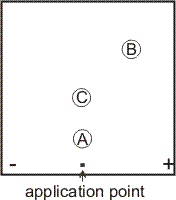
2. Suppose you subject the oligopeptide below to fingerprinting using Enzyme A, a proteolytic enzyme that hydrolyzes polypeptides after (i.e., on the carboxyl side of) amino acid residues with a negatively charged side chain. All operations are carried out at pH7. The resulting fingerprint with 3 spots is shown below. If does not appear, click here.
gln-lys-ser-thr-glu-val-ile-phe-pro-glu-arg-phe-leu-val-glu
A. Show where Enzyme A cleaves by drawing vertical lines through the sequence.
B. Below each segment write the letter of the spot that corresponds to that segment.
C. Suppose you did not know the sequence but could sequence the sub-peptide in each spot. Explain whether or not you would be able to deduce the sequence by repeating the whole experiment using trypsin, which cleaves after amino acid residues having a positive side chain.