C2005/F2401 '06 -- Lecture 19
-- Last Edited: 11/15/06 04:24 PM
© Copyright 2006
Deborah Mowshowitz
and Lawrence Chasin Department of Biological Sciences Columbia University New York, NY.
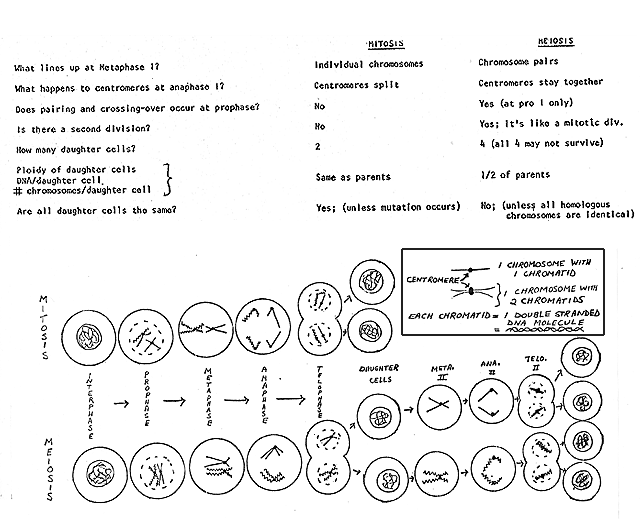
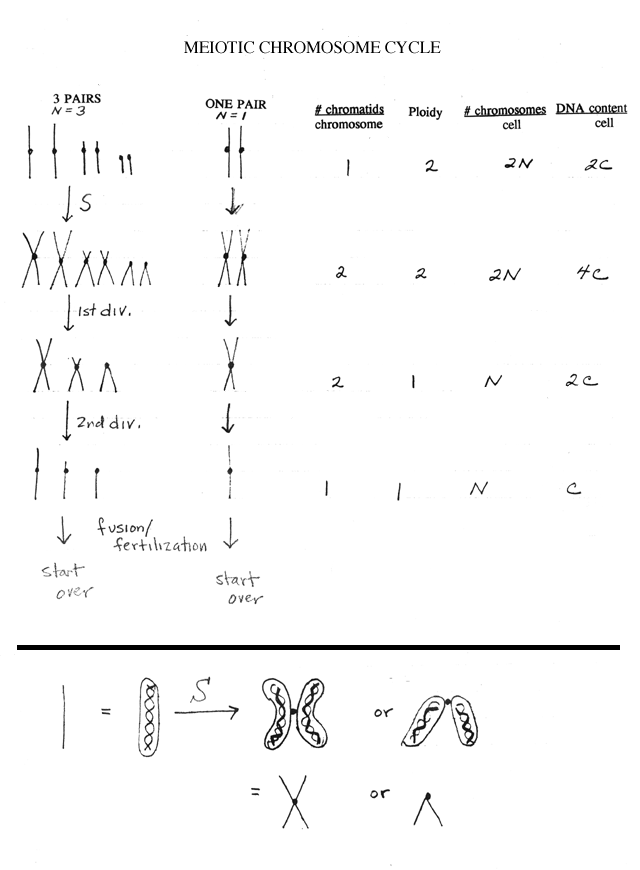
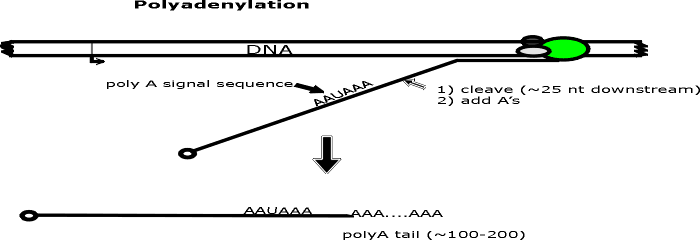
Handouts for today: 19A = Meiosis/Mitosis ; 19 B = Meiotic Chromosome Cycle ; 19 C = Euk. RNA processing (Not on web)
I. Eukaryotic RNA Processing, Cont.
A. Additional Processing steps -- caps and poly A -- most eukaryotic transcripts that will be used as mRNA must be modified on both ends (as well as spliced) before they can be transported to the cytoplasm and used for translation. A "cap" is usually added to the 5' end and a "poly A tail" to the 3' end. The steps involved generally precede splicing and are shown on handout 19C. (Numbers below match steps on handout.)
(1) Beginning of transcription. The start of transcription is usually indicated by a bent arrow. (The boxed areas of the DNA = exons; plain DNA between them = intron.)
(2). Capping. A modified G is added to the 5' end of the transcript shortly after transcription begins, while the transcript is still being made. The G is added "backwards" so there is a 5' to 5' connection. The structure of the cap and how it is connected to the transcript is shown on the bottom of 19C. The cap is represented on the handout as a filled circle.
(3) Transcription continues to or slightly beyond the end of the gene or transcription unit. There may be no fixed stop for transcription in eukaryotes (for production of most mRNA); the addition of poly A (see below) may determine the exact 3' end of the transcript. (Note: most but not all eukaryote mRNA's contain poly A. Also in eukaryotes production of rRNA, tRNA and mRNA is carried out by different RNA polymerases which have somewhat different properties. For details see texts.)
(4 & 5). Polyadenylation. A poly A tail -- a string of A's a few hundred long -- is added to the 3' end of the RNA. (Growth is 5' to 3' using ATP and splitting off pyrophosphate as usual.) The sequence AAUAAA is the signal for the appropriate enzyme to cut the transcript a bit downstream and add a string of A's. (Downstream = in the 3' direction on the mRNA or sense strand.) Note that the A's on the 3' end and the G of the cap are not encoded in the template DNA. On the handout cleavage of transcript = step 4; addition of poly A = step 5. These two steps may occur simultaneously.
(6) Nothing has happened to the RNA in step 6 except that it has been labeled to indicate exons and introns. By the time the transcript is released from the DNA it already has a cap on the 5' end and a poly A tail on the 3' end. This RNA -- modified on both ends but not spliced -- is usually called the primary transcript or pre-mRNA. (But see below at *.) The RNA is now ready for splicing (steps 7-9 on 18A). See also Becker fig. 21-23 [19-23] or Purves 14.9 (14.11).
*Some texts refer to unmodified RNA as the primary transcript, but such a state doesn't really exist since the pre-mRNA is modified before it is released from the DNA.
B. Do exons and translated regions coincide? See diagram at bottom of 18A or 19C. Note that the start and stop signals for translation are not at the ends of the exons -- the exons include untranslated regions (5' UTR's and 3' UTR's or leaders and trailers). Therefore the exons are not = protein coding sequences, as some texts imply. (The diagram in Purves 14.4 (14.6) is incorrect.) Exons = sections of genes that are represented in the mRNA. Exons include untranslated 5' and 3' regions as well as the translated regions.
1. Leaders. At the 5' end, there is a 5' untranslated region (UTR) or
leader before translation begins (before the first AUG) that is part of the
first exon.
2. Trailers. At the 3' end, there is a 3' UTR or trailer that is after
the stop codon that is part of the last exon.
Is an exon a "coding region"? It is a "coding region" in the sense that it codes for mRNA, but NOT in the sense that it (necessarily) codes for protein. Exons contain sequences that are represented in the mRNA but do not code for amino acids.
C. Alternative splicing
A gene with more than one intron can be spliced in more than one way, so it can code for more than one protein. For example, consider a gene with 2 introns, such as the one shown at the beginning of this lecture. It could be spliced twice, removing both introns, to produce a message containing exons 1, 2 & 3. Alternatively it could be spliced once, joining the 5' splice site of intron #1 to the 3' splice site of intron #3. This would produce a message with exons 1 & 3. These two messages would code for related but different proteins. Alternative splicing of the same transcript is known to occur in different tissues or at different times. (Some examples will be discussed next term.) Thus "proteomics" or the study of the proteins encoded in the DNA has emerged as an area different from "genomics" or the study of the DNA sequences alone.
For a review of processing etc., try problem 13-15 parts A-C.
II. Problems/issues of Cell Division
A. So we know how prokaryotes divide. How do
eukaryotes do it? First let's consider how individual cells (or unicellular eukaryotes)
→ 2 and then how a multicellular organism → 2.
B. How do individual eukaryotic cells do it? Eukaryotic cell structure and implications
1. Structure
a. Many chromosomes (multivolume encyclopedia as vs one vol.) = genetic material is divided into several pieces.
b. Chromosomes are linear and not attached to anything.
c. Much more DNA per cell and more per piece. 2-5 X 10⁷ BP per euk. chromosome (or more); clearly > million; E. coli only 3 million BP total and all in one chromosome/piece. Also replication forks move more slowly (so replication takes longer even for same # nucleotides).
d. Chromosome and cell structure is more complex. Entire nuclear & chromosome structure as well as DNA must duplicate.
Chromosomes are in a separate compartment = the nucleus. In prokaryote, entire cell is one compartment.
More complex chromosome structure in eukaryotes; DNA is complexed with proteins called histones. Tune in next term for details.
|
Comparison of Organization of Genetic Information in Eukaryotes & Prokaryotes |
||
|
Property of Chromosomes |
Prokaryotes |
Eukaryotes |
|
Number |
one |
many |
|
Shape |
circular |
linear |
|
Attached to something? |
yes |
no |
|
Size |
3 X 10⁶ base pairs for E. coli |
2-5 X 10⁷ base pairs/ av. chromosome |
|
In separate compartment? |
no (no nucleus) |
yes (in nucleus) |
|
DNA associated with histones? |
no |
yes |
2. Resulting Problems -- how will cell get DNA (& histones) doubled in time and distributed properly?
III. Basic Eukaryotic solution -- Have 2 different states of nucleus & DNA, and separate times (& states) for synthesis and distribution. Both states have DNA in double helix and super coiled with proteins. The issue here is super-super coiling.
A. State one -- interphase (between divisions)
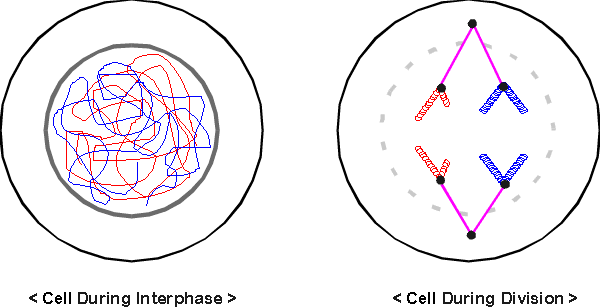
1. Chromatin. DNA (& histones) not visible as individual structures. Form tangled mass called chromatin -- relatively loose coiling, accessible to polymerases for transcription and replication, not ready to distribute. No distinct structures visible in microscope.
2. Nuclear membrane (and nuclear structure) intact -- nucleus organized for RNA and DNA synthesis, processing, transport, etc. = chromatin in separate compartment
3. No spindle -- chromosomes not attached to anything.
4. All transcription and replication occurs in this stage
B. State two -- during divisions
1. Chromosomes. DNA (+ proteins) visible in microscope as individual structures called chromosomes. DNA tightly coiled, easy to distribute but not accessible to enzymes of replic. and transc. (condensed > 10,000 X). Individual balls of string (in this state) vs unwound, tangled mess (between divisions). Chromosomes can look like J's, V's, rods or X's, depending on how the parts are connected and what stage of division you are looking at; see below.
2. Nuclear membrane (compartmental separators) disassembled . Disassembly is temporary -- membrane components not lost, just taken apart into subunits. (Lego castle disassembled -- will be reassembled into two smaller castles after division).
3. Spindle -- have set of fibers attached to chromosomes (and to structures at poles). Assembly of spindle is temporary -- fiber components are not new, but were rearranged to form a new structure. (Building blocks rearranged -- take apart one structure and build another using the same pieces.)
4. No transcription or replication in this stage.
C. Reminder: all eukaryotic DNA is in double helix, supercoiled, AND associated with special proteins called histones at all times -- it's super-supercoiling and association with additional proteins that changes.
IV. Cell Cycle
A. What is it? Look at what goes on during the various stages as a single cell goes from newborn (small; just made by cell division) to double-size = ready to divide again → division → start over. This called the cell cycle. See Becker fig. 19-1 (17-1) or Purves 9.3 (9.4).
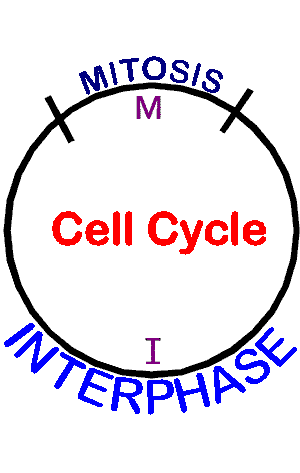
You can divide the cycle into 2 major stages: I (interphase) and M (mitosis or division). The picture below puts the element of time in -- cell goes around and around. The two stages of I and M corresponds to the two states of DNA described above.
B. When is DNA made? Can I (interphase) be subdivided?
1. DNA made in I, prior to M.
Pictures: Doubling of DNA prior to M is often implied by pictures of doubled chromosomes at start of M. This was not obvious when M first discovered, because two parts of a doubled chromosome can stick together and look like one structure.
Terminology: Whether chromosomes are single or double refers to whether the DNA has been replicated yet or not. A 'single' or 'undoubled' chromosome does NOT contain single stranded DNA. It contains double stranded DNA that has not replicated yet. See chromatids and chromosomes below and/or see box on 19A or middle panel of 19B.
2. Stages -- Can I be subdivided? Does DNA replication take all of I?
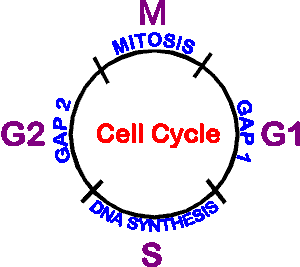
a. G-1. There is a period in interphase, after division but before DNA made; this is called G-1 or gap 1.
b. G-2. There is a period after DNA is made but before division which is called G-2 or gap 2.
c. S. DNA is made in the middle of interphase -- the period when DNA
is made is called S, for Synthesis (of DNA)
Therefore interphase can be divided into G-1, S (period of DNA synthesis) and
G-2 as follows:
3. How were stages discovered?
If you supply radioactive T (T*) when cell isn't in S, the T* doesn't get into DNA. In other words, cells don't make radioactive macromolecules (from T*) when they are in G-1, G-2 or M. (If supply labeled/radioactive U or aa, it's different. These precursors are made into macromolecules throughout I.)
4. Lengths of stages. FYI only -- Typical lengths of stages for mammalian cells:
S about 8 hrs; M = 1, G2 = 3 and G1 = 3 to 12 (in culture); >12 in adult tissues. G-1 varies most; more details next term.
5. Replication of Eukaryotic DNA -- The replication fork in eukaryotes moves more slowly than the fork in prokaryotes. Therefore getting the DNA replicated in time (since S is so short) is a complex process requiring multiple origins of DNA replication and other details which we will skip for the time being. Next term we will discuss some of the complications and regulation of the stages of the cell cycle. For now we will assume DNA can be replicated properly and packaged into chromosomes (with histones) and we will concentrate on how the DNA is distributed to the daughter cells.
V. Chromosomes, Chromatids and Centromeres. See handout 19B middle panel, and box on 19A.
Chromosomes at start of cell cycle (before S) contain one double-stranded DNA molecule. Chromosomes after S contain two double-stranded DNA molecules. How are these DNA molecules related and/or connected? (Remember you can't see the chromosomes during interphase.)
Terminology: By the end of the cell cycle, chromosomes are doubled -- each chromosome has two (identical) parts called chromatids (sister chromatids) which are connected (by proteins) at a section of the chromosome called a centromere.
How much DNA per chromatid? Each chromatid contains one double-stranded DNA molecule.
Sister/Sibling Chromatids: The DNA molecules in sister chromatids are identical because they are the two products of a single semi-conservative DNA replication.
How many chromatids per chromosome? Before S, each chromosome has one chromatid (containing one double-stranded DNA molecule); after S each chromosome has 2 chromatids (each containing one double-stranded DNA molecule).
Centromere position. The centromere = the structure connecting the two sister chromatids. The connection forms at a specific region of the DNA (with a specific sequence). The connecting material itself is protein. The centromere can be at the end of the chromosome or in the middle, so a doubled chromosome containing two chromatids can look like a V or an X. (The term 'centromere' can refer to the region of the DNA where the connection forms, or to the structure connecting the two chromatids.)
Double vs single chromosomes. Whether a chromosome is said to be single or double refers to the number of chromatids per chromosome. Not to whether the DNA in the chromosome is double or single stranded. The DNA is always double stranded.
To review the terminology, try problem 8-0, 8-1, parts A-B, and 8-2 Parts A-C. If you are feeling very confident, try 8-6.
VI. Mitosis (see handout 19A) First let's go through stages as shown. See Purves 9.8 or Becker 19-20 & 21 (17-19 & 20). When we get to meiosis we'll compare and contrast the two processes (mitosis & meiosis) as listed in table on handout (& see Purves 9.17). Important points to notice about each stage of mitosis.
Interphase: All DNA is doubled (in S prior to division) before M.
Prophase: this stage is reached when you can see chromosomes (as opposed to just chromatin) and nuclear membrane starts to break down. Chromosomes are doubled (2 chromatids/chromosome) but the two sister chromatids can stick together and appear as a single unit. So chromosomes may not look doubled (in microscope) even though they are. When they don't look doubled, the centromere is often visible as a constricted region of the chromosome.
Metaphase: Chromosomes achieve the maximum degree of condensation; all chromosomes are lined up in the same plane (metaphase plate) = slice through equator on handout. Idea of mitosis is to separate or segregate sister chromatids, so the chromatids line up in pairs. (In meiosis, chromosomes, not chromatids, will line up in pairs.)
Anaphase: Separate sister chromatids; each chromatid now becomes a full fledged chromosome and is pulled to pole by its centromere. Can appear V or J or rod shaped, depending on position of centromere. (Pulling done by spindle fibers; not shown on handout. For pictures see Purves 9.7 (9.9) or Becker 19-22, 24 & 25 (17-21, 23 & 24). See Becker for details of spindle and mechanism of chromosome movement if you are interested. More details will be discussed next term. For now, emphasis is on where the genetic material ends up.)
Telophase: Start putting cells back to normal. Start reassembling nuclear membrane, decondensing chromosomes, and starting to divide cytoplasm. (See Purves 9.10 or Becker fig. 19-28 & 29 (17-27 & 28) for how cytoplasm is divided.)
Daughter cell stage: End product of mitosis = two cells with genetic information identical to that of original.
To review mitosis and the cell cycle, do problem 8-13.
VII. Karyotypes
A. What are Karyotypes and how do you get them?
There are drugs that stop cells at metaphase (the drugs interfere with spindle fiber function). So what? This allows you to conveniently collect lots of cells at metaphase and look at the chromosomes.
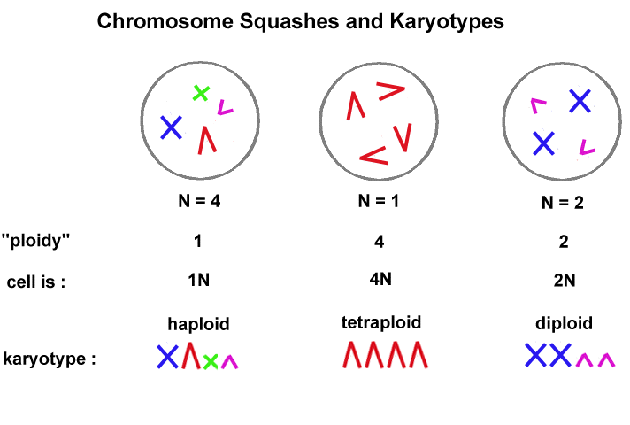
1. Chromosome squash. Can squash cells in plane of metaphase plate and see all chromosomes spread out. Picture of this = chromosome squash. (See picture below or handout 19B or Purves 9.13, left.)
2. Karyotype. If make squash, cut out each chromosome and line them up in order of size, this = karyotype. Gives standard pattern for each species. (Squash is harder to analyze, if there are a lot of chromosomes, since chromosomes are in random order.) See picture below or Becker fig. 19-23 (17-22) or Purves 9.13.
B. What do you see in a normal squash or karyotype? (Banding, and Topics 4 & 5, may not be covered in this lecture; if so they will be discussed next time.)
1. Can see number of chromosomes, size and shape (determined by position of centromere) for each chromosome and can identify each individual chromosome by banding techniques. (Banding = procedure to stain chromosomes with standard dyes; different dyes give different patterns of dark and light regions. Each band = block of 100's of genes, not a single gene.)
2. Each species has a standard karyotype with a fixed number of chromosomes. You can use similarities and differences to evaluate relationships between species and to detect certain abnormalities which we will discuss later. Same number in all body (somatic) cells and in each generation.
3. Important general features of a (normal) karyotype
a. "N" -- Number of different types of chromosomes is called N. For humans, N = 23.
b. Ploidy = number of chromosomes of each type. Cell can be
haploid -- 1N -- have one of each type of chromosome (for humans, this occurs in gametes -- eggs and sperm)
diploid -- 2N -- have two of each type of chromosome (for most multicellular organisms, this is the state in most body cells).
triploid (3N) or tetraploid (4N) -- has 3 or 4 of each type of chromosome. (Higher multiples of N are possible too.)
4. Human karyotypes -- sex chromosomes & autosomes. See Purves 9.13 for a real human karyotype. Many more examples can be found on the web. (Try the images on Google for a large assortment.) If you want to try making a karyotype for yourself, go to http://bluehawk.monmouth.edu/~bio/karyotypes.htm. For another simulation try http://www.biology.arizona.edu/human_bio/activities/karyotyping/karyotyping.html.
If you do karyotypes on human cells, you will discover that the pattern is different from males and female, as follows:
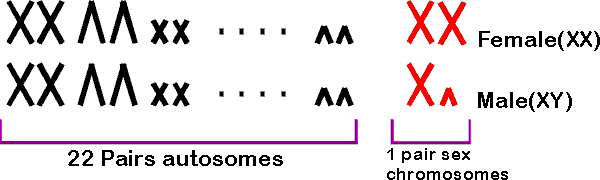
Both sexes have 22 pairs of chromosomes that look the same regardless of sex, but the 23rd pair is not the same in both sexes. In females, the 23rd pair consists of 2 large chromosomes that look alike. In males the 23rd pair consists of a large and a small chromosome that do not look alike but act as a pair during meiosis. The 22 pairs of chromosomes that are the same in both sexes are called autosomes. The remaining pair are called sex chromosomes, and the big one is called the X chromosomes and the little one the Y chromosome. So females are XX and males are XY.
5. Homologs
a. Definition:
Homologs = All the chromosomes of each type = all chromosomes of same size, banding pattern, & position of centromere (shape).b. Number: There are 2 homologs = 2 of each type of chromosome in diploid cells. One from mom, one from dad.
c. Relationship of genes on homologs; alleles. Homologs (except for sex chromosomes) carry homologous DNA. They carry the same genes, in the same order, in corresponding places (loci), but they do not necessarily carry the same version of each gene. For example, the gene for eye color is in the same place on both homologs, but the "eye color gene" on a particular chromosome could be the blue-determining or the brown-determining version. Each alternative version of a gene is called an allele. Each homolog carries one allele of the eye color gene. Homologs carry the same genes, but not necessarily the same alleles. Another example: Consider the gene for the beta chain of Hemoglobin -- the beta chain gene is always in the same position, but the chromosome could carry the Hb A or Hb S allele (version) in the Hb position (locus).
d. Sister chromatids vs homologs: Sister chromatids = 2 halves of a doubled chromosome. Why are they identical? Because they contain the two products of a semi-conservative DNA replication. Homologs need not be identical -- each came from a different source (a different parent). Important: be sure you know the difference between homologs (homologous chromosomes) and sister chromatids.
C. What can you see in an abnormal karyotype?
1. Types of visible mutations. Since you can do banding, you can tell all the chromosomes and chromosome regions apart. Therefore you can detect large abnormalities affecting whole chromosomes and/or large blocks of genes (so called "chromosomal" mutations) from looking at karyotypes. Many of these abnormalities are associated with known genetic conditions -- diseases and/or tendencies thereto. What can you see?
a. Rearrangements.
You can pick up extra, missing and rearranged pieces.
Note these are large changes. You can not see base changes or even changes of whole
genes -- only changes in large sections containing many genes (kilobases not bases) are
visible in karyotypes. (If large enough, loss, additions, inversions, or translocations are
visible.) Smaller changes must be detected using other methods.
b. Aneuploidy. Since you can tell all the individual chromosomes apart, you can see cases of
missing or extra chromosomes. Cells are normally haploid (N), diploid (2N) etc. Cells with
extra or missing chromosomes (2N + 1, or N -1, etc.) are called aneuploid.
2. Details of Aneuploidy
a. Terminology. The terms "monosomic" and "trisomic"
apply to diploid cells as follows:
(1). Monosomic or monosomy
= one chromosome missing = one chromosome has no partner (no
homolog), but all other
chromosomes still occur in pairs.
(2).
Trisomic or trisomy
=
one chromosome has 3 copies (3
homologs) but all other chromosomes still occur in pairs.
Note trisomic is different from triploid: trisomic means 3 copies of one type of
chromosome, say #2; triploid means three copies of all the chromosomes.

b. What types of aneuploidy are common?
(1). Trisomy 21. Most aneuploid fetuses abort spontaneously but a few survive to birth. The only autosomal aneuploidy that is not regularly lethal early in life is trisomy 21 or Down's syndrome. (Chromosome 22 may look smaller, but 21 is the autosome with the smallest amount of genetic information.) Individuals who are trisomic for chromosome 21 have multiple developmental problems which usually result in significant mental retardation, distinctive facial features and a tendency to develop Alzheimers at a relatively early age. (The gene coding for the protein that clogs the brain in cases of Alzheimers is on chromosome 21.) All these abnormalities are thought to be due to a "gene dosage" effect. All the gene copies are normal, but trisomics have 3 copies of the genes on chromosome 21 instead of 2. The extra copies of the genes produce extra protein (for a total of 3 doses instead of 2). The extra amount of protein is what messes up development.
a. Examples. Individuals are known who are XXY, XO (O stands for no 2nd sex chromosome), XYY, XXX etc. Humans who are XO are female, but have certain abnormalities called Turner's syndrome. Humans who are XXY are male, and have Klinefelter's syndrome.
b. What determines maleness? The Y or the single X? The sex of the aneuploid individuals described above indicates that it is the presence of the Y that is the male-determining factor in humans, not the absence of the second X. The human Y chromosome has very few genes, but it has one critical gene that triggers a sequence of events leading to male development; the default is female. (The case in fruit flies is different: XO flies are male, and XXY flies are female. In flies it is the ratio of X's to autosomes that determines sex.)
c. Why do XO and XXY survive? Why is an extra and/or missing X compatible with a more or less normal existence while a missing or extra autosome is almost always deadly? Because variation in the number of X's is "normal" -- females have twice as many as males, yet both males and females are "normal." So there must be a mechanism to cope with "extra" X's (or missing X's, depending on your point of view). This will be discussed next time.
d. Secondary Sex Characteristics. Most genes on X and Y have nothing to do with secondary sex characteristics (beard growth, breast development); most genes for secondary sex characteristics are autosomal (although some are on the X). Presence of Y determines which hormones are made and therefore which autosomal (and X linked) genes are turned on. If you add hormones externally, either sex can develop secondary sex characteristics of the other. Also note there is no correlation between unusual combinations of sex chromosomes and sexual preferences.
e. The birds & the bees. The mechanism of sex determination is similar in many other organisms, in that one sex has a matching pair of chromosomes (the homogametic sex) and the other has a non-matching pair (the heterogametic sex). Which is which, and the fine points of how the balance determines sex, varies. The sex ratio (males/females) is about 1:1 in all these cases because the heterogametic sex produces male-determining and female-determining gametes in equal proportions. (In birds, the female, not the male, is the heterogametic sex. In bees, one sex is diploid and one is haploid -- an extension of the sex-is-determined-by-chromosome-balance principle to the whole set of chromosomes. So when they say they are going to tell you about the birds and the bees, it's not a good way to explain human sex!)
How do aneuploidies occur? Next time. To review mitosis and karyotypes, try problem 8-8 parts A-D, & G.
VIII. Ploidy and the need for meiosis
A. Karyotype of a species is constant, so N and ploidy stays constant from generation to generation.
B. How is ploidy kept constant?
1. Need for meiosis/reduction division
Most of the cells of most higher organisms are diploid. Humans, for example, have 46 chromosomes, or 23 pairs, in virtually all of their cells. If eggs and sperm also have 46 chromosomes, the next generation, formed from the fusion of an egg and a sperm, would have 92 chromosomes. But clearly the chromosome # does not double each generation. So the eggs and sperm, unlike all other cells, must have only 23 chromosomes and be haploid. So there must be a way to make haploid cells from diploid cells. There is, and the process is called meiosis. During meiosis, one chromosome from each pair is picked at random so that the resulting haploid has 23 chromosomes instead of 23 pairs. Then 2 such haploids fuse, during fertilization, to give you back a diploid with 23 pairs.
2. Why bother with all this? Why sex?
After all, you could start the next generation with one complete diploid cell from either parent and save yourself a lot of trouble! Some organisms do reproduce this way, at least some of the time, but most organisms engage in sexual reproduction. They probably do so because each cycle of meiosis, followed by fusion, allows for a new combination of chromosomes. (Crossing over, which occurs at meiosis, also allows for new combinations of genes within chromosomes as well.) So it looks like sexual reproduction is useful because it allows reshuffling of the genetic material (same argument as for bacteria). Reshuffling is needed to give
new variety (for selection to act on) and/or for repair (& replacement) of damaged copies.3. How reshuffling works
a. Reshuffling
Chromosomes.
Suppose one person has 2
identical copies of chromosome #1 and 2 identical copies of chromosome #2. (Draw these
chromosomes in one color, say pink.) Another person has 2 copies of chromosome #1 that are
the same as each other but different from the copies in the first person, and similarly
for chromosome #2. (Draw these chromosomes in another color, say white.) The offspring
of these two people will have a mixture of "pink" and "white
chromosomes. After several generations, it will be possible to get all conceivable
combinations of "pink" and "white" chromosomes.
(See problem 8-4 parts A & B.)
b. Reshuffling genes:
IX. Meiosis -- Overview of the Chromosome Cycle -- Probably next time.
A. What happens to chromosomes during meiosis? (See handout 19B.)
1. DNA synthesis occurs first -- before division. Meiosis is preceded by DNA duplication just as mitosis is. During the S before meiosis (or mitosis) the cell doubles the DNA content and # of chromatids per chromosome. So cell starts with pairs of doubled chromosomes = 4 copies of each chromosome.
2. Products: There are 4 products, each haploid (from meiosis), instead of 2 products, each diploid (from mitosis). To cut the number of copies of each chromosome from 4 to one requires 2 division, not one.
3. Two divisions of meiosis: The first division of meiosis separates homologs; the second division of meiosis separates sister chromatids.
4. What happens to N, c and # of chromatids/chromosome? The first division cuts the chromosome number per cell in half from 2N to N and cuts the DNA content per cell in half from 4c to 2c ("c" is defined below). The second division halves the DNA content per cell (from 2c to c), halves the number of chromatids/chromosome (from 2 to 1) and halves the total chromatid # per cell (from 2N to N). What happens in a cell with one pair of chromosomes is as follows:
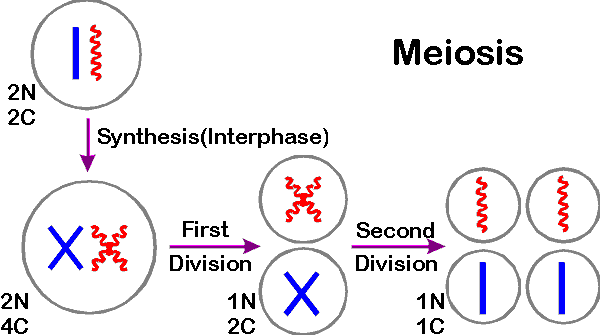
Handout 19B summarizes c, N etc. for cells with one chromosome pair (N = 1) and for 3 pairs (N = 3). Handout shows chromosomes per cell at each stage (before S, after S, after 1st div. of meiosis and after 2nd div.)
See Becker fig. 20-3 (18-3) for a similar diagram of meiosis in a cell with 2 pairs of chromosomes.B. Definition of c
"c" is a measure of DNA content per cell, not the number of chromosomes or chromatids.
c = minimum DNA content per haploid cell of an organism = DNA content of haploid cell before S (with unreplicated chromosomes) = DNA content of one set of chromatids. C is NOT equal to N; c is the DNA content of N chromosomes (with one chromatid/chromosome).
To review Meiosis (so far), and compare to Mitosis, do or finish problems 8-1, 8-2 (parts A to E), 8-3, & 8-8 (parts A-D & G). Details of meiosis next time or see handout 19A.
Next Time: Whatever parts of
meiosis/mitosis we don't finish and then life cycles and nondisjunction (how
aneuploidy occurs).