C2005/F2401 '06 Lecture #22
© Copyright 2006
Deborah Mowshowitz and Lawrence Chasin Department of Biological Sciences
Columbia University New York, NY
Last Updated:
12/04/2006 05:14 PM
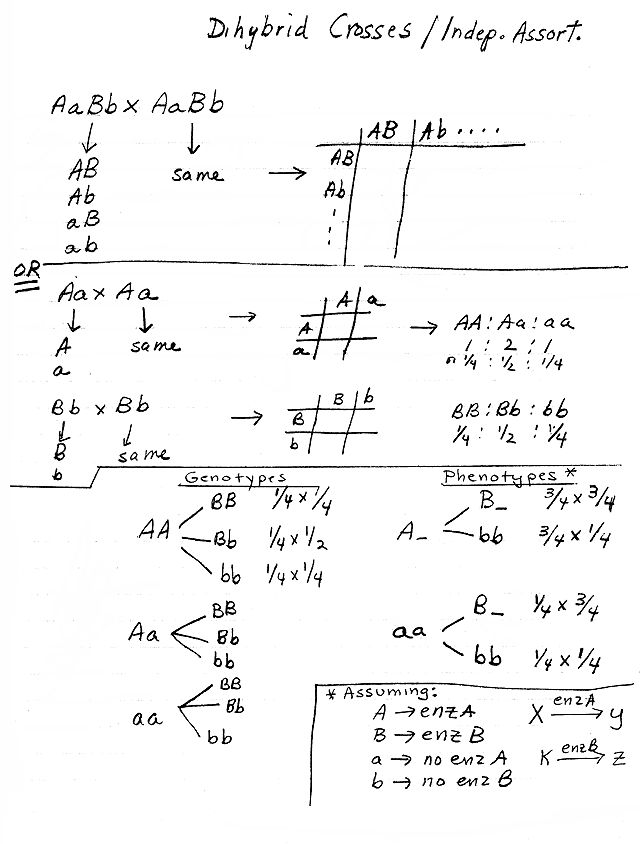
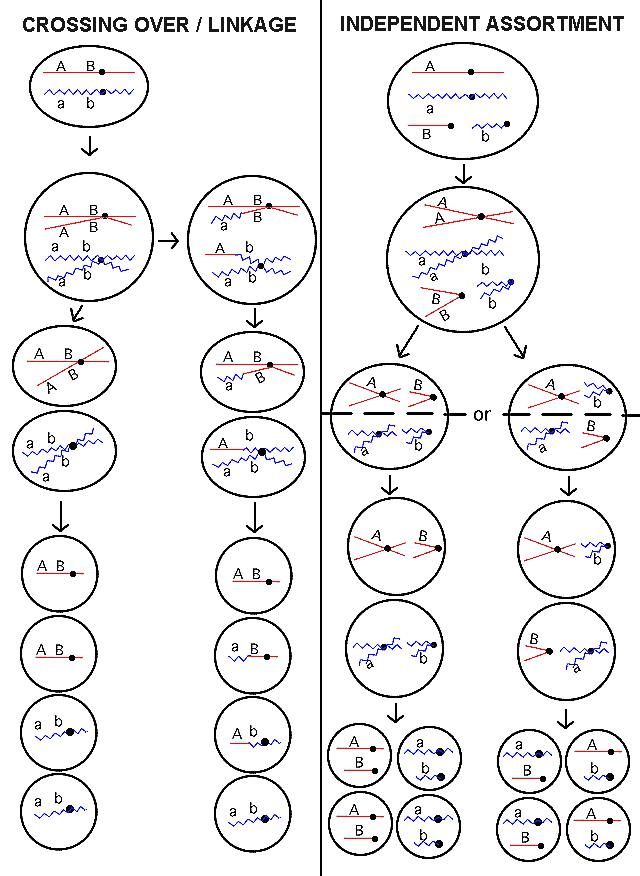
Handouts: 22 A (Dihybrid Crosses) and 22 B (Independent Assortment & Linkage).
I. Crosses with Multiple genes (on separate chromosomes) -- Genotypes
A. Consider a dihybrid cross (for example) AABB X aabb. What will the offspring (F1) be?
1. Procedure: Same procedure as with monohybrid crosses (such as AA X aa) -- figure out the gametes, and mix them to get zygotes.
2. Results: In this case (AABB X aabb), first parent must produce AB gametes and second parent ab gametes, so all zygotes must be AaBb = F1. (If you think gametes of first parent could be AA or BB, you should convince yourself why you are wrong. Put the genes on homologous chromosomes, go through meiosis, and see why only AB gametes are possible.)
3. Terminology: A monhybrid cross gives an F1 that is hybrid for 1 gene. A dihybrid cross gives an F1 that is hybrid for 2 genes, and so on.
B. What will gametes of AaBb be? See handout 22B
Suppose you want to cross the F1's (AaBb) from above to get the F2. How do you do it? Repeat standard procedure as in previous cases. Figure out gametes, then zygotes. So let's figure out the gametes of AaBb. What do you expect? (handout 22B or Becker fig. 20-16):
Let's start with the simplest case: Independent Assortment/Separate Chromosomes. (See right panel of Handout 22B, or Becker fig.20-15 or Purves 10.8). Other cases are considered later.
C. What will the zygotes be for the case of independent assortment? See Handout 22A.
1. Using a Square: Can make a 4 X 4 Punnett square with gametes (AB Ab, aB, ab) on each side and fill it all in. (See Purves 10.7 for an example.) These method is tedious, subject to error, and unwieldy when crosses involve more than 2 genes. In order to use this method to get the gametes and do the square, we have to assume that the two genes assort (are distributed) independently. If this is so, there is an easier way to figure out the offspring -- the branch method.
2. Using the Branch/probability method: This is another way to figure out what zygotes are expected, and in what proportions. This method works for any number of genes as long as they assort independently. This is the "branch" method (shown on your handout; it is just the application of elementary probability).
a. Figure out what would happen if you did the cross with one gene (here Aa X Aa). Use a small square if you don't remember. In this case results will be three genotypes, AA, Aa, aa in ratios of 1:2:1.
b. Figure out what would happen if you did the cross with the other gene(s), here Bb X Bb.
c. Put the results together.
(1) Number of possible different genotypes: Since the alleles of the A gene and the alleles
of the B gene are distributed independently, any expected A genotype can go with any
expected B genotype. This gives the following possibilities:
AA with BB, Bb or bb; Aa with BB, Bb or bb; aa with BB, Bb, or bb. (This is most easily
followed using a branching diagram as shown on the handout.) This shows that 9 different
genotypes are expected; the square gives the same result.
(2)
Proportions of different genotypes:
Figure out the chance of each A combination (AA, Aa, or aa) and of each B combination; chance of any particular combination (say aaBb)
is the product of the individual chances (= 1/4 X 1/2 for aaBb).
The general rule is: if the chances of any two (alternative) outcomes are known, the
chance of both happening at the same time is their product.
d. Important: Don't panic if probability is not your strong point.
All the probability you need to handle genetics (at the level of this course) is as follows: The chance of this AND that both happening = chance of this TIMES chance of that. The chance of this OR that happening = chance of this PLUS chance of that.) See Purves 10.9.
Note: the "or means add" rule only works if the two alternatives are mutually exclusive. For example, you can't be both AA and Aa at the same time, so chance of being one or the other is the sum of the two chances. If the alternatives can both occur, the rule is different. (Famous example: Suppose there is a chance of 50% that it will snow today, and a 50% chance tomorrow. What is the chance it will snow either today or tomorrow? The answer is not 100%!)
e. How this works for crosses with many genes. Suppose you have a cross involving more than two genes, such as AaBBccDd X aaBbCCDd. If all genes assort independently, you can figure out the results for each gene (Aa X aa; BB X Bb etc.) and multiply the probabilities to figure out the chances of getting some combination such as AaBbCcDd. In this case, that would be 1/2 X 1/2 X 1 X 1/2.
To review independent assortment, try problem 10-1 (A-C).
II. Crosses with Multiple genes -- Phenotypes
A. One gene -- One Trait. (Two genes & two traits overall, but each gene controls only one trait or characteristic.)
Assume the simplest case -- complete dominance of A over a and B over b; each gene affects a different trait. (A sample set up, as shown on handout 22A, would be A → one enzyme; B → different enzyme; each enzyme acts in a different pathway.)
1. How many phenos? In the simplest case, there are 4 different phenotypes corresponding to A_B_; A_bb; aaB_ and aabb. A_B_ gets both the "A" job and the "B" job done, aabb does neither and so on.
2. How many of each pheno? In this case, you need to know what proportion are A_ (= what is chance of getting A_)? A_ = AA plus Aa. If chances of AA and Aa are known, chance of either one = sum of the two chances. From Aa X Aa, 1/4 should be AA and 1/2 Aa so 3/4 should be A_. By the same reasoning, 3/4 should be B_. What proportion should be A_B_? That's 3/4 X 3/4 or 9/16. Using this reasoning, one can get the famous ratio of 9:3:3:1; that is, the proportions of the 4 phenotypes should be 9/16: 3/16:3/16:1/16. To say it another way, 9/16 should be able to do both jobs, 3/16 able to do the B job or A job (but not the other) and 1/16 should be able to do neither.
To review the genotypes and phenotypes expected in cases like this (independent assortment, and one gene/one trait) try 10-1 part D, 10-2, 10-3 & 10-5.
B. One gene -- Two (or many) traits.
Suppose one gene → 1 peptide. This one peptide can have multiple direct or indirect effects. This is called pleiotropy. In this case, one gene affects several traits. (For an example, see Waardenburg syndrome, described in problem 10-18. )
C. Two (or more) genes -- One Trait.
Suppose 2 genes → 2 peptides. Both genes/peptides can affect the same trait, for example by affecting the same or different steps in a single pathway. Examples:
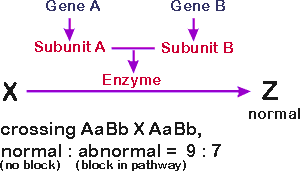
1. Two genes control a single step.
Suppose 2 different peptides → 1 enzyme (with two subunits). Enzyme catalyzes, say, X
→ Z. Then an absence of either gene product will cause a block in the same step (X to Z).
Therefore, aa B_, A_bb and aabb will have the same phenotype - - in all these cases, X to
Z will be blocked, so X will not be broken down and/or Z will not be made. If you do the
cross AaBb X AaBb, the ratio of normal to mutant phenotypes will be 9:7. (In this case,
normal is often called Z+ or X+, since it is able to make Z and/or break down X, while
mutant is called Z- or X- since it is unable to make Z and/or breakdown X.)
If X is colorless and Z is colored, say black, then phenotypic ratios will be 9:7
black to colorless.
2. What if the 2 genes affect different steps in the same pathway?
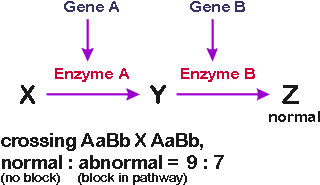
Now suppose the 2 peptides (products of genes A and B) catalyze different steps in the same pathway. For example, suppose enzyme A, product of gene A, catalyzes X → Y while enzyme B, product of gene B, catalyzes Y → Z.
a. Z+ vs Z-. If
you define normal phenotype as ability to make Z, then defect in gene/enzyme A or
gene/enzyme B produces the same effect = a block in the pathway. (Although a different
intermediate will build up in each case.) If you are only interested in ability to make Z,
a cross of AaBb X AaBb gives normal: mutant phenotype in a ratio of 9:7. (Same ratios as
case discussed last time).
If you are only interested in color, and both X and Y are colorless (but Z
is pigmented), then ratios will be 9:7 of pigmented (normal) to colorless
(albino).
b. Epistasis. If X and Y serve different functions (other than to make Z) and/or X, Y and Z are different colors (as indicated below), then a block in X →Y looks/acts differently than a block in Y → Z. For example shown, aaB_ or aabb is white/colorless; A_bb is brown, and A_B_ is black. In this case, if you define phenotypes by color, a cross of AaBb X AaBb --> offspring with three phenotypes in ratios of 9 (black): 3 (brown) :4 (white). This type of situation is known as epistasis -- effects of gene A (when it is aa) override (are epistatic to) the effects of gene B. In other words, if genotype is aa, it doesn't matter what the state of the B's are -- aa__ is always white. The gene controlling the first step is said to be epistatic to the gene controlling the second step. (For a similar case, with a picture, see Purves 10.15)
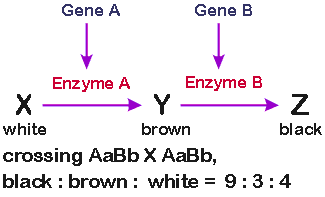
c. Epistasis vs Dominance. Epistasis is sometimes confused with dominance, as both cases refer to how the effects of one allele or gene overrides the effects of another. However they are quite different.
1. Dominance refers to the effects of one allele overriding the effects of another allele (of the same gene). For example, A is dominant to a.
2. Epistasis refers to the effects of one gene overriding the effects of another gene. For example, gene A (really the aa genotype) is epistatic to gene B.
d. General Case. For each pathway you can think of, there will be a characteristic number of phenotypes and ratios of phenotypes (From AaBb X AaBb). From the pathway you can predict the ratios; from the ratios you can often deduce the pathway. Note: If genes are on the X (sex-linked), or there is incomplete or co-dominance, that will affect the ratios and numbers of phenotypes as well (although the underlying principles are the same). See problem set 10 for examples and to test your understanding.
To get practice in matching up patterns of inheritance and the underlying metabolic pathways, try 10-4, 10-15 & 10R-5.
III. Introduction to Linkage and crossing over -- Suppose gene A & gene B are on the same chromosome. What are the genetic consequences?
A. What gametes do you get? (Left Panel of Handout 22B)
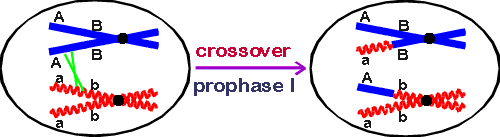
Suppose two genes, A and B, are on the same pair of homologs. In any particular meiosis, there can either be no crossover in the region between between the 2 genes (case at far left on handout) or there can be crossovers in the region between the 2 genes. The results of a single crossover are shown in the right side of the left panel on handout 22 B; also see picture below.
1. If there is no crossover between genes A and B, what gametes will you get? Only 2 kinds, AB and ab, in equal proportions. (This is assuming that you start with AB on one homolog and ab on the other.)
2. What if one crossover occurs between the two genes? In that case, the equivalent parts of two homologous (not sister) chromatids are exchanged (see handout) switching an A and an a allele. What gametes will you get this time? The result will be 4 different gametes, two that are AB and ab (the parental combination), and two that are Ab and aB (called recombinants). See Purves 10.19 or Becker fig. 20-17.
B.
Terminology:
1. Parents. You can start with
AB/ab or Ab/aB. Letters before slash = alleles on one chromosome (from one parent);
alleles after slash = alleles on other homologous chromosome (from other parent).
This way of writing the genotype of a diploid is used because it is easy to
type. Although it is the standard way of writing genotypes, it is often easier
to understand what is happening if you draw out the two homologs and write the
alleles in the corresponding positions (loci) on each homolog. For example,
instead of (1) AB/ab or (2) Ab/aB draw out
| (1) | (2) | |
| ----A--------B---- | or | ----A--------b---- |
| ----a---------b---- | ----a--------B---- |
2. Products of Meiosis. Products of meiosis (gametes or spores) can be classified as parental or recombinant
Parental = has alleles that were on one homolog in the heterozygous parent = combination of alleles you started with (before meiosis).
Recombinant = has a new combination of alleles on one homolog.
| Diploid Parent | Parental Gametes/Spores | Recombinant Gametes/Spores |
| AB/ab (1 above) | AB and ab | Ab and aB. |
| Ab/aB (2 above) | Ab and aB | ab and AB |
3. Linkage
a. Definition: Genes are said to be linked if there are more parental gametes than recombinant ones. Linkage is said to be zero when the number of recombinants and parentals is equal (see d).
b. Mechanism: If the two genes of interest, in this case genes A and B, are relatively close together, most meioses will occur without a crossover between the genes, and most gametes will be the parental type. (In this case, most meioses take the far left fork on 22B.) However there may be some recombinant type gametes from the meioses with a crossover. (These are meioses that take the right fork -- of the left panel on 22B.)
c. Linkage and Distance: The number of recombinant gametes and the number of meioses that take the right fork (of left panel on 22B) will increase as the distance between A and B increases (up to a point). As distance & the number of recombinants increases, linkage decreases. How linkage and distance are treated numerically will be discussed later.
d. Genes on the same chromosome can act unlinked. If A and B are on the same chromosome, but relatively far apart, then meioses can occur with multiple cross over events (not shown on handout). If A and B are far enough apart, they can be switched back and forth multiple times, so that on the average they are equally likely to end up switched or not. So if A and B are very far apart on the same chromosome they will act unlinked -- that is, they will assort randomly = you will get all 4 kinds of gametes in equal proportions. (Same result as if the genes were on separate chromosomes.)
C. What is the significance of all this? Why does linkage and crossing over matter?
1. Biological significance. Crossing over allows more combos by reshuffling existing alleles and/or mutations. Without crossing over, the same alleles would remain together on each chromosome (homolog) indefinitely. Allowing more combos provides more raw material for natural selection/evolution. Crossing over also allows repair -- if a and b are defective alleles, crossing over allows you to get a chromosome with both A and B from Ab plus aB.
Note: In eukaryotes, crossing over occurs only at prophase I of meiosis. It doesn't occur at mitosis. Therefore, crossing over only affects the next generation, not the generation in which it occurs. If crossing over occurs in the germ cells of a multi-cellular organism, the gametes of the organism are changed, but the somatic cells of the organism are unaffected.
2. Laboratory and/or medical significance. The frequency of crossing over between genes provides positional information that allows the making of maps, and linkage can be exploited for predictive purposes and other applications, as explained below.
To review the expected gametes and terminology, see problem 10-6 esp. B-C. (More details on terminology are below in V.)
IV. An example of the use of linkage -- How the HD gene (the gene that causes Huntington's Disease when defective) was located and cloned.
A. Without a marker (linked gene) -- Who will get HD?
1. The Problem. Symptoms of HD don't develop until late adulthood (usually). Disease is dominant; causes degeneration of nervous system. (HD allele causes disease; hd is the normal allele that does NOT cause disease.) What gene or protein involved was unknown (until recently, when gene isolated). How to tell who will get the disease?
2. Prediction (pre-linkage). Suppose there is an affected parent and normal parent. They have a kid. What is chance kid will have HD? Since cross is probably HD hd X hd hd, kid has 50% chance of getting disease. So kid will have to wait 40-50 yrs to find out if s/he has disease or not, well after deciding whether or not to have kids. This is not optimal!
B. With a marker -- Who will get Hd?
1. The Idea. Suppose you have a parent who is AB/ab, and genes Ay and Bee are closely linked. Then if a kid inherits allele A, s/he will probably get allele B but if kid inherits the 'a' allele s/he will probably get the 'b' allele. In a similar way, if you have a gene linked to the HD locus, then you could infer which allele of HD the kid got from which allele of the linked gene was inherited. In the case of HD, and many similar diseases the "linked gene" was really not a gene but a variable section of the DNA called a polymorphism. (Actually an RFLP -- see handout 17A.)
2. Polymorphisms. There are regions of the DNA that are very variable. These regions are said to be polymorphic because they come in multiple forms (with different base sequences). These highly variable regions often occur in sections of the DNA that do not affect phenotype -- in spacers, introns etc. These various forms or polymorphisms are important (even though they have no effect in phenotype) because the variations can be used as the basis of identifications, as previously explained. These differences can also be used as "genetic markers" that can be followed through crosses. You can follow the multiple forms of the DNA sequence through a pedigree just as you would alleles A vs a or B vs b.
3. Haplotypes. A polymorphic section of the DNA comes in multiple versions that are distinguished by their differences in the number and/or lengths of fragments generated by PCR, restriction endonuclease digestion, etc. Each version is often called a haplotype. A haplotype is similar to an allele in that it is one alternate version of a DNA locus. The term "allele" is usually used to refer to a section of the DNA that has a known function; differences in alleles are reflected in differences in phenotype. The term "haplotype" is usually used to refer to a section of the DNA that has no known function (or whose function is irrelevant). Different haplotypes are distinguished by their differences in DNA sequence. The "phenotype" is the genotype = the state of the DNA. Just as different alleles of the same gene can be be followed through crosses, so can different haplotypes.
4. The details for HD (These may not all be covered in class.)
a. The polymorphism. The gene that causes HD (when defective) is linked to a polymorphic region with 4 alternatives, or haplotypes, known as A, B, C & D. These haplotypes are distinguished by how they are cut by a particular restriction enzyme. In the DNA near the HD gene, there are 4 restriction sites, of which two are invariant and two are polymorphic (variable).
Short Version: With respect to the polymorphic sites, a DNA molecule can be - - (A) , + + (B) , + - (C) , or -+ (D). The '+' means there is a sequence recognized and cut by the enzyme; a '-' means the sequence is not recognized by the enzyme. The haplotype is determined by digesting the DNA and doing a Southern, using a probe to the region between the two invariant sites. (See table below.)
Long Version: The DNA looks like this:
| ↓ | (1) | (2) | ↓ | ||||
| <-------------10kb-------------> | <-----4kb------> | <-----------8Kb----------> | HD or hd allele |
Sites marked with a vertical arrow are not polymorphic; (1) & (2) are polymorphic sites. In some individuals (1) is mutated and so is not cut by the restriction enzyme; in others, (2) is mutated and in some people, both are mutated. Any individual DNA molecule/chromatid/chromosome can be cut at one or both of the variable sites, so there are 4 versions (haplotypes) of this region:
| Haplotype | Site (1) Cut? | Site (2) Cut? | Size of pieces | # of pieces |
| A | - | - | 22kb | 1 |
| B | + | + | 10, 4, 8 kb | 3 |
| C | + | - | 10 & 12 kb | 2 |
| D | - | + | 14 & 8 | 2 |
People have 2 chromosomes, so they have a mixture of pieces that depends on the sites on both chromosomes, but from the set of pieces you can tell if a person is AA or AB etc. See below and problem 10-17 for an example of how to analyze a family tree using these RFLP's. (Note that the problem refers to the marker region as the A/B/C/D gene.)
The linkage between HD and the RFLP was discovered by analyzing the pattern of inheritance of HD and the pattern of inheritance of the A/B/C/D polymorphism. The polymorphism can be used as a "marker" to indicate which chromosome the child has inherited from the affected parent, as in the example below.
b. An example: Suppose normal parent is AA and affected parent is AB and HD, and you know (from family history) it's A HD/B hd (HD allele on same chromosome as A). If kid is AB, will s/he be likely to get HD? If kid is AB, and there was no cross over, kid got chromosome from affected parent with B & hd and kid will be okay. If kid is AA, kid will get HD (if there was no crossover). Note that you need a family history to know whether affected parent is A HD/ B hd or A hd/ B HD.
c. Additional Details
(1). A test like the one described above (using linkage between a polymorphic region and the HD gene) was used for
predicting inheritance of HD until the gene itself was isolated. (Now you can test for
the sequence
of the gene itself.) Many other similar
procedures have since been developed for predicting inheritance of other genetic
diseases.
(2). Phase. Does HD (or whatever disease we are talking about) always go with same particular haplotype of the A/B/C/D region (or whatever the linked marker gene is)? No. In any particular family, HD can go with any version of the A/B/C/D region. It depends which haplotype (A, B, C or D) was on the chromosome at the time the original mutation of hd → HD occurred.
(3). Effects of crossing over. The closer the linked marker (such as A/B/C/D) is to the disease gene, the more accurate the predictions can be, because the lower the chance of crossing over between the "marker" and the actual disease gene.
To review linkage of HD to the A/B/C/D locus, see problem 10-17. For additional examples of using polymorphisms as "markers" to follow in crosses, see 10-18 (A-D), and 13R-4 to 13R-6. (13R-7 is a good review.)
C. Positional Cloning. Problems of phase and crossing over (see above) can be eliminated by identifying the gene itself. How to do that? The HD gene and many other disease genes have been located by their linkage to a polymorphism. The genes were cloned (see below) on the basis of this "positional information" -- their position relative to some variable site.
1. How do you find a gene responsible for
a hereditary disease?
In the "old days" scientists would find out what
protein was missing/abnormal and use this info to pin down the gene responsible.
(From knowledge about the protein you'd get the mRNA and make a cDNA probe, or
make an oligonucleotide probe, etc. Then you'd use the probe to find the gene.) The
standard approach was to go from protein to gene. This was considered "forward"
or standard genetics. (Backwards relative to central dogma, but the classical way of doing
it.)
Nowadays, scientists have done all the cases that can be easily
done this way. Now we have lots of inherited diseases where the protein that is
defective is unknown. What to do? You find a gene or marker (spot in the DNA) linked to
the disease gene (by pattern of inheritance) and use linkage = position = to find the gene
(as explained further below). Then you sequence and decode the gene to see
what protein it makes. This is "reverse" genetics or positional cloning; first
you find the gene (by what it is linked to) and then you figure out what protein the gene
codes for (from the DNA sequence).
2. Why examining and/or isolating a gene itself is better than
following a linked marker
a. No need to worry about crossovers between
the marker and the allele that causes disease.
b. No need to worry about phase -- don't have
to figure out which allele of marker (really which haplotype) goes with the disease allele
in that particular family.
c. From gene sequence, can get protein sequence
and hopefully get hints on treatment and/or do gene therapy. This has not led to much
practical treatment so far, but many methods of gene therapy are currently in the works.
3. Chromosome walking -- How gene is isolated once its position
is known (we'll discuss idea/outline only, no details).
Once you know area where gene is (near some polymorphism) you isolate (clone)
regions of DNA nearby. It's called chromosome walking because you look at successive
overlapping sections of the DNA as you go down the chromosome, away from the
polymorphic site (usually
in both directions). * You keep looking at successive sections of DNA until you find one
section that is always messed up in diseased/affected individuals. (Messed up here means
clearly changed -- can 't be properly spliced, or translated, etc.) That section must be
the gene responsible for the disease in question.
* You cut up the DNA in a way that gives you a library (or libraries) containing overlapping fragments. You use a probe made of the end of one fragment to fish out the next, overlapping fragment. For a picture see here.
V. Details of Linkage and crossing over
A. How do you measure the extent of Linkage between genes A and B?
a. Recombination Frequency (RF) is used to measure the frequency of crossing over.
| RF | = Recombination Frequency | = % of meiotic products (gametes or spores) that are recombinant |
| = # recombinants/total products X 100 | ||
| = frequency of recombinants that are recovered |
b. Frequency of crossing over (between any two points on the DNA) is proportional to the distance between the points
c. RF is proportional to distance within proper range
B. How will an individual meiosis go? See handout 22B, panel titled "Crossing over/ Linkage" and/or diagram below. You start with parental chromosomes at meiosis (say AB/ab). What gametes will you get from a single meiosis? We've already considered two possibilities:
1. No Crossovers. If there is no crossover in a meiosis you get the outcome shown in "left fork" on handout from 22 and below. (All parental products). Becker 20-16, case (b).
2. One Crossover. If there is one crossover event in a meiosis you get the outcome shown in "right fork" on handout from 22 and middle case below (1/2 parental, 1/2 recombinant products). Becker 20-14 or 20-16, case (c).
There is a third possibility (included below, but not on handout 22B):
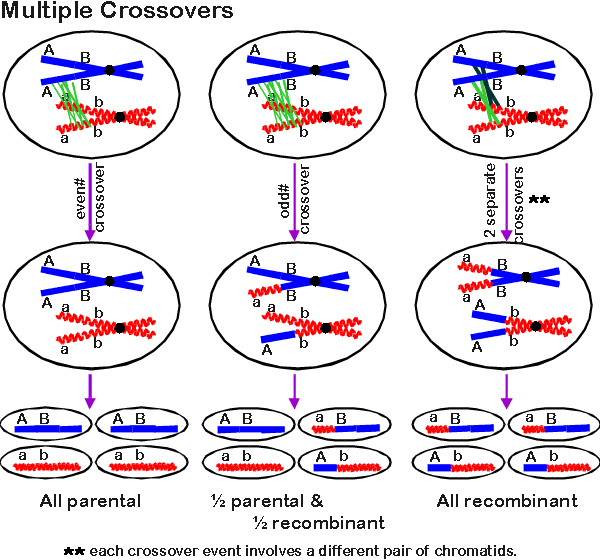
3. Multiple Crossovers. If there are multiple crossovers in one meiosis, there are several possible outcomes. Multiple crossovers (in any one meiosis) can give either all parental gametes or all recombinant gametes or 50 - 50. (Extreme right fork in diagram immediately below; details in second diagram below, called "multiple crossovers." Second diagram is included FYI only.) Note that these diagrams show the possible results of any one individual meiosis. If you look at the pooled results of many meiosis, you never get all recombinant gametes -- you never get more than 50% recombinants. (More details below.)
Possible Outcomes from Individual Meioses
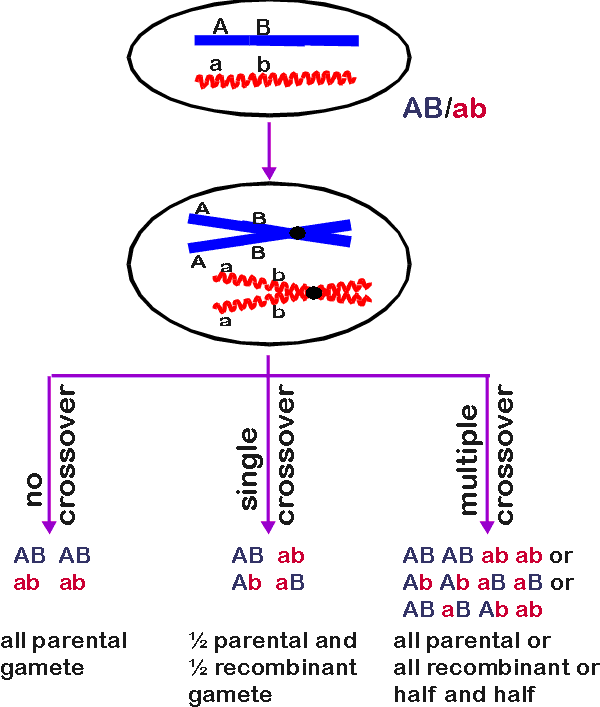
Figure below shows details for multiple crossovers. This figure is included FYI
for the experts.
C. How will Many Meioses Go, Overall? How RF changes with distance. (See table below.)
RF is calculated by examining the products of many meioses, not one. RF is used as an indication of the actual incidence of crossing over because we seldom examine the results of a single meiosis. Instead, we look at the total results from many meioses. The chart below shows the correlation between R.F., distance, type of individual meiosis, and types of gametes from a total of many meioses.
1. If A and B are very close -- Why min. value for RF is zero.
In this case, virtually all gametes will be parental, since almost all meioses take left fork (on 22B), so there are few if any recombinants. The minimum RF = zero. (Zero is a limit approached as distance from A to B --> zero.)
2. If A and B are close, but not that close -- Why RF is proportional to distance up to a point.
This time, most meioses will take the left fork but a few will take the right fork (on 22B). Therefore most gametes will be parental but some will be recombinant. As A and B get farther apart (up to a point), the # of meioses that take the right fork will increase, and so will the # of recombinants and the RF.
Once A and B get far enough apart, then multiple crossovers can occur -- a single meiosis can take the right or left fork or involve multiple crossovers. In this case, RF will not be proportional to distance, for reasons explained below.
3. If A and B are very far apart -- Why max. value for RF is 50%.
If A and B are very far apart, the average meiosis will involve multiple crossover events. The resulting gametes can be recombinant, parental, or a mixture, depending on whether the total # of crossovers is even or odd and whether crossovers involve same pair of chromatids (crossing over more than once) or more than one pair (a different pair of chromatids for each crossover). Any individual meiosis with multiple crossovers can give you all recombinant gametes, all parental, or half and half. The average result of many meioses with multiple crossovers is 50/50 parental and recombinant gametes. So if you look at many gametes from many meioses involving multiple crossovers, the total gametes will be 50% parental and 50% recombinant. This means that genes far apart on the same chromosome will assort independently just like genes on separate chromosomes [Becker 20-16, case (a) or Purves 10.8)]. In both cases, you will get 50% recombinants and 50% parental, or RF = 50 %.
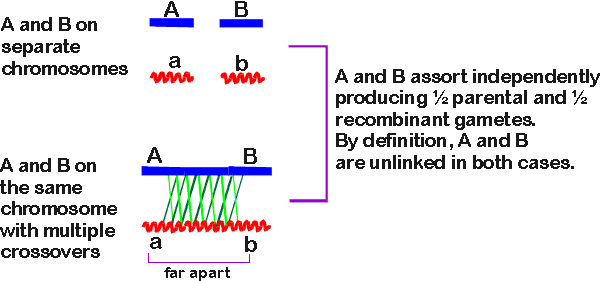
Note: whether genes are considered linked or not depends (by definition) on the ratio of recombinants/parentals. If the ratio is 1 (50% recombinants) the genes are considered unlinked (genetically), whatever the physical relationship of the two genes. All that matters is whether or not each allele of gene A (A or a), has a 50% chance of ending up in a gamete with either allele of gene B (B or b). How it happens doesn't matter -- if it does, the genes are said to be unlinked.
4. Summary Chart -- What Happens When A-B Distance Changes?
| Distance | per meiosis | from many meioses | Overall | Linkage |
| As A-B distance declines | left fork more often | all parentals | RF → 0 | Approaches 100% (complete linkage) |
| As A-B dist. increases | right fork more often | mostly parentals | RF is
proportional to distance |
Genes Linked (extent depends on distance) |
| As A-B dist. gets very large | multiple crossovers | 50/50 | RF levels off at 50% | Approaches none -- genes act unlinked |
To review the terminology and significance of crossing over, do problems 10-6 & 10-7.
Next time we will wrap up recombination & the genetics of individuals, and then discuss how you analyze the genetics of populations.
© Copyright 2006
Deborah Mowshowitz and Lawrence Chasin. Department of Biological Sciences
Columbia University New York, NY
Last Updated: 12/04/06 05:14 PM