C2005/F2401 '07 -- Lecture # 13 --
RNA & Protein Synthesis
Handouts: 13A -- Comparison of DNA & RNA synthesis; 13B -- Protein Synthesis.
© 2007 Deborah Mowshowitz and Lawrence Chasin
Department of Biological Sciences Columbia University New York, NY .
Last edited
10/17/2007 04:51 PM
I. Where does RNA come from?
You need lots of kinds of RNA to make protein -- tRNA, rRNA & mRNA (see
last lecture). How do you make the RNA? All RNA is transcribed
from a DNA template. See Sadava 12.5 (12.4) or Becker fig. 21-9 & 21-11 (19-9 & 19-11).
II. DNA synthesis vs RNA synthesis. The easiest way to go over RNA synthesis, given that we've discussed DNA synthesis at length, is to compare DNA and RNA synthesis. See handout 13-A
A. Basic mechanism of elongation is the same:
1. Use nucleoside triphosphates (ones with ribose not deoxyribose, but mechanism same) & split off PPi; use pyrophosphatase.
2. Chain grows 5' to 3' by addition to 3' end.
3. Need anti-parallel DNA template, put in complementary bases -- A (in template) pairs with U not T, but otherwise same {Q&A}
4. All RNA molecules (mRNA, tRNA and rRNA), not just mRNA's, are made from a DNA template. tRNA and rRNA molecules are not made from an "mRNA" template.
See problems 7-1 & 7-2.
B. Enzymes are different
1. Chain growth
Growth of DNA chain is catalyzed by DNA polymerase (and associated enzymes)
Growth of RNA chain is catalyzed by RNA polymerase.
2. Choice of Substrate. If you put all 8 XTP's in a test tube, what do you get, DNA or RNA? Enzyme (DNA vs RNA pol) is responsible for which nucleotides used.
RNA pol. uses ribonucleoside triphosphates.
DNA pol uses deoxyribonucleoside triphosphates.
See problem 7-5 A.
3. Products are different
DNA is long and double stranded
RNA is short and single stranded
4. Choice of Template is different.
Template = short section, one strand at a time (for RNA synth.) vs all of both strands (for DNA synth.)
Why? Because starts and stops are different. Starts & stops = sequences in DNA recognized by the enzymes = places where replication or transcription starts (or ends). These must be different for the two enzymes. See table on handout & below for more details.
C. Template Details
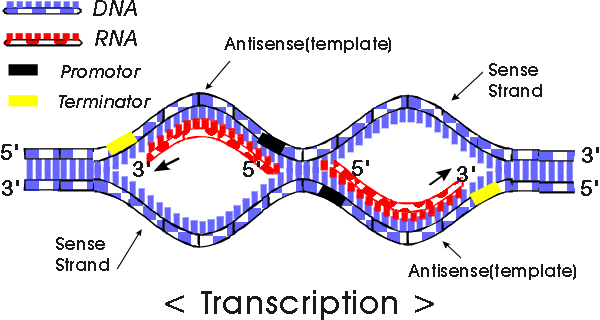
1. One Strand is Template for RNA polymerase. For any one gene or region, RNA polymerase uses Crick or Watson, but not both, as template. RNA that is made is complementary (and antiparallel) to the template strand. Note that an entire strand is not used as template throughout. The "Watson" strand of DNA is used as template in some sections and the "Crick" strand in others.
2. Continuous vs. discontinuous synthesis.
DNA synthesis: fork moves down DNA making complements to both strands; one new strand is made continuously and one discontinuously. Ligase is needed for synthesis of lagging strand.
RNA synthesis: RNA polymerase moves down DNA making complement to one strand or the other (in any particular region). Therefore RNA synthesis is continuous and doesn't need ligase.
3. Terminology
a. Transcribed Strand. Strand used as template is called the transcribed or template strand or the antisense strand (in that region). This strand is complementary to the RNA that is made.b. Sense Strand. Strand that is not transcribed (in that region) is called the sense strand or coding strand. The base sequence of this strand is identical to the RNA that is made (except that the RNA has U and the sense strand has T).
c. An entire DNA strand (going the length of a whole molecule) is not all "sense" or "antisense." "Watson" may be sense in one section and "Crick" may be sense in the other (as in the picture on handout 13-A). The terms "sense" and "transcribed" strand are defined for each section of the DNA that is transcribed as a unit (usually a gene or small number of genes).
d. Sense RNA. The usual RNA transcribed from the DNA is said to be "sense." (Sense RNA matches the sense strand of the DNA.) The complementary RNA, if it exists, is said to be "antisense." Some practical uses of "antisense RNA" are below.
e. Why this terminology? The sense strand (not the template) actually contains the information used to line up amino acids to make proteins. (Assuming the gene codes for a peptide.) When a DNA sequence is published, it is usually the sense strand that is given. Why? If the gene codes for a protein, the amino acid sequence of the protein is much easier to figure out using the sense strand -- you just consult the code table.
f. Additional notes FYI on terminology:
(1). Becker (and some others) call the sense strand the coding strand, meaning the "strand coding for protein." I prefer the term "sense strand" since coding strand could mean "coding for protein" or "coding for mRNA." (The term "coding strand" is almost always used the way Becker uses it, to mean "coding for protein.")
(2). The terms "template strand" or "transcribed strand" can also be interpreted in more than one way, but these terms are virtually always used to mean the strand acting as template for RNA synthesis (= the strand that is transcribed from, not the strand that is being made, during transcription). The template or transcribed strand is not the strand equivalent to the mRNA -- the template strand is the strand complementary to the mRNA.
4. Directions: Suppose you have a double stranded DNA template. If need to copy "Crick," RNA polymerase will go one way (say right to left -- actual direction will depend on which end of template is 5' end); if need to copy "Watson" RNA polymerase will need to go the other way (say left to right). What determines where RNA polymerases starts & which way it goes? See promotors, below.
See problems 7-3, 7-5C & 7-9.
D. Details for Starts and stops (see picture below = bottom of handout)
1. Promotors determine the direction of transcription. Promotor and enzyme are asymmetric; therefore once enzyme binds, the catalytic end of RNA pol. is "facing" in one direction, and that determines the direction of transcription (and therefore which strand will be template).
2. The promotor will be a double stranded sequence at the end of
the gene where RNA polymerase starts (= on 3' end
of template strand = on 5' end of sense strand). Going along the sense strand,
the way the gene is usually written (5' to 3', left to right) the promotor
is "upstream" of the gene.
See problem 7-8.
III. Sense & Antisense
A. Why use only one strand in any one region?
1. The function argument: Messenger RNA must be single stranded to fit in a ribosome and be translated. If RNA complementary to mRNA were present, what would happen? The "sense" mRNA and the "anti-sense" complementary RNA would hybridize. The resulting double stranded RNA wouldn't be translated. So even though the gene was present, and transcribed, it's protein product wouldn't be made. This is what would happen if both strands were transcribed. See Sadava fig.16.14 (16.11 in 7th ed, 17.12 in 6th).
2. The evolutionary argument: If both strands are used to make mRNA, you can't optimize one without messing up the other, and vice versa. If natural selection favors the sequence of one strand so that it has optimal function or coding activity, that automatically determines the sequence of the other strand. Natural selection can't simultaneously select for the optimal sequences of both strands (if each strand has an independent function).
B. Uses of "anti-sense" mRNA
1. What good is anti-sense RNA? Gene therapy (adding DNA) should allow you to replace a defective gene that is making an ineffective product. But what do you do about a gene that is making too much product, or making it when it shouldn't? In other words, how do you silence an over-active gene? This is an important question, because inappropriate or over expression of genes is thought to be a major factor in disease, for example, in allowing cancer cells to multiply when they shouldn't. Use of anti-sense technology should allow you to silence an over-active, or inappropriately active, gene. This technology has not been very productive so far, but the concept is important and there may be considerable potential in it. (However the use of RNAi will probably turn out to be more practical -- see below & handout from Times.)
2. How to add anti-sense RNA? There are 2 ways to do it:
a. Antisense mRNA can be added to cells. Since RNA is easily degraded, modified RNA's, more resistant to hydrolysis, are used instead of ordinary RNA's. (This hasn't worked very well, and the use of anti-sense to silence genes has been largely superseded by the use of RNAi, as explained see below.)
b. Antisense mRNA can be made in the cell from a second copy of the gene. The second copy is added by genetic engineering methods; it is inverted (relative to the promotor), so that the second copy of the gene is transcribed in the opposite orientation from the original copy. Inverting a gene relative to its promotor is equivalent to moving the promotor to the opposite end of the gene (and turning it around) thereby reversing the direction of transcription. The original copy is transcribed from the usual template ("transcribed") strand to make mRNA; the second copy is transcribed from the complementary ("sense") strand to make anti-sense RNA. The two RNA's hybridize to each other and neither RNA is translated.
3. RNA interference -- other effects of anti-sense
The presence of short double stranded
RNA segments in eukaryotes often leads to destruction and/or blocking of
translation of all mRNA's from
the corresponding gene. (In some cases, it may also inhibit production of mRNA
from the corresponding gene.) This phenomenon is called "RNAi" or RNA interference.
RNAi uses several normal cell enzymes,
and it appears to be a normal cell function. The enzymes cut up the double
stranded RNA into short ds pieces, called siRNAs (short interfering RNAs). Then
one strand is degraded, and the remaining 'antisense' strand hybridizes to the
complementary mRNA. The formation of the hybrid blocks translation and/or
triggers degradation of the mRNA by cell enzymes.
What is RNAi good for?
a. RNAi is used by cells as a defense against many viruses. (The replication of many viruses involves double stranded RNA.)
b. Regulation of translation in multicellular organisms. Very short microRNAs (single stranded) are made and used by cells in a process very much like RNAi. These short microRNAs act as antisense to regulate translation. Precursor RNAs are made that fold back on themselves to form hairpins. The double stranded hairpins are processed by the cell enzymes used in RNAi to make very short 'antisense' RNAs (called microRNAs). The microRNAs hybridize to mRNAs and inhibit translation. This type of regulation seems to be very important during development in normal muticellular organisms. See links above & Times Articles.
c. RNAi is used in laboratories to block production ('knock down' expression) of specific proteins. Very short double stranded RNAs are added to cells, or the cells are genetically engineered to produce the double stranded RNAs. There is a lot of interest in RNA interference, because it is easier to use and more effective than blocking translation with antisense RNA. RNAi has been used extensively (in lab experiments) to silence specific eukaryotic genes and see what happens (in order to determine the function of the genes).
d. Therapeutic uses. Many possible uses are currently being tested, and promising results have been obtained for treatment of macular degeneration. For a review of possible therapeutic uses of RNAi click here. (You may need to use a CU computer to reach this site.) Additional info is on the Nova/PBS site. See Becker Figs. 23-35 & 23-36 or Sadava fig.16.14 (16.11).
The 2005 Nobel prize in physiology and medicine was awarded to Fire & Mello for the discovery of RNA interference. See the article from the NYTimes. For more info on RNAi, try the Nova/PBS site or the Ambion site. For a diagram of how it works, click here.
To check your understanding of antisense, see problem 7-16, part C.
IV. Proofreading or Editing . Table on handout 13-A says DNA polymerase edits (proofreads) and cannot start new chains; RNA polymerase does not edit (does not proofread) and can start new chains. These properties are linked. We will not go into all the details, but the structure of DNA polymerase that allows editing (proofreading) prevents the starting of new chains. (Note: the term editing is sometimes used for another process, so the term 'proofreading' is preferable and is used below.)
1. What is proof reading?
Here is the normal elongation reaction catalyzed by DNA polymerase (to the right):
rxn1: Chain (n units long) + XTP ↔ Chain (n+1 units long) +PPi
DNA pol. can back up and hydrolyze (break) phosphodiester bonds it has just made (if the wrong base was put in). This is called proof reading or editing. When it proof reads, DNA pol. catalyzes the following reaction:
rxn 2: chain (n+1 units long) + H2O ↔ chain (n units long) + XMP
2. Proofreading is not the same as catalyzing the reverse of the polymerization reaction.
Any enzyme can catalyze its reaction in both directions, given the right concentration of substrates and products. Reversing the polymerase reaction would mean breaking the phosphodiester bond by adding pyrophosphate back and regenerating a dXTP like so:
(rxn 1 to the left): Chain (n+1 units long) +PPi ↔ Chain (n units long) + XTP
However, what proof reading does is not the reverse of rxn 1 -- it's the hydrolysis of the phosphodiester bond (rxn 2). Hydrolyzing or adding water across the newly made phosphodiester bond releases a dXMP (not a dXTP). Therefore hydrolysis is different from reversing the polymerase reaction.
Terminology:
The ability to remove nucleotides one at a time from the end of a chain is called exonuclease activity. (exo = from the exterior or end).The enzymatic ability of DNA polymerase used in proof reading removes nucleotides one at a time from the 3' end of a chain. Therefore it is called 3' to 5' exonuclease activity.
The enzymatic activity of DNA polymerase that removes RNA primer has a different exonuclease activity -- this enzyme removes nucleotides one at a time from the 5' end of the primer (not from the 3' end). It has 5' to 3' exonuclease activity.DNA polymerases are complex enzymes that have multiple subunits (peptide chains) and multiple enzymatic activities. The different enzymatic activities may be catalyzed by different subunits.
3. DNA polymerase can proof read, but RNA pol. probably does not
DNA polymerase has 3' to 5' exo activity but it is generally
assumed that RNA pol. *does not -- once
RNA polymerase catalyzes formation of a phosphodiester bond, the bond can not be
hydrolyzed by RNA pol. Proof reading allows DNA polymerase to back up and remove bases
(really nucleotides) that
were inserted by error. If a G is added at the end of a growing chain where an A should
have been (opposite a T in the template), the enzyme can back up and break off the G.
Then it can try again to add the correct base (in this case an A). This allows DNA polymerase to keep the error rate low, as befits an
enzyme that replicates the archival copy of the genetic information. See Sadava
fig. 11.22 (a) (11.19 (a)). It is generally assumed that RNA pol.
does not need to proofread, because RNA molecules are working copies that can tolerate a few errors
(and can be replaced by new copies transcribed from the DNA).
*Note: There is some evidence that some RNA polymerases do
have 3' to 5' exo activity and can proofread. How wide spread this is, and
important it is in reducing errors (compared to DNA proofreading) is not
settled. If you are interested in the experimental evidence for RNA
proofreading,
click here. Since RNA proofreading is not well established, we will ignore
it. The important point is to understand how a proofreading polymerase works and
how it differs from a polymerase that does not proofread.
The remaining two sections, 4 & 5, are FYI only. We are not going into the details in lecture, and you are not responsible for them.
4. FYI. How does proof reading work?
Every polymerase has a substrate binding site that includes the template, the
last nucleotide added to the growing chain and the next dXTP to be added. With
DNA polymerase, both bases, the one just added and the one about to be added, are checked each round to
be sure the bases match their complements in the
template. First, the last base added-template match is "rechecked" before the chain grows
any longer. If the last base added turns out to have been the wrong one (perhaps it was in
the wrong tautomeric form temporarily and mispaired with the template?), then the enzyme
backs up and removes the last base before trying to add another. Once the enzyme
checks that the last base added is ok, it checks the match between the base to
be added and the template. If there is a match, the enzyme catalyzes formation
of the phosphodiester bond. So each base - template
match is checked twice -- once when the base is about to be added to the growing chain and once
before the next base is added to it.
RNA pol. also holds 2 nucleotides that are
about to be linked by a phosphodiester bond and the template. But RNA pol. only
checks the pairing between the base to be added and its complement in the
template. So if the last base put in was wrong, so be it. No backing up or
corrections.
5. FYI. Why does proof reading affect ability to start chains?
DNA polymerase can not start chains because the
substrate binding site of DNA polymerase must hold both a nucleotide already part of a chain
(the one just added) as well as the next
nucleotide to be put in. There must be a phosphodiester bond that is already
made, so the 3' to 5' exonuclease will have something to hydrolyze, just in case
of a mismatch. At the start of a chain, there is no nucleotide already attached to the end of
a chain -- there is no chain. There are only two, unattached nucleotides. So DNA pol.
can't get started.
We assume that RNA pol. can start chains because its substrate
binding site does not need to hold a nucleotide that is already attached to a chain. It
can hold two nucleotides and hook them up.
An example of proof reading (which you should be able to do) is in problem 6-14, part B-4.
Reminder: All kinds of RNA (tRNA, mRNA & rRNA) are made in the same way from a DNA template. Product of transcription can be a tRNA, mRNA or rRNA. RNA is NOT used as template to make more RNA. So how do all three types of RNA "make protein?" That's the next question.
See problem 7-9.
V. Details of Protein Synthesis/Translation
What are the big issues? Same as for all non repeating polymers = Order, energy and enzymes!! We'll focus on order first.
A. How is tRNA used to line up amino acids (AA)? How is mRNA read?
1. The mRNA is read 5' to 3.' Translation usually starts at first AUG and ends at the first stop codon after the AUG.
a. Leaders & Trailer. The region before the first AUG is not translated. It is called a leader, or 5'UTR (un-translated-region) or 5'UTS (un-translated sequence). Translation generally stops before the end of the mRNA (at a stop codon -- UAG, UAA or UGA). The untranslated region after the stop codon is called a trailer, or 3' UTR or 3' UTS.
b. The Code Table. See handout 12B or texts for code table. Note that the code table lists the codons = sequence in mRNA which is equivalent to the sequence in the sense strand of DNA. Code table does NOT list anticodons. For details and pictures of initiation of translation, see Sadava fig. 12.11 (12.10) or Becker fig. 21-8 (20-8). More details below or next time. Note that some codons signify "stop", not an amino acid. AUG does double duty as both "start" and "methionine."
To be sure you understand how to use the code table, try problem 7-12, parts A & B.
2. 2 AA at a time are held in place by tRNAs (for forming peptide bond) -- see handout 13B. Why 2? because a ribosome can hold only 2 loaded tRNAs at a time that are hydrogen bonded to mRNA. (See details below.)
3. tRNA
molecules have both secondary and tertiary structure as explained previously See
Sadava fig. 12.8 (12.7)
or Becker fig. 22-3 (20-3).
Each tRNA molecule is doubled back on itself to form a cloverleaf with
double stranded sections (= secondary structure), and then sections of the
cloverleaf are folded further back on themselves (= tertiary structure). The
final folded tRNA molecule is about one codon wide. That way two tRNAs can
attached to neighboring codons without bumping into each other.
See problem 7-18.
3. How are the tRNA and AA connected? The AA is attached to the 3' end of its respective tRNA by a ester bond between the COOH end of the AA and the 2' or 3' OH on the final ribose (at the 3' end). This leaves the amino of the AA free.
4. tRNA/mRNA pairing is antiparallel -- All nucleic acids pair in an antiparallel fashion. So if mRNA is written in usual way (5' → 3'), then tRNA is lined up in the opposite way, 3' → 5'. (With the amino acid or chain on its left, 3' end.) Anticodon is often written 3' → 5' to make this clear. For ex., if codon is AUG, anticodon is usually written 3' UAC 5' not CAU (or it is written upside down).
B. How does the new peptide chain grow? See handout 13B or Sadava fig. 12.12 (12.11) or Becker fig. 22-10 (20-10).
1. Chain adds to newest AA. When each peptide bond is made, the growing chain is transferred (from the tRNA that previously held it) to the next amino acid (still attached to its tRNA), not the other way around, for logistical reasons. The newest amino acid is not added to the free end of the chain. Instead, the chain is added to the newest amino acid. (The current system allows the translation machinery to slide down the mRNA reading 2 adjacent codons at a time. The other way doesn't.)
Catalyst for formation of peptide bonds is called peptidyl transferase because the chain is transferred as described above. This catalyst is part of the ribosome.
2. Peptide chain grows amino → carboxyl. This follows because the amino acids are held down (attached to tRNA) by their COOH ends. So if chain must add to free end of next AA, must add to amino end of next AA. (Note for those who have had organic: From the point of view of mechanism, the electrons go the other way; the electrons of the amino attack the carboxyl.)
3. Energy for peptide synthesis. The energy derived from splitting the tRNA~AA (really the tRNA~chain) bond drives peptide bond synthesis. In other words, the AA-tRNA connection is a high energy bond. How it is formed at the expense of ATP will be discussed next time. (Additional energy is required to bind the AA~tRNA and move the ribosome down the mRNA, but we will ignore the energy details of those steps, as well as the proteins needed to promote them.)
4. Starts & Stops. The peptide chain starts at the first AUG and stops growing when the translation machine comes to a stop codon. There are no tRNA's for the stop codons, so there is no way that the chain can keep growing if a stop codon comes next. See Sadava fig. 12.13 (12.12) or Becker fig. 22-11 (20-11); more details below or next time.
C. Loading of tRNA
We see what happens if you have lots of loaded tRNA. How do you get AA on tRNA in the first place and/or how do you reload the tRNA once it gives its AA away? Loading requires enzymes and energy -- we'll look at it carefully next time. For now we'll just assume each tRNA is loaded with its respective amino acid,
To review protein synthesis so far, and the role of tRNA, try problem 7-21.
D. How do ribosomes fit in?
1. Important Structural Feature of Ribosomes (See Becker, fig. 22-2 (20-2) or Sadava fig. 12.10 (12.9.) Detailed Structure & Assembly of Ribosomes will be discussed next time. Ignore the T site shown in the 7th ed. of Purves/Sadava.
a. 1 site or groove for mRNA.
b. 2 sites for loaded tRNA (hybridized to mRNA) per ribosome -- These are called A and P; more details below. These sites bind both mRNA and (loaded) tRNA.
c. One site for unloaded tRNA This site binds binds empty, used tRNA before it is bumped off the ribosome. (It's called E for exit site). This site is sometimes omitted in diagrams of elongation. (The T site shown in the 7th ed. of Purves probably does not exist and should be ignored.) The E site binds tRNA but not mRNA.
d. All ribosomes are the same. Which protein is made does not depend on the ribosome.
2. How Ribosomes Function (See Becker fig. 22-7 & 22-10 (20-7 & 20-10) or Sadava fig. 12.12 (12.11.)
a. Attachment. When not in use, ribosomes come apart into subunits. (See handout 12B.) The cell contains a pool of subunits. When translation starts, one small subunit and one large subunit clamp onto the mRNA to form a ribosome and begin translation. When translation ends, the two subunits come apart, fall off the mRNA, and return to the pool -- ready to be used again.
b. Directions:
Ribosome moves down mRNA 5' to 3' (or mRNA slides through ribosome) as peptide is made amino to carboxyl.
Both peptides and
nucleic acids are both made/read as written, left to right.
How mRNA is made and how
it is translated happen to be in the same direction, but transcription and translation are
two separate processes (which are usually coupled in prokaryotes but not
eukaryotes).
c. A & P sites. The two binding sites for loaded tRNA are different -- 1 called A binds amino acyl tRNA & 1 called P binds peptidyl tRNA.
d. Translocation -- Movement of mRNA (& tRNA's) relative to the Ribosome.
(1). Differences between the A & P sites allow unidirectional movement. Before peptide bond is formed, AA-tRNA is in A site and peptidyl-tRNA is in P site. As soon as peptide bond is formed, tRNA in A site becomes a peptidyl-tRNA, and tRNA in P site becomes unloaded or empty tRNA, Since "wrong" types of tRNA are now in A & P sites, ribosome no longer fits properly and moves over one codon, shifting peptidyl-tRNA to P site, empty tRNA to E site and leaving A site empty to hold next AA-tRNA. The empty or unloaded tRNA is then released to be reloaded and used again.
(2). Which part actually moves? Ribosome or mRNA?
mRNA & ribosome: Move one codon relative to each other. On handout 13B, in steps 5 & 6, it looks like the ribosome moves one codon toward the 3' end of the message. Probably, the ribosome stays in fixed position and the mRNA advances one codon through the ribosome in the 5' direction, as shown in step 2 → 3. (In other words, if drawn correctly, the mRNA moves to left instead of the ribosome moving to the right.)
Messenger RNA & tRNA: These do not move relative to each other but are pulled together.
Note that the effect is the same whether the ribosome or the mRNA (& attached tRNAs) move -- the ribosome and mRNA are shifted one codon relative to each other and all the tRNA's shift down one site. Either way you look at it, the overall result is:
(3). Protein Synthesis uses up a lot of Energy. Movement and binding tRNA both require energy which we are ignoring. You probably need at least 5 P's split from ATP (or GTP) per AA added if you count all the steps involved, not just growth of peptide chain. So making proteins is a very expensive procedure, and making unnecessary proteins is very wasteful. As a result, there has been strong selection for efficient regulation of protein synthesis; how regulation works will be explained next time. (For involvement of GTP in translation see Becker figs. 22-8 &22-10 [20-8 & 20-10].)
To review how the A & P sites fit in, try problem 7-12, part C.
d. Polysomes.
More than one ribosome can read a single message at one time. The first ribosome attaches near the 5' end of the mRNA. Then the ribosome moves (see note below) down the mRNA toward the 3' end, making protein. Once the ribosome has moved far enough down, a second ribosome can attach behind it (on the 5' side) and follow the first ribosome down the message. As each ribosome moves toward the 3' end, making protein, another ribosome attaches after it until the entire mRNA is covered with ribosomes. The mRNA remains covered with ribosomes; although some ribosomes finish and fall off the 3' end, others continually attach at the 5' end. The mRNA covered with multiple ribosomes is called a polyribosome or polysome for short. Sadava fig.12.14 (12.13).Note: This description assumes that the ribosomes move down the mRNA, 5' to 3'. The result is the same if you assume the ribosomes stay put while the mRNA moves through the ribosomes, 5' end first. Once enough mRNA has slid through the first ribosome, a second ribosome can attach to the space on the 5' end and the mRNA can thread through that one next, and so on.
To review polysomes, try problem 7-16, part B.
VI. Starts & Stops. How do peptide chains get started? How does peptide chain growth stop?
A. Starts -- AUG is used for both 'start' and 'methionine'
1. How
does protein synthesis start? -- you need a special met-tRNA for the
P site.
If the P
site holds only tRNA's with chains, how will the first AA-tRNA fit on the ribosome? The
answer is that there is a special tRNA (initiator tRNA or tRNAmeti) which is used only in starting
chains. This tRNA carries met and recognizes the codon AUG, which is both the (only) codon
for met and the (only) start codon. This AA-tRNA is special in that it only fits in the P
site.
2. How does met get inserted in the middle of chains?-- you need a different met-tRNA for the A site.
If the tRNA for met fits in the P site, how will met be added to a growing chain? There is a second "ordinary" tRNA for met, one that fits in the A site. Both tRNA's for met recognize the same codon and carry the same amino acid, but one fits only in the P site and one only in the A site. The first (initiator tRNA) is used only to start chains and the other is used only in the middle of chains. Sadava fig. 12.10 or Becker fig. 22-8 (20-8) if you are curious about all the details of initiation.
3. Processing. Why don't all protein chains start with methionine? Met is usually removed from the amino end of the protein before the peptide chain folds up. This method of synthesis (having all proteins start with met) is chosen for ease of manufacture, not because met is needed for protein function. It makes synthesis easier but produces a product that needs alterations before use (removal of met). Post synthetic modifications such as removal of met are common (for all macromolecules, not just proteins) and are often called processing. It is not at all unusual for a modification or processing enzyme to take off a few amino acids or nucleotides here or there, add a group or cofactor, etc. These modifications are much more extensive in eukaryotes than in prokaryotes and will be discussed at length in later lectures and/or next term.
B. Stops -- No tRNA is involved
There are no tRNA's for stop codons, so a ribosome stalls when it comes to a stop codon. A tRNA with a peptide chain is now sitting in the P site, but there is no tRNA to fit in the A site. A protein called a release factor binds to the stop codon in the A site and triggers release of the completed peptide chain. Once the peptide is released from its tRNA, the tRNA falls off the ribosome and then the ribosome disassociates into subunits and the subunits fall off the mRNA. The peptide chain folds up and goes off to do its job, and the tRNA, ribosomal subunits and mRNA can be used again. Sadava fig. 12.12 or Becker fig. 22-11 (20-11).
To review starts and stops, try problems 7-12 G, 7-17, & 7-20 B.
Next time: Any details of the above we don't get
to, plus details of ribosome structure & function, tRNA loading, and wrap up of
translation. Then (1) what happens when macromolecular synthesis makes
mistakes, and (2) how is protein synthesis regulated in prokaryotes?
© Copyright 2007 Deborah Mowshowitz and Lawrence Chasin
Department of Biological Sciences Columbia University New York, NY