C2005/F2401 '08 Lecture #12 --
Wrap Up of DNA Synthesis; PCR; What is
RNA & What is it Good For? Next time: How is RNA Made?
© Copyright 2008 Deborah Mowshowitz and Lawrence Chasin,
Department of Biological Sciences, Columbia University New York, NY. Last updated
10/16/2008 10:05 AM
Handouts:
11-3 -- DNA Replication - Details at Fork & 12A -- PCR (Not on web.) 12B =
Comparison of RNA & DNA synthesis (Not on web).
Copies of all handouts are placed in the boxes outside Dr. M's office (7th floor
of Mudd) after each lecture. There should be plenty of copies if you want an
extra. Email Dr. M (dbm2) if we run out. Unclaimed exams are also in the
hall on the 7th floor of Mudd.
For all corrections in notes, current and previous editions of the problem book, etc., see the corrections page. If you find any errors, don't hesitate to email Dr. M.
Part I: DNA replication,cont. -- How does DNA do job #2?
I. Events at a DNA replication Fork
A. Review of Discontinuous Synthesis = Handout 11-3, top.
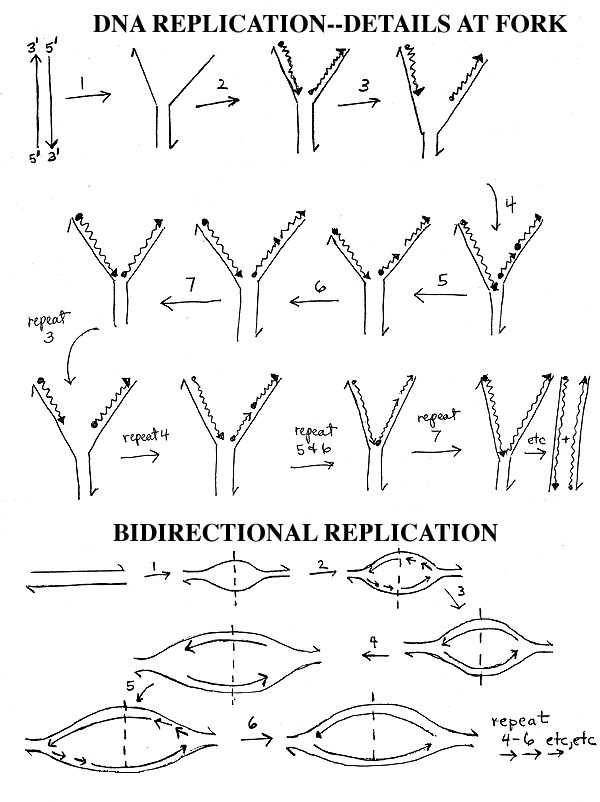
How does replication work with a real DNA molecule that is millions of base pairs long? See Sadava 11.18 (11.16 in 7th, 11.17 in 6th ed) or Becker 19-9. This is diagrammed on handout 11-3. The steps and letters listed below refer to the top diagram on the handout.
You don' t unwind the entire molecule and replicate each template strand separately. Instead you unwind a little of the double helix at a time, starting from one end (step 1), to give molecule A.
Then you replicate the short denatured region as above (step 2), to get molecule B.
Then you unwind a little more (step 3), to get molecule C.
Now one of the new chains (the leading strand, which is the one being made on the left on the handout) can keep on growing 5' to 3' in a continuous manner while the new section of the other chain (the lagging strand, the one being made on the right) must be made 5' to 3' in a retrograde fashion (step 4). This gives molecule D. The short, discontinuously synthesized fragments of about 100 - 1000 bases made in step 4 are known as Okazaki fragments after their discoverer. (See Becker 19-8.)
Skip steps 5 & 6 (and molecules E & F) for now. Steps 5 & 6 involve primers and are explained below.
If this retrograde or discontinuous synthesis continues, the new chain on the right (the lagging strand) will have breaks in it, so the cell has an enzyme called ligase that ligates or ties up the short fragments into one continuous chain (step 7). This gives molecule G.
These steps are repeated until the entire double helix is duplicated.
To review discontinuous synthesis,
go over handout 11-3 (top) and/or figures in texts. Problems are listed after we
go over primers.
B.
Topology. (This is for reference; will not be discussed in class.)
1. What Moves? In the pictures on the handouts and in many pictures in the texts, it looks like the DNA stays put and the enzymes move down the DNA. It is probably the other way around -- the enzymes stay put, and the DNA slides through them. See Sadava fig. 11.13 & 11.14 (11.11 & 11.12 in 7th ed, 11.12 & 11.13 in 6th; not in 5th edition.)
2. How Polymerase is Oriented: (FYI only.) The polymerases making the leading and lagging strands are probably moving (or facing) effectively in the same direction, relative to the fork, because the template for the lagging strand is looped around. See Becker fig. 19-14. (The leading and lagging strands are both being made in the 5' to 3' direction, anti-parallel to their respective templates.) The end of the animation (see link above) called 'How nucleotides are added in DNA Replication' shows the looping.
II. Bi-directional Replication. (Bottom of handout
11-3). Multiple Replication Forks
A. How many replication forks per DNA? The more forks, the faster replication is. Most small genomes (such as bacterial and viral DNA's) are circular, and replicate bi-directionally -- 2 forks emanate from a single origin as shown on the bottom of handout 11-3 or Sadava 11.13A (11.11a in 7th, 11.12a in 6th ed.) or Becker 19-4 (19-5). Longer DNA molecules are usually linear and often have multiple bidirectional origins of replication as shown in Sadava 11.14B (11.12 b or 11.13b) or Becker fig. 19-5 (19-6) -- this will be discussed later when we get to eukaryotes.
B. How does bi-directional Replication go? In the top picture on the handout you have one fork or zipper moving down the DNA. In the bottom picture, you have 2 zippers or forks. Both start from the same point (the dotted line = origin of DNA replication = ori) but one fork goes to the left and one fork goes to the right. The events at each fork are the same as those shown in the top of the handout, but the forks go left and right instead of down. At each fork you have unwinding, continuous synthesis on one strand and discontinuous synthesis & ligation on the other strand, just as before. If the DNA is circular, the right fork is really going clockwise and the left fork counterclockwise, and the 2 forks proceed until they meet in the middle of the molecule, approximately 180 degrees from where they started. (See Becker fig. 19-4 (19-5).)
C. An Important Definition: Bidirectional replication means that there are 2 forks that move in opposite directions. It does NOT refer to the fact that the 2 DNA strands (leading and lagging strands) are made in opposite directions. That is called discontinuous synthesis, and it always happens at every fork whether there is one fork (unidirectional replication as in the top panel of handout 11-3) or two (bidirectional replication as on the bottom of the handout.)
To be sure you understand what is happening in the bottom picture, it is a good idea to write in all the 5' and 3' ends on the DNA's shown and also to number the Okazaki fragments at each fork to show the order in which they are made.
To review bi-directional replication, see problem 6-13, part A.
III. Primers & Primase. (Top of
handout 11-3. Steps 5 & 6)
A. The Problem
If you put DNA polymerase, ligase, pyrophosphatase,
dATP, dGTP, dTTP & dCTP in a test tube (+ all unwinding enzymes) will you get DNA? No, because DNA polymerase can't start a new chain
-- it can only add on to the 3' end of a pre-existing chain. (There are
multiple DNA polymerases, but all have this property.) So how do new
DNA strands get started? Using primer and primase.
B. The Solution in vivo
1. How Primase makes Primer -- see
Sadava 11-16 (11-14 in 7th ed, 11-15 in
6th ed) or Becker 19-11.
a. Primase: Primase is a type of RNA
polymerase that uses nucleotide triphosphates to make a short RNA stretch (probably less
than 20 bases long {Q&A}) complementary to the 3' end of the template (= 5'
end of new strand). RNA polymerases (unlike DNA polymerases) can start new
chains from scratch.
RNA chains are made 5' to 3' in much
the same way as DNA, using ribo-nucleoside triphosphates (containing U, not T) instead of deoxy-nucleoside
triphosphates.
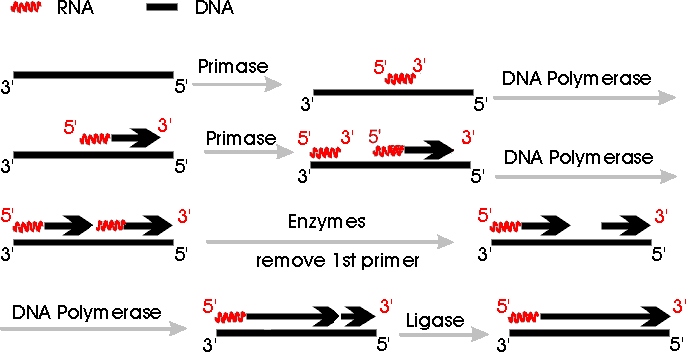
b. Primer: Short RNA stretch made by primase is called primer. On handout (11-3) of events at fork, RNA primer is represented by a dot. (In diagram below, primer is a red squiggly line.) Primase catalyzes synthesis of primer, and then DNA polymerase adds on the 3' end of the RNA primer.
2. How
Primer is Removed & Replaced
The primer (the short RNA section) must be
removed and replaced by DNA. The process is shown in steps 5 & 6 of handout
11-3 and in the diagram below. Some of the steps below may occur simultaneously,
but are described separately to make the process
clearer.
Step 5: Primer is removed, leaving a gap between the 3' end of Okazaki fragment #2 and the 5' end of fragment #1, giving molecule E.
Step 6: DNA polymerase adds on to the 3' end of primer #2 to fill the gap, giving molecule F.
Step 7: Ligase joins the loose ends of the lagging strand, giving molecule G.
Removal of RNA primer (step 5) and filling of the gap with DNA (step 6) may occur at the same time, using two different catalytic parts of a single enzyme. The enzyme responsible is a DNA polymerase, although not necessarily the same one that adds to the 3' end of the regular growing chain. (In this class, we are lumping all the DNA polymerases together and treating them as a single enzyme. In more advanced classes the properties of the different DNA polymerases will be distinguished.)
Thus DNA polymerases have at least two
different catalytic activities:
(1) polymerase: adds to 3' end of growing chain, using dXTP
and releasing PPi
(2) 5' to 3' exonuclease: removes nucleotides from 5' end of
primer by hydrolysis.
DNA polymerases can have an additional
catalytic activity:
(3) 3' to 5' exonuclease: removes nucleotides from 3' end of
growing chain by hydrolysis. This allows the enzyme to proofread -- to 'back up'
and remove nucleotides that were added in error. (Note: This is not the reverse
of reaction (1).)
3. Summary Pictures of Use & Replacement of Primer
See Becker Fig 19-13 or Sadava 11.19 (11.17 in 7th ed, 11.18 in 6th ed) or Picture Below. Note:
Some of the pictures in the older editions of the texts don't have all the details right.
Some of the figures imply that DNA can replace RNA primer
without the need for a free 3' end for DNA polymerase to add on to. Other
figures show ligase joining the Okazaki fragments at the wrong place. (See
picture below or solution to problem 6-14, part B-3, for correct position of
ligation. Note that the replication fork in problem 6-14 goes in the opposite
direction from the fork in the picture below.)
In the picture below, which summarizes the process of primer synthesis and replacement, all arrows go 5' to 3'. Only one side of the replicating fork is shown -- the side carrying out synthesis of the lagging strand. The side carrying out continuous synthesis is omitted. Note that replication fork below goes right to left -- DNA is unzipping from right to left.
Function & Replacement of Primer; see also handout 11-3.
For animations of primer removal and other events at the replication fork, see the links given above at the start of the lecture.
C. Telomeres and Telomerase -- a
Biological consequence of the need for primers
1. The "loose end" Problem
There is no easy way to replace the primer on the left end of the new strand (in picture above); also see Becker fig. 19-15. The RNA can be removed, but no DNA can be made to fill in the gap.
2. Solutions
a. Small DNA's
(& most prokaryotic chromosomes) are generally circular, which circumvents
this problem.
b.
Linear chromosomes (the norm in eukaryotes) tend to get shorter with each
replication -- in next go round, chain that has just been made will be
template, and it is shorter than the original by the length of the primer. The
consequences will be discussed next term when we focus on eukaryotes.
FYI only: Eukaryotic chromosomes get shorter with each replication, but it doesn't usually matter because the DNA molecules in the chromosomes have special repeated sequences (called telomeres) on the ends. The repeats are gradually lost unless replaced by an enzyme called telomerase. See Sadava 11.21 (11.18 in 7th ed, 14.3 in 6th) or Becker 19-16. (Note: in Purves' picture in the 6th edition, the wrong strand is "too short." The 3' end should be longer than the 5' end, not the reverse.) The lack of telomerase may be what limits normal somatic cells to a finite life span of 50-60 divisions; the presence of telomerase may be what allows indefinite multiplication of cancer cells. Germ cells, that produce eggs and sperm, make telomerase, so a new generation always starts out with full length telomeres. For an animation of how telomerase works, see http://faculty.plattsburgh.edu/donald.slish/Telomerase.html. (Note that this is for eukaryotes; in this case there are two different DNA polymerase for the leading and lagging strands. Both grow chains in the 5' to 3' direction.)
To review primers, see problem 6-12, A-D and problem 6-14. If you have the 2004 ed. of the problem book, there is a typo in problem 6-12, part D. The later editions are corrected.
Part II -- PCR (Handout 12A)
IV. PCR (Polymerase Chain Reaction) A Practical Application of the need for Primers.
The inventor, Kary Mullis, received the Nobel prize in 1993. For his acceptance speech, biography, etc. see the Nobel Prize official site. Also see class handout.
A. Idea of prefab primer, hybridization.
DNA synthesis will not start without a primer. In a living cell, primase (a type of RNA polymerase) makes the necessary RNA primer. Then DNA polymerase can take over, adding on to the 3' end of the primer. In a test tube, you can omit primase and use an oligonucleotide (short polynucleotide, usually DNA) as primer (= prefab DNA primer) to force replication to begin wherever you want. The primer you add will hybridize to its complementary sequence, wherever that happens to be (not necessarily at the end of the DNA) and DNA polymerase will add on to the 3' end of the primer, thereby starting elongation of a chain from wherever the primer is.
B. Steps of PCR -- see PCR handout (12A), Sadava 11.23 (11.20 in 7th ed, 11.21 in 6th), and/or Becker Box 19 A. For an animation, go to http://www.dnalc.org/ddnalc/resources/pcr.html
The site listed above (The Dolan DNA Learning Center) has many good features you may want to check out. There is a list of additional animations on PCR, DNA replication, etc. at http://www.dna.utah.edu/PCR_Animation_Links.htm. Please let Dr. M know if you find any of these sites (or any others) particularly useful.
1. First Cycle: You denature your template (A) and add primers (one to each strand) to the denatured DNA (B). Then you cool the mix down, and each oligonucleotide primer hybridizes to its complement (step 1 on handout; gives D). The two long strands of template do not renature. Then DNA polymerase adds on to 3' end of primer until it reaches the end of the template strand (step 2 = elongation). This completes the first cycle (ends at E). The new strands you just made (dashed on handout in E) include the target sequence, plus some extra DNA on their 3' ends. (This "extra" corresponds to the sequence between the target area and the 5' end of the template strand.)
2. Second Cycle: You heat the DNA to denature it (step 3), and add more of the same primers as before (step 4). Then you allow DNA polymerase to add on to the 3' ends of the primers (step 5). This completes the second cycle (ends at H). On the handout, only the fate of the new strands made in cycle two is shown after steps 4 & 5. The old strands simultaneously go through another cycle just like the one above (steps 1 & 2), but this is not shown on the handout. The new strands you made in cycle 2 (shorter strand of each molecule of H) include only the target sequence.
3. Third Cycle: You heat the DNA again to denature it (step 6), add primers (step 7) and allow DNA polymerase to add to the primers (step 8). This completes the 3rd cycle (ends at K). On the handout, only the fate of the new strands made in cycle two is shown after steps 7 & 8. (The fate of the complementary strands, left over from the previous cycle, is to repeat steps 4 & 5.) At the end of this cycle, you finally have double-stranded DNA molecules the length of the target sequence (see K).
4. Additional Cycles: After each cycle you heat the reaction mixture to denature the DNA, and then you cool the mixture down to start the next cycle. In each cycle, primer sticks to the appropriate spot (its complement) and polymerase starts at the 3' end of the primer and goes to the end of the template. Note that primers are complementary to sequences in the middle of the original chain, but that after two cycles the parts beyond the primers are no longer copied. {Q&A}.
5. How reaction is actually carried out. All components (template and excess of heat resistant polymerase, primers & dXTP's ) are present from the very beginning. The mixture is heated and cooled repeatedly to end and start subsequent cycles. You don't have to add primers, polymerase, etc. to start each cycle.
6. How many Primers? New molecules of primer are used in each round. However, the primer molecules used in each round have the same sequences as the ones used in all the previous rounds. The primers are not reused -- new primers (with the same sequences as before) are needed for each cycle. You need only two types (sequences) of primer, but you need many molecules of each.
7. Identification of Product. The products of the PCR reaction are usually identified by their lengths, which are determined by gel electrophoresis without SDS. (Why no SDS needed? Think about it.) Gels are used that separate DNA molecules on the basis of their molecular weights (which depends on chain length). Hybridization to labeled probes is often used to detect the positions of the bands of DNA on the gel. (More on this later.) An animation of DNA gel electrophoresis is at http://www.dnalc.org/ddnalc/resources/electrophoresis.html.
C. Special Features of PCR (as vs. regular DNA synthesis)
1. Special Polymerase. The DNA polymerase used in this procedure is a special heat-resistant one (called Taq polymerase) that is not denatured when the temperature is raised to separate the two strands of the DNA. This special polymerase was isolated from bacteria that live in a hot spring.
2. No replication fork or discontinuous synthesis. Note that the entire template molecule is denatured (or 'unzipped') completely before each cycle, so the complement to each strand can be made continuously. There is no replication fork and thus no discontinuous synthesis here.
3. Preformed DNA primer. Primase is absent, so no RNA primers are made. Oligonucleotides of DNA (not RNA) are added instead to act as primers.
To review the
PCR technique, see problem 6-13, C-1 and 6-15.
For an animation of PCR and links to animations of other DNA techniques, see the
urls listed above or go to the
links page.)
D. Uses/Advantages of PCR
1. Amplification: Uses small number of starting molecules & produces large number of copies of target sequence.
The beauty of this scheme (PCR) is that the desired (target) sequence is copied exponentially and the other parts of the original DNA are copied linearly. So after a few cycles you have lots of copies of the target sequence (and not much of anything else). To convince yourself of this, see the answer to problem 6-13, part C-2. To use this technique and make many copies of the target sequence all you need (in theory) is ONE starting DNA molecule (and appropriate primers). Given current technology, you need 10-50 starting DNA molecules. You can use the multiple copies for many different purposes such as characterization and/or identification as explained below. Before PCR, you couldn't get enough DNA to do chemical tests, so you couldn't compare different DNA samples.
2. Detection -- Can be Used to see if a particular target DNA is present or not.
You can add primers to a sample that you suspect contains some particular target DNA, such as HIV DNA, or DNA from genetically modified corn, or DNA from a particular species of protected whales. The primers are complementary to a sequence found only in the target DNA -- the one you are testing for. (In the cases mentioned, the primers would be complementary to a sequence in HIV DNA, or a sequence added to ordinary corn DNA by genetic engineering methods to make the special corn, or to a DNA sequence unique to the protected species of whales.) Then you see if polymerase can make DNA. If no target DNA is present, primers will have nothing to hybridize to, so polymerase will have nothing to add on to, and no copies of DNA will be made. So if you don't get multiple copies, it indicates there was nothing to copy -- your target DNA was not there. If you do get multiple copies, your target DNA was in the sample.
Notes: (1) The standard HIV screening test is not for HIV itself or for HIV DNA but for antibodies to proteins of HIV. (PCR is used as a backup to confirm a positive result with the standard screening test, or to measure the actual levels of HIV.)
(2). Why would you test for genetically modified corn? StarLink corn is a type of genetically modified corn that was approved for animal feed, but not for human use. In spite of attempts to keep it separate, it has turned up in many human foods. It is probably harmless to humans, but no one wants to take any chances. Testing for the modified DNA is the only way to tell if StarLink corn (or any other genetically modified food) is present in a mixture or not. A site with an explanation of the StarLink fiasco is at http://www.geo-pie.cornell.edu/issues/starlink.html.
3. Forensics -- Can be Used for identification -- DNA fingerprinting
a. Basic idea: PCR can be used to copy specific sections of the DNA from different samples -- for example, from DNA left at the scene of a crime and from DNA from a suspect. The sections of amplified DNA can then be compared to see if they match or not (in length, sequence, etc.). The sections that are compared are highly variable ones that probably don't carry any information and are merely spacers in the DNA. If enough sections are checked, you can determine (to a very high degree of certainty) whether the two DNA samples came from the same person or not. DNA testing can be used to identify the guilty (inclusions) and to clear the innocent (exclusions). Alec Jeffreys, who first came up with the idea of using DNA testing for identifications, received a Lasker award in '05. For a pdf with details see the Lasker site.
b. Examples: See articles handed out in class and article from the San Francisco Chronicle of 10/19/99. (Note: you'll need to go to the SFChronicle web site itself if you want to see the pictures or get some of the older articles.)
c. Inclusions: If the samples match at enough highly variable spots, then there is a very high probability the samples came from the same person, because the degree of variation is so high that only a few different people in the world should have the same pattern.
d. Exclusions: If the two samples do not match, then it is clear that the two samples came from different individuals and the suspect could not have committed the crime (since the DNA at the scene came from someone else).
e. STR's: The variable sections that are tested are often ones that have different numbers of short tandem repeats (STR's). The primers hybridize to regions outside the section with the repeats. The number of repeats in each DNA can be figured out from the length of the sections amplified by PCR. The new FBI data base contains the information from checking 13 sections with variable numbers of STR's.
For a great site from the Dolan Learning Center with examples of how DNA is used for identification and forensics click here.
4. Bar Coding (See the article about identifying the fish in sushi. For more details, see the FishBol site.)
The tests of the various samples of sushi used a similar principle to the one used in forensics. A particular gene that varies from species to species was amplified and then sequenced. (The sequencing procedure produces a pattern that looks like a supermarket bar code.) There is enough variation in the sequence of that particular gene to identify the species of fish from which it came. In this case, the amplified DNA from the different samples was compared to DNA from reference samples. In forensics, the amplified DNA from the crime scene is compared to the amplified DNA from the suspect.
5. Why you can't do this with proteins
There are very sensitive tests for presence of proteins (usually using the catalytic activities of enzymes and/or binding abilities of antibodies), but no way to amplify (make copies of) what you detect. You can't make more protein from a protein template. PCR takes advantage of fact that DNA replicates for a living to make more copies. You can make more DNA from a DNA template.
Note: So-called DNA fingerprints are characteristic of the person/DNA from which they came. So-called protein fingerprints are characteristic of the protein from which they came. That's why both are called 'fingerprints.' However the two types of 'fingerprints' are made differently and used for different purposes.
Part III -- How does DNA do job #1? How does 'DNA make Protein?'
V . Central Dogma -- How does DNA do job # 1?
A. Big Picture. So we have a big DNA that includes a particular gene = stretch of DNA coding for a single peptide; how will we make the corresponding peptide?
Note: gene usually means a stretch of DNA encoding 1 polypeptide, but there are complications as we'll see later.
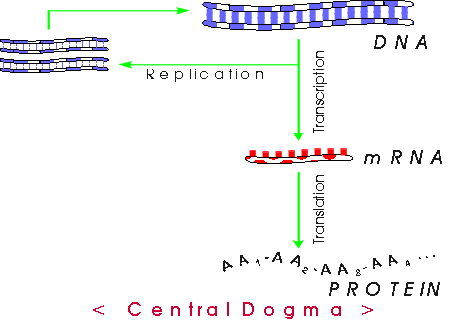
1. Basic idea -- see also Becker fig. 21-1 or Sadava 12.2 & 12.3:
2. Terminology:
Replication = DNA synthesis using a DNA template.
Transcription = RNA synthesis using a DNA template.
Translation has two possible meanings (we will stick to the first):
(1) Usual meaning = protein synthesis using an RNA template (RNA → protein). Used in contrast to transcription (DNA → RNA).
(2) In some contexts, translation can mean the entire process (DNA → RNA → protein).
B. What RNA is
1. Structure: See Sadava fig. 3.24 (3.25 in 7th ed, 3.17 in 6th) and table 3.3 or Becker table 3-5 & fig. 3-17 for comparison of DNA and RNA. RNA is single stranded (although sections may double back on themselves → double stranded regions), has U not T, ribose not deoxy and is generally shorter, but otherwise like DNA. RNA is less stable than DNA -- more easily damaged (because of reactive OH on ribose and because a single strand is more exposed) and less easily repaired (because no 2nd strand to use to correct mistakes on first strand). DNA is also more easily repaired because it has T not U, so damaged C's (which are oxidized to U) can be recognized and removed. In summary:
DNA RNA Significance/Effect of Difference Double Stranded
Single Stranded*
For RNA: Ease of repair down; likelihood of damage up.
T not U
U not T
For DNA: Ease of repair of damaged (oxidized) C up. (Damage that coverts C to U can be detected & repaired.)
Deoxyribose
Ribose
For RNA: Reactivity up, stability down
Very long
Relatively Short
For RNA: Less Information carried per molecule but molecule is much more convenient size
* RNA is basically single stranded, but can fold back on itself to form hairpins -- short regions that are double stranded. See Sadava 3.25 (3.26 in 7th ed.)
2. Synthesis. RNA grows just like DNA by adding nucleoside triphosphates (XTP's) to the 3' end of a growing chain. For RNA, enzyme for elongation is called RNA polymerase, XTP's are ribo (not deoxy) and U replaces T. Details to follow.
3. Types. There are 3 major types of RNA involved in translation: messenger RNA (mRNA), transfer RNA (tRNA) and ribosomal RNA (rRNA). The roles of the different types of RNA are outlined below and will be explained in detail next time.
VI. Why mRNA?
A. Basic idea: mRNA = Working, disposable copy vs DNA = archival, permanent master copy. DNA = big fat comprehensive reference book or complex web site. mRNA = Xerox of one (book) page or print out of one web page with information you need for a particular assignment. Book stays safe in library; web site remains unchanged. Xerox goes to your room, is actually used, gets covered with coffee stains, smudged, and thrown away.
B. How function of mRNA corresponds to structure
1. Convenience. Small size (1 or a few peptides' worth) is much more convenient than many genes' worth. Xerox of one page much more convenient to work with than big fat book.
2. Preserve Master. Using mRNA to make protein saves wear and tear on master -- no coffee stains on the archival copy (DNA).
3. Flexibility. Different amounts of mRNA can be made when you need to make different amounts of protein. More on this when we get to regulation (operons).
C. Summary: How does RNA make protein?
1. "RNA makes protein" means two things:
a. Need mRNA (info goes DNA → RNA → protein) -- see Sadava 12.2
b. Need several kinds of RNA to make protein:
mRNA to act as template -- determines order of amino acids
tRNA to carry the amino acids to the template, and line them up
rRNA (in ribosomes) to align the tRNA's carrying the amino acids and hook the amino acids together
Of course you need additional proteins (enzymes and other factors) to make protein
2. Hardware vs. Software. rRNA and tRNA are the hardware or tools or machines; mRNA is the software or working instructions or tapes/CDs/punchcards. Cells use same old hardware and constantly changing, up to the minute, supply of new software.
VI. Where does RNA come from?
You need lots of RNA to make protein -- tRNA, rRNA & mRNA. How do you make the RNA? All RNA is transcribed
from a DNA template. See Sadava 12.5 (12.4) or Becker fig. 21-8 (21-9) &
21-10 (21-11).We'll go over how the RNA is made, and then consider how the RNA is used
to make protein.
VII. DNA synthesis vs RNA synthesis.
The
easiest way to go over RNA synthesis, given that we've discussed DNA synthesis
at length, is to compare DNA and RNA synthesis. See handout 12-B. (Any
part of this not covered will be done next time.)
A. Basic mechanism of elongation is the same:
1. Use nucleoside triphosphates (ones with ribose not deoxyribose, but mechanism same) & split off PPi; use pyrophosphatase.
2. Chain grows 5' to 3' by addition to 3' end.
3. Need anti-parallel DNA template, put in complementary bases -- A (in template) pairs with U not T, but otherwise same {Q&A}
4. All RNA molecules (mRNA, tRNA and rRNA), not just mRNA's, are made from a DNA template. tRNA and rRNA molecules are not made from an "mRNA" template.
See problems 7-1 & 7-2.
B. Enzymes are different
1. Chain growth
Growth of DNA chain is catalyzed by DNA polymerase (and associated enzymes)
Growth of RNA chain is catalyzed by RNA polymerase.
2. Choice of Substrate. If you put all 8 XTP's in a test tube, what do you get, DNA or RNA? Enzyme (DNA vs RNA pol) is responsible for which nucleotides used.
RNA pol. uses ribonucleoside triphosphates.
DNA pol uses deoxyribonucleoside triphosphates.
3. Products are different
DNA is long and double stranded
RNA is short and single stranded
4. Choice of Template is different.
Template = short section, one strand at a time (for RNA synth.) vs all of both strands (for DNA synth.)
Why? Because starts and stops are different. Starts & stops = sequences in DNA recognized by the enzymes = places where replication or transcription starts (or ends). These must be different for the two enzymes. See table on handout & below for more details.
See problem 7-6
C. Template Details
1. One Strand is Template for RNA polymerase. For any one gene or region, RNA polymerase uses Crick or Watson, but not both, as template. RNA that is made is complementary (and antiparallel) to the template strand. Note that an entire strand is not used as template throughout. The "Watson" strand of DNA is used as template in some sections and the "Crick" strand in others.
2. Continuous vs. discontinuous synthesis.
DNA synthesis: fork moves down DNA making complements to both strands; one new strand is made continuously and one discontinuously. Ligase is needed for synthesis of lagging strand.
RNA synthesis: RNA polymerase moves down DNA making complement to one strand or the other (in any particular region). Therefore RNA synthesis is continuous and doesn't need ligase.
3. Terminology
a. Transcribed Strand. Strand used as template is called the transcribed or template strand or the antisense strand (in that region). This strand is complementary to the RNA that is made.b. Sense Strand. Strand that is not transcribed (in that region) is called the sense strand or coding strand. The base sequence of this strand is identical to the RNA that is made (except that the RNA has U and the sense strand has T).
c. An entire DNA strand (going the length of a whole molecule) is not all "sense" or "antisense." "Watson" may be sense in one section and "Crick" may be sense in the other (as in the picture on handout 13-A). The terms "sense" and "transcribed" strand are defined for each section of the DNA that is transcribed as a unit (usually a gene or small number of genes).
d. Sense RNA. The usual RNA transcribed from the DNA is said to be "sense." (Sense RNA matches the sense strand of the DNA.) The complementary RNA, if it exists, is said to be "antisense." Some practical uses of "antisense RNA" will be covered next time.
e. Why this terminology? The sense strand (not the template) actually contains the information used to line up amino acids to make proteins. (Assuming the gene codes for a peptide.) When a DNA sequence is published, it is usually the sense strand that is given. Why? If the gene codes for a protein, the amino acid sequence of the protein is much easier to figure out using the sense strand -- you just consult the code table (details next time).
f. Additional notes FYI on terminology:
(1). Becker (and some others) call the sense strand the coding strand, meaning the "strand coding for protein." I prefer the term "sense strand" since coding strand could mean "coding for protein" or "coding for mRNA." (The term "coding strand" is almost always used the way Becker uses it, to mean "coding for protein.")
(2). The terms "template strand" or "transcribed strand" can also be interpreted in more than one way, but these terms are virtually always used to mean the strand acting as template for RNA synthesis (= the strand that is transcribed from, not the strand that is being made, during transcription). The template or transcribed strand is not the strand equivalent to the mRNA -- the template strand is the strand complementary to the mRNA.
4. Directions: Suppose you have a double stranded DNA template. If need to copy "Crick," RNA polymerase will go one way (say right to left -- actual direction will depend on which end of template is 5' end); if need to copy "Watson" RNA polymerase will need to go the other way (say left to right). What determines where RNA polymerases starts & which way it goes? This will be discussed next time.
See problems 7-3, 7-4, 7-8 & 7-9.
Next time: We'll finish RNA synthesis vs DNA synthesis, and then consider how the RNA that was transcribed is translated -- how it's used to make protein.
© Copyright 2008 Deborah Mowshowitz and Lawrence Chasin Department of Biological Sciences Columbia University New York, NY