W3006 Physiology Fall 2000 Exam #2 NAME_____________________________________________
1. A. After receiving a liver transplant, a person is given glucocorticoids, such as cortisol, to prevent rejection of the transplant. Cortisol works by inhibiting the
a. NK cells 1 b. B cells c. T cells 1 d. monocytes, which are the cells most likely to directly attack a foreign cell, and to lyse it. (2)B. Shortly thereafter, the person is found to have developed osteoporosis. One possibility is that this develops as a result of the original liver disease that necessitated the transplant. How might a diseased liver lead to osteoporosis? (8)
25-alpha hydroxylase
2 from liver adds OH to 7-dehydrocholesterol, first step in activating Vitamin D. 2 Vitamin D increases Ca++ absorption from small intestines. 2 Unhealthy liver means less active Vitamin D produced, less Ca++ absorbed, less Ca++ available for deposition in bone, decreased bone density, osteoporosis. 2C. A second possibility is that osteoporosis develops because glucocorticoids can inhibit Ca++ absorption from the intestines and increase Ca++ loss in the urine. It has been suggested that this causes osteoporosis because it leads to a. an increase 1b. a decrease in PTH, which would be expected to a. increase osteoblast activity b. increase osteoclast activity 1 (2)
D. A third possibility is that osteoporosis develops because glucocorticoids can act directly on bone to inhibit osteoblast function. To get a measure of osteoblast activity, one might take a blood or urine sample. Which of these is/are indicative of bone formation: a. bone-specific alkaline phosphatase
1 b. collagen crosslinks c. osteocalcin 1 d. pyridinium and deoxypyridinoline e. n-telopeptide (2)E. Briefly (ie, one sentence) suggest a fourth mechanism by which glucocorticoids might logically lead to osteoporosis (2)
Cortisol stimulates glycogen breakdown, less glucose is stored in muscles, protein is broken down to produce more energy in muscle. Weak muscles mean body moves less, less mechanical stress on bones, so less bone deposited. OR: Cortisol exerts negative feedback effect on ACTH, so less stimulation of adrenal steroids. ACTH stimulates conversion of cholesterol to progesterone, so less ACTH means less progesterone and other steroids derived from it (adrenal androgens and estrogens). A decrease in these steroids leads to a decrease in bone density, as we saw with osteoporosis developing after menopause. 2 points for either explanation.
F. A drug called thiazide is sometimes used in treating this disease. Thiazide works by inhibiting the Na/Cl co-transporter in the luminal membrane of cells in the distal tubule of the nephron. Explain why this is helpful in dealing with osteoporosis.(6)
Usually: Energy is used to run the Na/K pump, which creates the Na gradient, with low intracellular Na. This pulls Na in via 2 carriers, one cotransports Cl- into the cell, the other is an antiporter, sending Ca out of the cell, into the ISF. This latter movement creates a concentration gradient for Ca, pulling Ca from the filtrate into the cell In this way, Ca moves from filtrate to blood. If the Na/Cl transporter is inhibited, only one carrier brings Na in down the concentration gradient, that is, the carrier that moves Ca++ into blood. So a maximal amount of Ca can be reabsorbed from the lumen.
W3006 Physiology Fall 2000 Exam #2 NAME_____________________________________________
G. This drug also helps combat another potential side effect of glucocorticoids: hypertension. Explain how inhibition of the Na/Cl co-transporter in these nephron cells works to lower blood pressure. (6)
More Na + Cl ions remain in filtrate, so (osmotically) more water in filtrate, and more water leaves body in urine. This lowers blood volume, which means that blood pressure will fall.
H. These nephron cells are found to have a hormone receptor on their membranes. This receptor is most likely to combine with (PTH- peptide hormone)) 2 (1, 25-OH Vitamin D) (25-OH Vitamin D) (aldosterone) (angiotensin) (renin) and the receptor is most likely to be found in position (A) (B)1 on the blood side (3 pts)
I. These nephron cells are also found to contain calbindin. Describe the likely role of calbindin in these cells. (3)
As we saw in intestinal cells, calbindin is thought to act as an intracellular carrier, transporting the calcium from the luminal to basolateral membrane.
2. True or False. If you mark it False, correct the underlined part to make the sentenceTrue. (2 pts each) You lost 2 points if you simply wrote that a statement was False, without correcting it.
____a. Considering how it influences bone, it is likely that osbteoblasts have receptors for somatomedins or PTH
____b. Chondrocytes are the major type of cell found in cartilage or epiphyseal plates
____c. Recent studies show that leptin inhibits osteoblast activity.
__T__d. The osmotic concentration is about 300 mOsm in the interstitial fluid of the kidney cortex .
___
T_e. During alkalosis, bicarbonate excretion increases.__
T__f. Stimulation of alpha receptors on blood vessels generally causes vasoconstriction____g. Considering how perforin acts on its target cells, perforin must be a paracrine secretion.
____h. SALT refers to immune cells which lie under the skin
____i. Perforin is released by Natural Killer cells, and helps lyse infectious cells.
____j.Renin is the only hormone that has been shown to act as an enzyme.
____k. Melanin is produced by melanocytes
W3006 Physiology Fall 2000 Exam #2 NAME_____________________________________________
3. The body is sometimes faced with a decrease in blood volume, accompanied by an increase in osmolarity.
A. This would happen if a person (CHOOSE ONE): a. drank a lot of salt water b. drank a lot of plain water c. sweated a lot in the marathon and didn't stop to drink This is the only choice that would lead to a decrease in blood volume, together with an increase inosmolarityd. sweated a lot in the marathon and replaced the lost fluid by drinking plain water e. sweated a lot in the marathon and replaced the lost fluid by drinking Gatorade, a 300 mOsm solution f. lost a lot of blood (2)
B. In this situation, the adrenal cortex gets conflicting signals: (4)
The decrease in blood volume signals the adrenal cortex to a. increase 1 b. decrease aldosterone secretion. This message is communicated to the adrenal cortex by way of an increase in a. angiotensin
1 b. calbindin c. ADH d. ANPThe adrenal cortex also can respond directly to the increased osmolarity in the blood. You would expect this to a. increase b. decrease 2 aldosterone secretion, which would help restore osmolarity towards normal.
C. In this kind of conflict, the adrenal cortex integrates the signals it gets, and acts first to restore osmolarity. Why would a high osmolarity be potentially more dangerous than a low blood volume? (2)
High osmolarity of ECF would pull water out of all the body's cells..Everything would malfunction, dehydrated cells wouldn't be able to restore homeostasis. The major immediate danger of low blood volume is that there would be insufficient blood volume and pressure to bring oxygen-rich blood t
o the brain...but fainting would help with that, and provide time for the body to restore homeostasis. 2D. This means that the adrenal cortex is ignoring the angiotensin signal. But angiotensin does have an important role in restoring homeostasis in this situation. Explain the role of angiotensin elsewhere, and how this would help restore homeostasis. (8)
2 Vasoconstriction of peripheral blood vessels would increase blood pressure, and help maintain homeostasis of pressure. By constricting the afferent arteriole, it would decrease GFR and decrease water loss, although the greater constriction of the efferent arteriole would help negate this, and ensure that filtration continues.3 Increases ADH secretion, so water retention, helping to maintain blood volume, and to dilute fluids, so restore osmolarity to normal.
3 Increases thirst, either via stimulation of hypothalamic areas that control drinking, or via effect on salivary glands, that decrease saliva and so increase sensation of thirst, to stimulate drinking behavior, so that lost fluids are replaced.
4. Multiple choice. Circle all correct answers. No explanation needed. (2-4 points each) -1 for each incorrect answer circled, even if you circled correct answer, too.
A. The role of the loop of Henle is to
a. produce a concentration gradient that will allow the nephron to
produce a hypotonic fluid 2
b. produce a salt gradient that will allow the kidney to retain salt ions
c. produce a glucose gradient that will facilitate the reabsorption of glucose
d. produce a water gradient that will allow reabsorption of Na+
e. actively pump water from the nephron into the renal medulla
B. In his review of what we know about the effects of space flight on bone, Turner did not
mention the following critique(s)
a. Astronauts were performing studies on themselves, and so may have
been biased in collecting data.1
b. Different studies have found conflicting results: bone formation has been reported to
increase, remain constant, and decrease after spaceflight.
c. Animal experiments have been of relatively short duration, so not relevant to long-term
human space travel.
d. Only a small pool of potential subjects is available.
e. Researchers did not measure Ca++ inside of skeletal muscle cells,
an important site in calcium balance.
C. Which of these findings can be construed as evidence that the sympathetic nervous
system can influence the immune system? (all answers are true, but
only b and c relate to the symp n.s.)
a. A body under stress is more likely to develop stomach ulcers.
b. Sympathetic neurons have been found to form synapses on
lymphocytes.2
c. Cortisol inhibits the production of complement.
d. B cells have receptors for cortisol.
e. T cells have receptors for norepinephrine.2
W3006 Physiology Fall 2000 Exam #2 NAME_____________________________________________
D. To increase the pressure of the blood flowing into the glomerulus
a. constrict the afferent arteriole and constrict the efferent arteriole
b. constrict the afferent arteriole and dilate the efferent arteriole
c. dilate the afferent arteriole and constrict the efferent
arteriole
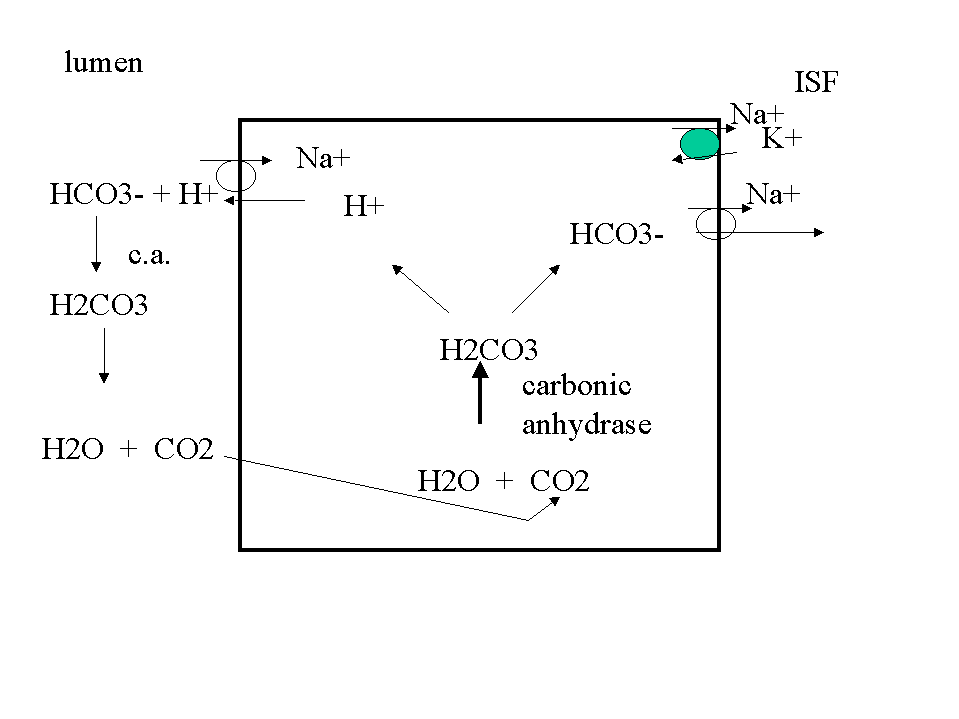
5. Under normal circumstances (no acidosis or alkalosis), most of the H+ secreted into the lumen of the proximal tubule, is used to reabsorb HCO3- . Fill in the carriers that are involved in this reabsorption of HCO3- and show where H+ is involved. (8)
6. It has long been known that African-American men are more likely to develop high blood pressure than are other-American men. This was assumed to be due to genetic differences, but recently a more environmental explanation has been offered: African-American men face more discrimination in our society, and so are exposed to more stress, and long-term stress can lead to high blood pressure.
A. Briefly describe the neuronal/hormonal changes during long-term stress that could lead to high blood pressure. (6) 2 points each for any three:
Sympathetic nervous system activation stimulates vasoconstriction
> increases blood pressure.
Adrenal gland secretion of epinephrine stimulates increase in heart rate, increase
strength heart contraction > increase blood pressure
Aldosterone increases Na+ retention and thereby water reabsorption in nephrons, >
increase blood volume >increase blood pressure
ADH increases water retention > increase blood volume > increase blood pressure
B. To determine which of these explanations is more important, a scientist goes to a
small Caribbean island, where all the inhabitants are of African descent. He finds that
there is no difference, on average, in blood pressure, between the wealthy townspeople and
the poorer folk living out in the country, and he concludes that genes must be more
important than socioeconomic conditions in determining who gets high blood pressure.
Discuss whether or not you agree with his conclusion, and if not, suggest a more
appropriate experimental design to determine which explanation is more important (6
points). Changed this to 4 points, because exam had a total of
102.
A wide variety of answers were accepted here....
Some criticisms of this experiment included the question of whether
socioeconomic condition on a Caribbean island is a good model for racial discrimination in
the US. Some of you pointed out that it's not clear whether one of these groups had
more stress, or whether the stress was simply different: Poor country folk may have
worried about having food and clothing, but the stress might have been greater for city
folk who worried about how to invest their money.... Others pointed out that the
investigator didn't control for dietary factors, such as sugar and salt consumption, which
may be important factors in developing high blood pressure. Some of you
suggested that these observational studies are not as useful as interventional ones, in
which people are intentionally exposed to some stressful event, or in which individuals
from one culture/country are moved to the other. While these may be useful ways of
thinking about experimental design, there are obvious ethical problems with some of these
ideas... We'll discuss this more when we talk about cardiovascular disease.