

RON BRESLOW FETED WITH MUSICAL TRIBUTE
Chemical & Engineering News
April 2, 2001 Volume 79, Number 14
Celebrates 70th birthday with new piano composition and ACS award in his name
On March 24, following an all-day scientific symposium at Columbia marking his 70th birthday, Breslow was feted with the world premiere of "Liberating Chemistry from the Tyranny of Functional Groups," a five-minute piano solo
written by internationally acclaimed contemporary composer Bruce Saylor. The composition was performed by Michael Boriskin, a well-known pianist and recording artist, at a banquet for more than 200 current and former students and postdocs, colleagues, friends, and family.
Also at the banquet, Princeton
University chemistry professor
John T. Groves announced that a
new national award has been
established by the American
Chemical Society Board of
Directors: the Ronald Breslow
Award for Achievement in
Biomimetic Chemistry. Attending
the dinner from ACS were
President-Elect Eli Pearce,
Director-at-Large Joan Shields,
and former ACS president Ed
Wasserman. Breslow was ACS
president in 1996.
Breslow is renowned for the
breadth of his research spanning
almost half a century--from
research on thiamine begun when he
was just out of graduate school to
the creation of the cyclopropenyl
cation in the 1960s to the
development of unique anticancer
drugs today. But one of the most
important areas he pioneered is a
field whose name he coined:
biomimetic chemistry, or the use
of artificial enzymes to transform
molecules. He's also an
accomplished pianist and music
lover. Thus was born the idea to
commemorate his 70th birthday with
a musical composition that would
pay tribute to his scientific
accomplishments.
Saylor based the Breslow
composition on successive
transformations of the cadential
material that closes the great
adagio from Bach's C Major Sonata
for solo violin. These are
"achingly beautiful, almost
heartbreaking notes," Saylor said,
which he then transforms, much as
Breslow's chemistry has involved
transformations.
"One will scarcely recognize
Bach," Saylor explained to C&EN.
"From the beginning, I have pulled
the material apart rhythmically,
reordered the original pitches
into an incipient octatonic scale,
interrupted it with musical
interjections, allowed the
ever-evolving melodic and harmonic
source material successively to
transform and reinvent itself, and
cooked up a head of steam. Then in
a final oblique reference to the
great master's original, the
clouds of minor tonality burst out
into sunshine-splashed C major."
The score starts slowly and
lyrically, but the tempo soon
picks up and builds to an exciting
crescendo that brought the
audience into sustained applause
at the finale.
Saylor said he was not consciously
thinking of Breslow's seminal
contributions in chemical research
when he began to compose. "But
about halfway through, I realized
how appropriate the form and
content of the music was for this
happy occasion. To celebrate a
man's love of music in this way is
really just so sweet and, of
course, it is something that
echoes through music history."
Describing the occasion as an
"unbelievable and fantastic
honor," Breslow said the
commissioning of a contemporary
piano piece is particularly
exciting because in his research
he has tried to move chemistry
into a "modern idiom," much as
Saylor has composed a score that
interprets Bach in a contemporary
way.
The daylong symposium in Havemeyer
Hall--a National Historic Chemical
Landmark--attracted more than 250
people and featured talks by 25
distinguished chemists who either
received their Ph.D.s or did
postdocs with Breslow over the
course of four decades and who
returned to Columbia from as far
away as Japan and India. One
exception was Columbia assistant
chemistry professor Virginia W.
Cornish, who did undergraduate
research with Breslow. Speaker
after speaker lauded Breslow for
instilling a passion for science,
for his mentorship, and for the
diversity of scientific problems
he's tackled.
"I was blown away by the breadth
and depth of the talks and the
tributes we heard," said Groves,
who was chairman of the
celebration's organizing committee
and who did his Ph.D. with Breslow
on the cyclopropenyl cation.
"These talks indicated how freely
Ron gave of his insights,
intuition, and intensity. He
taught us how to be scientists,
how to be curious, and how to be
joyous."
Yale University chemistry
professor Alanna Schepartz, who
received her Ph.D. with Breslow,
said, "In addition to teaching us
how to do science, Ron showed us
how to run a group and how to
treat coworkers." University of
California, Berkeley, chemistry
professor Robert G. Bergman, who
did a postdoc with Breslow,
agreed: "Ron talked to us, we
didn't just learn things from him;
he was interested in our opinions
and cared about what we thought.
He taught us what a good mentor
does, and we've tried to do this
in our careers."
Summarizing the obvious affection
of Breslow's former students,
University of Wisconsin chemistry
professor Samuel H. Gellman said,
"I've had a very good
[professional] life, but I've
never been happier than when I was
a graduate student in the Breslow
group."
At the banquet, additional
tributes poured in from Columbia
President George Rupp, who called
Breslow a "luminous star in a
bright constellation" of
distinguished Columbia chemists;
Columbia chemistry department
chairman Gerard (Ged) Parkin, who
noted that "Ron has given life to
Columbia chemistry;" and longtime
colleague and distinguished
chemist Gilbert T. Stork, who
showed the first infrared spectrum
Breslow did for Stork when the
young undergraduate was at Harvard
University. The date was March 14,
1952--Stork drew a large laugh by
noting that Breslow was actually
in the lab working on his
birthday.
The evening closed with a beaming
Breslow uncharacteristically
almost at a loss for words. After
thanking everyone, he sat down at
the Steinway grand piano at which
"Liberating Chemistry" had been
premiered and brought everyone to
a standing ovation with a complex
and touching rendition of "Days of
Wine and Roses."--MADELEINE JACOBS
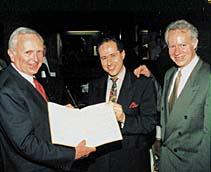
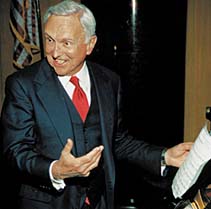
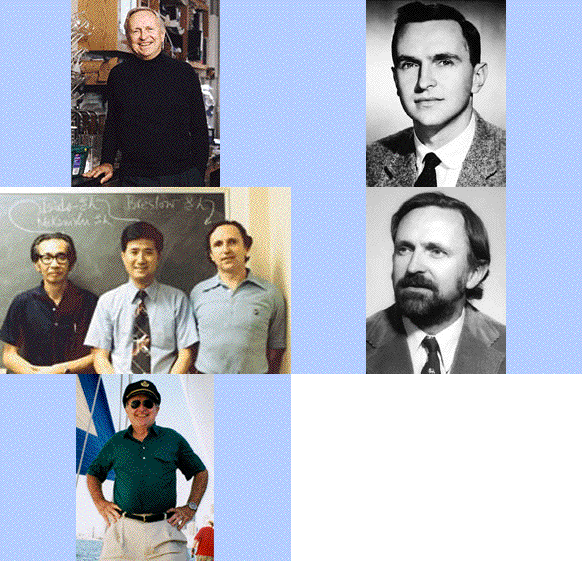
Boriskin (center) presented the score of "Liberating Chemistry" to Breslow, who reacted with delight when he read the music.
Chemical & Engineering News
Copyright (c) 2001 American Chemical Society - All Right Reserved
This site was created by Steve Dong
Last revised: Thursday, April 12, 2001.