Cadmium Hydride Compounds
Zinc is the lightest element of Group 12 in the Periodic
Table and a large variety of zinc hydride compounds are known, as illustrated
by our report of [TpBut]ZnH, the first structurally characterized
monomeric example. However, despite the
fact that zinc hydride compounds are now sufficiently well-established that they
are frequently used in catalysis, terminal hydride compounds of the
cadmium congener are uncommon and their chemistry is not well developed. Therefore, we have used the tris[(1-isopropylbenzimidazol-2-yl)dimethylsilyl]methyl ligand, [TismPriBenz],
to afford the terminal cadmium hydride complex [k3‑TismPriBenz]CdH, and thereby investigate the
reactivity of the cadmium hydride bond.
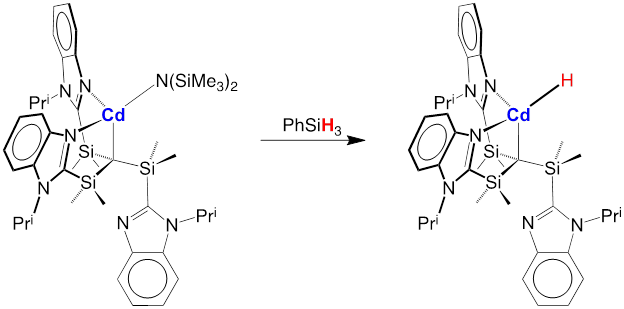
In addition to [k3‑TismPriBenz]CdH being noteworthy because terminal cadmium hydride compounds are very rare, it allows for the first time the detailed reactivity of the Cd–H bond to be determined. Of particular note, the hydride ligand can be abstracted by B(C6F5)3 to afford {[TismPriBenz]Cd}[HB(C6F5)3], in which the cadmium possesses an uncommon trigonal monopyramidal coordination environment.

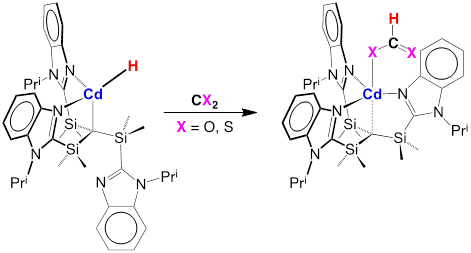
Other reactivity includes insertion of CO2 and CS2 into the Cd–H bond and metathesis of the Cd–H bond with C–X, Si–X and Sn–X bonds.
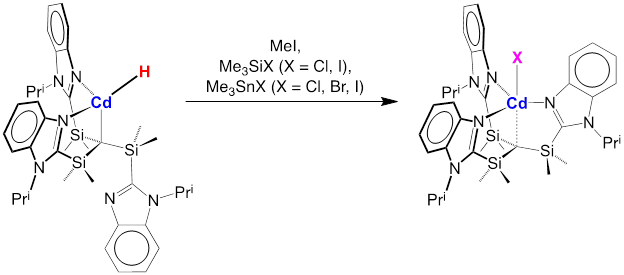
The existence of the pair of zinc and cadmium hydride compounds, [k3‑TismPriBenz]ZnH and [k3‑TismPriBenz]CdH, also provides a unique opportunity to compare the reactivity of the Zn–H and Cd–H bonds within the same system, and competition experiments indicates that the Cd–H bond is more reactive than the Zn–H bond towards MeI and Me3SnCl.
• Hammond, M.; Rauch, M.; Parkin, G. “Synthesis, Structure and Reactivity of a Terminal Cadmium Hydride Compound, [k3-TismPriBenz]CdH” J. Am. Chem. Soc. 2021, 143, 10553−10559