Bending Bonds
Covalent molecules typically have well defined structures. The structures of simple molecules are often rationalized in terms of valence shell electron pair repulsion (VSEPR) theory. For example, two-coordinate compounds, X–A–X, in which the central atom (A) has two lone pairs typically possess bent structures with an angle that depends on the atoms involved. In contrast, if there are no lone pairs, the molecule is linear. It is, therefore, interesting that we discovered a molecule that possesses both bent and linear structures. Specifically, whereas the carbodiphosphorane, (Ph3P)2C, was reported to have a bent structure, we discovered a crystalline form in which it is linear.
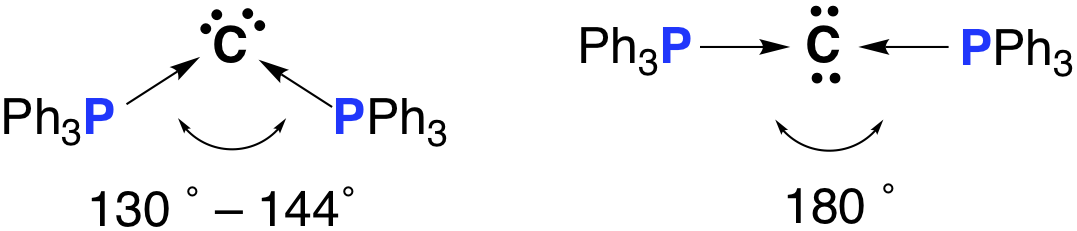
Density functional theory calculations show that the energy surface for bending the bonds in this novel molecule is very flat, such that crystal packing forces are sufficient to enable isolation of a linear form in the solid state.
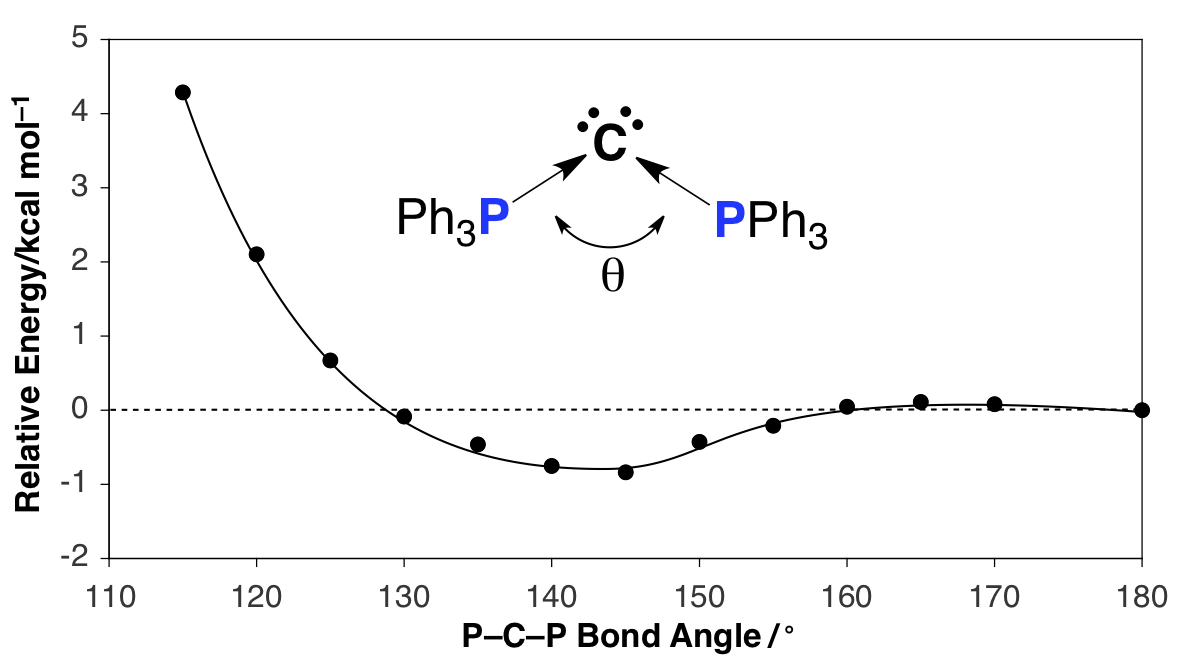
Analysis of the natural localized molecular orbitals (NLMOs) indicate that the flexibility is a consequence of the stabilization of the -type lone pair NLMO upon bending the molecule being offset by the corresponding destabilization of the two P–C bonding NLMOs.
• Quinlivan, P. J.; Parkin, G. “Flexibility of the Carbodiphosphorane, (Ph3P)2C: Structural Characterization of a Linear Form” Inorg. Chem. 2017, 56, 5493-5497.