Located at CSER and taught in cooperation with Barnard College's Interdisciplinary Concentration on Race and Ethnicity (ICORE), the Ethnicity and Race Studies major and concentration encompass a variety of fields and interdisciplinary approaches to the critical study of ethnicity and race.
Faculty and students find this field exciting because it opens up new ways of thinking about two fundamental aspects of human social existence: race and ethnicity. Although various traditional disciplines such as history, sociology, anthropology, and literature offer valuable knowledge on the subject, ethnicity and race studies provides a flexible interdisciplinary and comparative space to bring the insights of various conceptual frameworks and disciplines together in critical dialogue.
Overall, the major introduces students to the study of ethnicity and race and the deep implications of the subject matter for thinking about human bodies, power, identity, culture, social hierarchy, and the formation of political communities. The major encourages students to consider the repercussions of racial and ethnic identifications to local and global politics, and how race and ethnicity relates to gender, sexuality, and social class, among other forms of hierarchical difference.
Students majoring in ethnicity and race studies may focus their work on specific groups, including Asian Americans, Latinos, and Native Americans, and/or concentrate on the comparative study of how race and ethnic categories are formed and how they transform. Students also have the option of designing an individualized course of study. Individualized courses of study may encompass a wide variety of themes. Among the most studied are those involving the relationship between race, ethnicity and law; health; human rights; urban spaces; cultural production; visual culture; and the environment.
Due to its rigorous curriculum, which trains students in theory, history, and a wide range of modes of inquiry, the major enables a student to follow multiple directions after graduation. According to our internal surveys, nearly half of CSER students continue to graduate programs in history, anthropology, and ethnic studies, among other areas. A second group of students pursues a variety of professions, most notably related to law, medicine, media, social work, government, and human rights.
Students are highly encouraged to participate in study-abroad programs, as they represent an exciting opportunity to learn new languages and live in countries that are germane to their areas of study. In addition, travel abroad can enrich every student's intellectual experience by providing an opportunity to learn about other perspectives on ethnicity and race.
In the past, students have participated in study-abroad programs in many parts of the world, including Australia, the Dominican Republic, Mexico, and South Africa. To ensure that study abroad complements the major and integrates effectively with the major's requirements, students are encouraged to consult with CSER's undergraduate adviser as early in their academic program as possible. The director of undergraduate studies can advise students in what may be relevant programs for their areas.
The major consists of a minimum of 27 credits. Students will take three core courses and write a senior research project. Following the core courses, students will take a minimum of four elective courses, one of which must be a seminar.
CSER W3919 Modes of Inquiry (4 points)
This seminar aims to rigorously train students in theories and practices of knowledge production, and to prepare students for embarking on self-directed thesis research. Students will learn how to formulate and ask research questions and ascertain the most suited bodies of theories and methodologies pertinent to their work. This seminar will also ask students to think reflexively and critically about the methodologies and theories that they employ. The course will culminate in a semester project, a 12-to-15-page proposal for research that would include a question, basic background, preliminary directions and a research plan. Students will be encouraged to think of this proposal as part of designing a senior project.
CSER W3928 Colonialism, Decolonization and the Making of the Modern World (4 points)
This seminar aims to rigorously train students in theories and practices of knowledge production, and to prepare students for embarking on self-directed thesis research. Students will learn how to formulate and ask research questions and ascertain the most suited bodies of theories and methodologies pertinent to their work. This seminar will also ask students to think reflexively and critically about the methodologies and theories that they employ. The course will culminate in a semester project, a 12-to-15-page proposal for research that would include a question, basic background, preliminary directions and a research plan. Students will be encouraged to think of this proposal as part of designing a senior project.
One of the following:
CSER W1010 Introduction to Comparative Ethnic Studies (4 points)
CSER W1040 Critical Approaches to the Study of Ethnicity and Race
This seminar aims to rigorously train students in theories and practices of knowledge production, and to prepare students forembarking on self-directed thesis research. Students will learn how to formulate and ask research questions and ascertain the most suited bodies of theories and methodologies pertinent to their work. This seminar will also ask students to think reflexively and critically about the methodologies and theories that they employ. The course will culminate in a semester project, a 12-to-15-page proposal for research that would include a question, basic background, preliminary directions and a research plan. Students will be encouraged to think of this proposal as part of designing a senior project.
CSER W3990 Senior Project Seminar (4 Points)
*must have taken Modes of Inquiry first
The final requirement for the major is completion of a Senior Essay, to be written in the spring of the senior year. The final requirement for the major is completion of a Senior Essay, to be written in the spring of the senior year. Students may fulfill this requirement in one of two ways. One, by matriculating in the Senior Thesis course and writing it under the supervision of the course faculty. Two, by taking an additional 4-point seminar where a major paper is required and further develop the paper into a thesis length work (minimum of 30 pages) under the supervision of a CSER faculty member
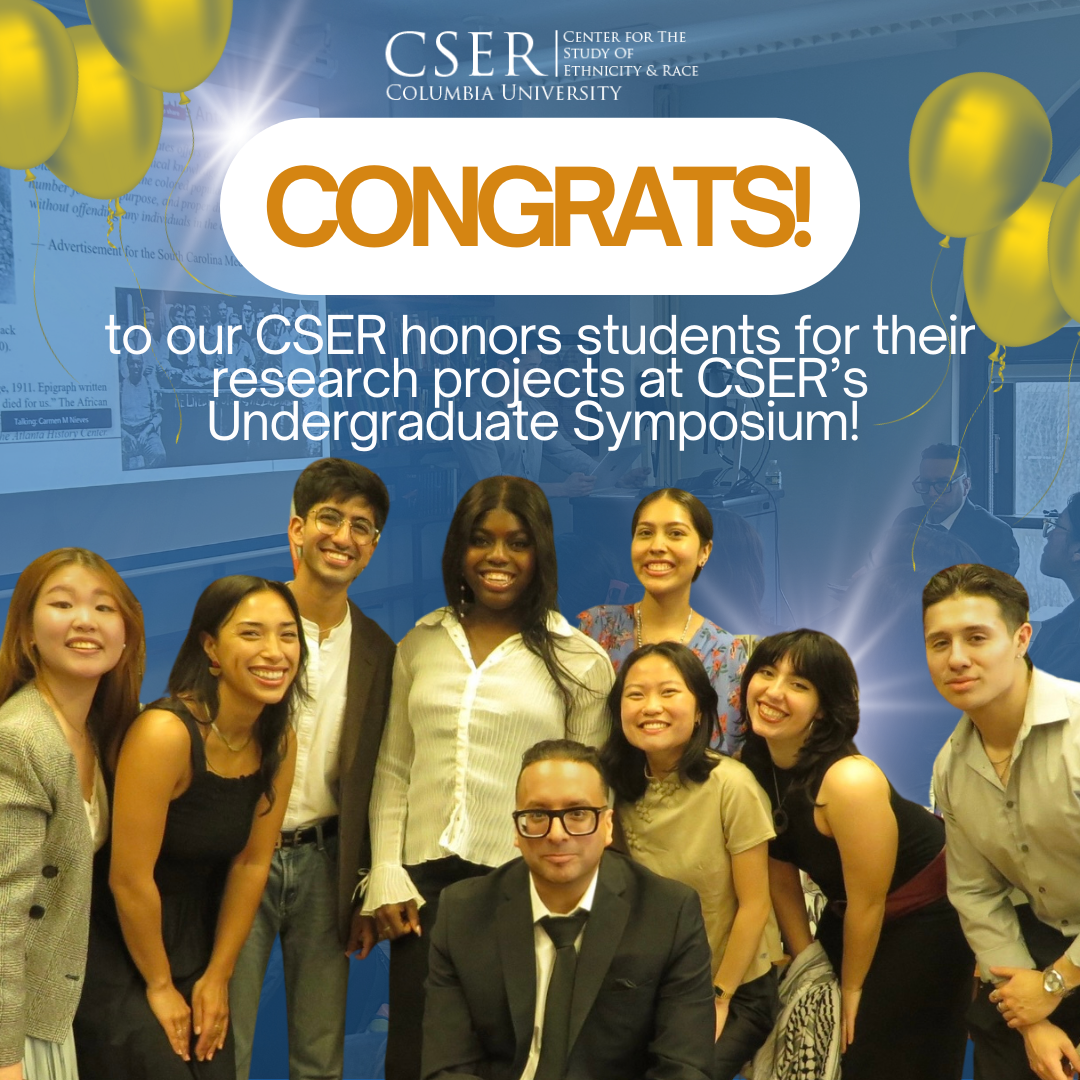
All CSER seniors are expected to present their paper at annual undergraduate symposium in April.
Students must complete at least four courses, in consultation with their major advisor, in one of the following tracks/areas of specialization:
· Asian American studies
· Comparative Ethnic Studies
· Latino/a Studies
· Native American/Indigenous Studies
· Individualized courses of study
One of the following is highly recommended, although not required for the major:
· One course beyond the intermediate-level in language pertinent to the student's focus
· An introductory course in a language other than that used to fulfill the degree requirements, but that is pertinent to the student's focus
· A linguistics or other course that critically engages language
· An Outside language and study abroad program that include an emphasis on language acquisition
The concentration requires a minimum of 19credits. Students will take two core courses and four elective courses, one of which must be a seminar.
CSER W3919 Modes of Inquiry (4 points)
This seminar aims to rigorously train students in theories and practices of knowledge production, and to prepare students for embarking on self-directed thesis research. Students will learn how to formulate and ask research questions and ascertain the most suited bodies of theories and methodologies pertinent to their work. This seminar will also ask students to think reflexively and critically about the methodologies and theories that they employ. The course will culminate in a semester project, a 12-to-15-page proposal for research that would include a question, basic background, preliminary directions and a research plan. Students will be encouraged to think of this proposal as part of designing a senior project.
One of the following:
CSER W1010 Introduction to Comparative Ethnic Studies (4 points)
CSER W1040 Critical Approaches to the Study of Ethnicity and Race
This seminar aims to rigorously train students in theories and practices of knowledge production, and to prepare students forembarking on self-directed thesis research. Students will learn how to formulate and ask research questions and ascertain the most suited bodies of theories and methodologies pertinent to their work. This seminar will also ask students to think reflexively and critically about the methodologies and theories that they employ. The course will culminate in a semester project, a 12-to-15-page proposal for research that would include a question, basic background, preliminary directions and a research plan. Students will be encouraged to think of this proposal as part of designing a senior project.
Students must complete at least four courses, in consultation with their major advisor, in one of the following tracks/areas of specialization:
· Asian American studies
· Comparative Ethnic Studies
· Latino/a Studies
· Native American/Indigenous Studies
· Individualized courses of study
CSER students are given the option of writing an honors thesis. This program is available to a limited number of seniors who are interested in doing substantial research projects and in writing honors theses. The honors thesis is expected to be approximately 50-65 pages in length and of exceptional quality. Honors students perform research as part of the Senior Project Seminar (CSER 3990) during their senior year. Honor students may, however, take regular seminars as electives toward the major. Theses are due in early April. To be awarded departmental honors, the student must satisfy all the requirements for the major, maintain a 3.6 GPA in the major and complete a thesis of sufficiently high quality to merit honors. In addition, each student is expected to meet periodically with the professor and with the preceptor supervising the thesis.