Programs

Native American Studies Initiative

The Office of the Vice Provost for Diversity Initiatives, The Center for the Study of Ethnicity and Race, The Institute for Research on Women and Gender, The Center for Ethnomusicology, The Columbia Native American Council, and the Office of Multicultural Affairs are pleased to present "Transcending Disciplines, Transcending Cultures: Native American Studies Today." Join us to discuss the future of Native and Indigenous Studies at Columbia.

Native American Studies Initiative Workshop

Claudio Lomnitz
Director, Center for the Study of Race and Ethnicity
William B. Ransford Professor of Anthropology

The objective of the workshop is to identify the advantages and disadvantages of studying Native Americans as a stand-alone group, or within the broader comparative frame of the study of indigeneity. This is a vexing question that involves weighing theoretical and historical considerations against the pragmatics of limited university resources, and an urgent concern with the recognition and study of Native American social conditions, culture, and thought. Our workshop opens a space for sustained consideration of this matter. The category "Native American" is one specific result and instance of the dialectics of identity formation around colonization, internal colonialism, and de-colonization. It refers to a set of peoples who suffered and who reconfigured their cultures and social institutions within the broad historical arc of British, French, and Spanish colonial expansion into North America, and subsequently within the national history of the United States. From the angle of a contemporary politics of recognition, the category also names a political space of identification.

Would the conceptual and comparative benefits of building a program around the more general category of indigeneity - a category that has been deployed across colonial worlds - outweigh sacrificing exclusive attention to the experience of Native Americans in the United States? Is there a way in which Native American Studies can be given pride of place within a program that acknowledges that indigeneity is a highly plastic idea, that has been used, for instance, to distinguish Black Dominicans from Haitians, to name "minorities" in the Soviet Union, and that has at times been substituted with a language of class (for instance, campesino, in the Bolivia of the 1950s)?

Our workshop seeks to explore the contours of comparative indigeneity studies and the place of Native American Studies within it. Its aim is to help us build a robust and intellectually coherent program in which Native American Studies can thrive.

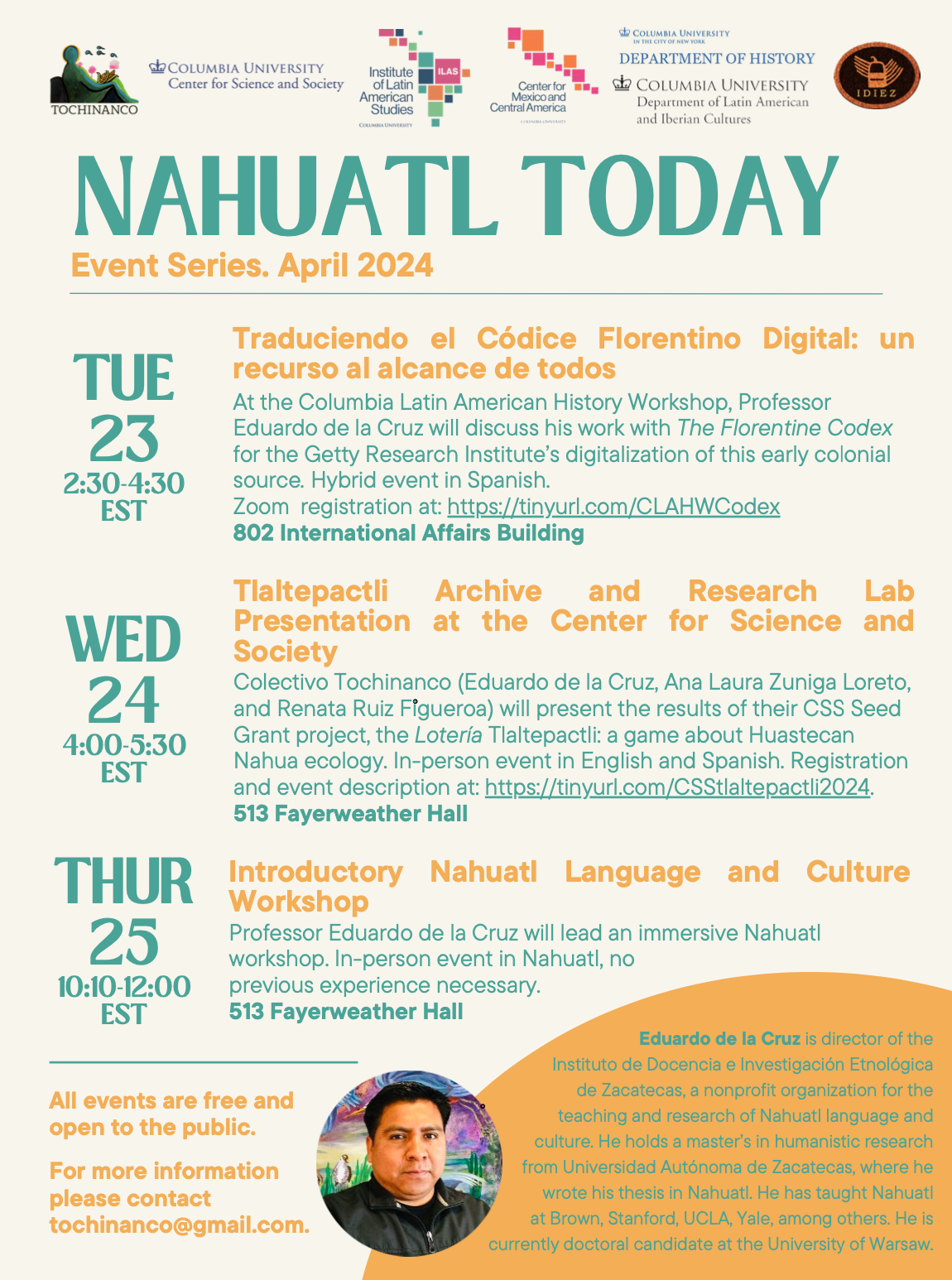
Nahuatl Program - The First Steps

By Caterina Pizzigoni

In 2007, Columbia joined the consortium that Yale and Chicago created to promote the teaching of Nahuatl, the indigenous language of central Mexico. While many ideas and options continue to be discussed, focusing on cooperation with Mexican instructors, we are ready to start with a first experiment. During my seminar 'Nahuatl Language and Culture' in Spring 2009, the director of IDIEZ (Institute for Teaching and Research in Ethnology, University of Zacatecas, Mexico), Professor John Sullivan, and a native speaker from the same institute will join the class for ten days of intensive instruction and activities. The hope is that this will be just the beginning of a long-term collaboration that will make possible for the consortium to work with Nahua instructors within the framework of a language program. At the same time, the interaction between students and native speakers from indigenous communities in Mexico will foster a deeper understanding of the language and the culture that nurtures it. I thank the Center for the Study of Ethnicity and Race and the Institute of Latin American Studies for their generous support which has made this initiative possible.

Courses, Fall 2008

CSER W3220 Native Peoples of North America
Chie Sakakibara ~ T/R 9:10 - 10:25am ~ 503 Hamilton
(Barnard American Studies) BC3300 Pedagogy of the Dispossessed
Sandy Grande ~ W 11:00am-12:50pm ~ Location TBA

Courses, Spring 2009

History W3667 INDIGENOUS WORLDS-EARLY LAT AM
Caterina Pizzigoni ~ T/R 2:40pm-3:55pm ~ Location TBA

You may download a complete listing of Columbia and Barnard Native American Studies courses, past and present.

Native American Studies Committee