 History: The Milling
Machine
History: The Milling
Machine
The CNC milling machine and numerical control system at Columbia represent one of several approaches to CAD/CAM (computer aided design and manufacturing) currently available to the designer and manufacturer. The machine tool itself is an essential component of manufacturing tradition and of current techniques for production, not only in metal, but also wood, ceramics, and plastic. Using processes related to laser printing and the lithographic techniques of micro-computer manufacturing, alternatives to the milling machine have further increased options for the designer and manufacturer in a highly competitive field where flexibility and speed are the keys to success. These recent trends in CAD/CAM have produced the unavoidable concept of "desktop manufacturing", reflecting a phenomenon also seen in publishing, with the increasing miniaturization, performance, and affordability of computers and computer operated accessories, as well as an increasing ease of communication between machines. "Desktop manufacturing", like its analogy in publishing, is concerned with the rapid, electronic transmission of information--in this case drawings and models--and the equally rapid transformation of that data into an object scaled to the human body, using a format which will facilitate repeated or large-scale production later on. When used for modeling and the creation of prototypes, this type of manufacturing has the potential to model not only the form and structure of an object, but also the process necessary for the 'mass' production of that form and structure.
The field of Rapid Prototyping is a refinement of CAD/CAM which fully integrates an essential stage of design development into a computer-assisted, fully automated process. Since much of what we design on computers is still intended for consumption or use in the physical world, Rapid Prototyping provides the very necessary rapid, literal translation of virtual drawings and models into physical objects. Currently the process has little to do with traditional modeling, where physical model-making influences design through the interplay and feedback between object, material, hand, and the critical eye of the designer. The speed of protoyping, however, and the easy modification of CAD models and drawings do provide an adequate degree of flexibility to this stage of the process.
History: The Milling
Machine
In this age of the micro-processor, it is very easy to ignore or forget our reliance on older technologies, technologies which have benefited greatly, in terms of efficiency and flexibility, from integration with computers. One such example is the technology of machine tools, a technology which pretty much predicated the development of industrial society, and the culture in which we still live. As Robert Woodbury at MIT has noted, steel--and the locomotives and machinery constructed from it--would have been of little significance without the machine tool.
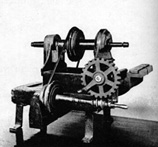
 The lathe was the first machine tool, and
existed well before industrialization. Traces of lathework occur as early
as the twelfth
century BC. The early use of the lathe to craft hollow bowls of wood
suggest an analogy between lathework and making pottery on a wheel. This
early relationship between machine tools and ceramics is striking in light
of recent rapid prototyping technologies which create ceramics rather than
objects of metal or easily machined materials. By the fifth century BC,
the lathe was widely used by the Celts, Etruscans, and in the Crimea, to
work not only wood, but stone and nonferrous metals. By the second
century BC, the lathe was known throughout most of the European and Near
Eastern world. With the bow drill, it was the most important tool
available to the mechanic up until the end of the eighteenth century.
The lathe was the first machine tool, and
existed well before industrialization. Traces of lathework occur as early
as the twelfth
century BC. The early use of the lathe to craft hollow bowls of wood
suggest an analogy between lathework and making pottery on a wheel. This
early relationship between machine tools and ceramics is striking in light
of recent rapid prototyping technologies which create ceramics rather than
objects of metal or easily machined materials. By the fifth century BC,
the lathe was widely used by the Celts, Etruscans, and in the Crimea, to
work not only wood, but stone and nonferrous metals. By the second
century BC, the lathe was known throughout most of the European and Near
Eastern world. With the bow drill, it was the most important tool
available to the mechanic up until the end of the eighteenth century.
Lathes operated by rotating the 'work' against a blade or cutter. The cutter shaped the 'work' by carving the piece of wood, stone, or metal as it turned. Power was provided by belts looped around the work and spun by treadle-- as with a potter's wheel-- by combinations of weights, springs, and pulleys, or by water wheels.
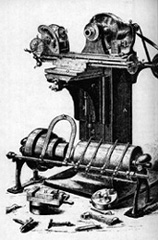 The next major development in machine
tools, the milling machine, used a
rotary, multiple-toothed cutter to remove metal from a work piece secured
to a table. The motion of the work piece relative to the cutter was
controlled in any combination of longitudinal, transverse, or vertical
feeds. Like many machines of its day, including the lathe, the early
milling machine received its power through belts connected by a system of
pulleys and gears to a central, mechanical source. Developed
principally
in New England in the 1820's, and later also in the midwest, the milling
machine was rapidly adopted by manufacturers of small arms and sewing
machines. The next significant advance occurred in 1861 with the Universal
Milling machine by Joseph R. Brown. Originally invented to solve an
immediate problem--the machining of the grooves on twist drills, replacing
the slow and expensive process of filing them out of rod by hand--Brown's
universal milling Machine was not only an ideal solution to the drill
problem, but could also perform other kinds of spiral milling, gear
cutting (often performed with a highly specialized machine tool), and
other work which up to this time was done by hand at considerable expense.
This machine was also significant for introducing the column and knee
principle as the final solution to the problem of vertical adjustment of
the cutter relative to the work. Many milling machines manufactured today
take their form from this miller of one-hundred and thirty years ago.
The next major development in machine
tools, the milling machine, used a
rotary, multiple-toothed cutter to remove metal from a work piece secured
to a table. The motion of the work piece relative to the cutter was
controlled in any combination of longitudinal, transverse, or vertical
feeds. Like many machines of its day, including the lathe, the early
milling machine received its power through belts connected by a system of
pulleys and gears to a central, mechanical source. Developed
principally
in New England in the 1820's, and later also in the midwest, the milling
machine was rapidly adopted by manufacturers of small arms and sewing
machines. The next significant advance occurred in 1861 with the Universal
Milling machine by Joseph R. Brown. Originally invented to solve an
immediate problem--the machining of the grooves on twist drills, replacing
the slow and expensive process of filing them out of rod by hand--Brown's
universal milling Machine was not only an ideal solution to the drill
problem, but could also perform other kinds of spiral milling, gear
cutting (often performed with a highly specialized machine tool), and
other work which up to this time was done by hand at considerable expense.
This machine was also significant for introducing the column and knee
principle as the final solution to the problem of vertical adjustment of
the cutter relative to the work. Many milling machines manufactured today
take their form from this miller of one-hundred and thirty years ago.
 Brown also provided a definitive design
with a
cutter he
patented in 1864.
Cutters on the original milling machines were more like rotary files.
Coarser teeth meant that metal cutting could occur more quickly and
efficiently. Teeth which could cut a substantial chip, however, also
experienced substantial wear, and required a costly amount of time and
labor to hand sharpen. Sharpening could also alter the shape of the
cutter, which affected its precision. Brown invented the first formed
cutter--a cutter shaped for a specific purpose--which could be ground on
its face without changing its very precise shape.
Brown also provided a definitive design
with a
cutter he
patented in 1864.
Cutters on the original milling machines were more like rotary files.
Coarser teeth meant that metal cutting could occur more quickly and
efficiently. Teeth which could cut a substantial chip, however, also
experienced substantial wear, and required a costly amount of time and
labor to hand sharpen. Sharpening could also alter the shape of the
cutter, which affected its precision. Brown invented the first formed
cutter--a cutter shaped for a specific purpose--which could be ground on
its face without changing its very precise shape.
Substantial improvements continued concerning the powering of the spindle and automatic feed, positioning the work in relationship to the cutter, and in the design of the cutter itself. The overall form and function of the machine remained close to Brown's very versatile design well into the twentieth century.
Automated Milling: Tracer and Electronic Controls
In 1818, the same year Eli Whitney invented the first milling machine, an automatic tool resembling a milling machine was shaping wooden rifle butts at the Springfield Armory in Massachusetts. Designed by Thomas Blanchard, the device could not do similar work in iron because the master cam which controlled the shaping wore out under the high pressure required to cut the metal: by necessity, a large component of the force exerted on the work was also exerted on the controller. Not surprisingly, full automation of the milling machine would have to wait for a form of electronic control. That development occurred in 1920 with J.C. Shaw's invention of an electrical sensing device which required only a very light contact with the master cam. Its movements were fed into a servomechanism which guided the work by controlling the various feeds. In 1927 J.W. Anderson developed the all-hydraulic, tracer-controlled milling machine. Both these devices depended on a model or master, sometimes hand-made of some relatively hard material, in contact with a tracer which translates its deflections into commands to the servo system operating the feeds. The work moved in relation to the cutter. From 1948 to 1954 Pratt & Whitney developed a machine in which the tracer did not actually touch the model, permitting models which were very soft or fragile to be used repeatedly. F.A. Pratt, the cofounder of the firm, had designed the first production milling machine (thousands were manufactured and sold the world over) in 1855.
In a way, we can interpret developments in milling machine automation as a dematerialization of the model traced by the machine...
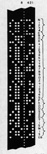
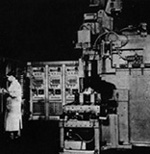 Numerical control occurred in 1953.
Working for the U.S. Air Force,
researchers at MIT adapted a large vertical miller to a n electronic
control system which received its instructions from drawings programmed
onto a punched tape. Reading the pattern of holes in the tape, the
electronic system then actuated the hydraulic controls of the miller in
three dimensions. Advances in numerical control occurred apace with
advances in electronics, from he use of vacuum tubes to control and
amplify electronic data, to the development of solid state components,
such as transistors, to integrated circuitry (the miniaturization of solid
state electronics), to the introduction of the minicomputer in 1971.
Before computer numerical control, specially designed numerical control
circuits were wired to meet the requirements of a particular machine tool.
The circuitry had no capacity for storing data. A general purpose
minicomputer replaced the specialized circuitry, and system requirements
were programmed, not wired, into the machine. Mini computers still read
their instructions off a punched tape, but these instructions could be
stored in the computers memory, and 'played back' as often as required.
Microprocessors completed the development of the milling machine into the
tool we have today.
Numerical control occurred in 1953.
Working for the U.S. Air Force,
researchers at MIT adapted a large vertical miller to a n electronic
control system which received its instructions from drawings programmed
onto a punched tape. Reading the pattern of holes in the tape, the
electronic system then actuated the hydraulic controls of the miller in
three dimensions. Advances in numerical control occurred apace with
advances in electronics, from he use of vacuum tubes to control and
amplify electronic data, to the development of solid state components,
such as transistors, to integrated circuitry (the miniaturization of solid
state electronics), to the introduction of the minicomputer in 1971.
Before computer numerical control, specially designed numerical control
circuits were wired to meet the requirements of a particular machine tool.
The circuitry had no capacity for storing data. A general purpose
minicomputer replaced the specialized circuitry, and system requirements
were programmed, not wired, into the machine. Mini computers still read
their instructions off a punched tape, but these instructions could be
stored in the computers memory, and 'played back' as often as required.
Microprocessors completed the development of the milling machine into the
tool we have today.
Numerical control cannot enhance the ability of the tool to cut more quickly through the material being milled. Along with increased accuracy, and the ability to repeat milling procedures in an identical fashion on multiple work pieces, a great advantage of numerical control is that it keeps the machine cutting a greater percentage of the time. Many CNC machines have the ability to rotate the cutter and the work around the combination of five axes, virtually eliminating the need to reposition or 'set-up' the work once the milling process is begun. By allowing the use of different cutters and drills during machining with little effect on the pace of production, automatic tool changers further the increase the efficiency of the milling process. Computer numerical control has allowed machine shops to operate in a 'lights out' mode--the last machinist to leave the shop turns out the light, but the machines keep working through the night, without supervision or intervention.
3/27/97
Childs, James J.; Principles of Numerical Control. NY, 1982.
Woodbury, Robert S.; Studies in the History of Machine Tools. Cambridge, MA , 1972.