Procedure


The two details chosen for this project, from Nicholas Grimshaw & Partners British Pavilion in Seville and Santiago Calatrava's Stadelhofen Train Station are easily rendered in two dimensions in a way that allowed the Columbia University team to cut the seperate components from sheet material on the University's CNC Milling machine. These components were then assembled as three dimensional models.

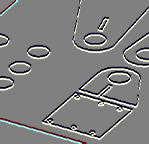
  • First, the OSU team constructed three dimensional models of the Grimshaw and Calatrava details in form-Z. These models were then ftp'd to Columbia University, where the CU team then 'split' the form-Z models, pulling the seperate components apart and setting them down on a flat plane as two-dimensional objects.

  • The split, flattened model was the saved inb form-Z as a .DXF file. While the file still retained its 3-D format in form-Z, it was now reradablein Auto CAD and the MasterCAM application used by the CNC milling machine at Columbia.

  • MasterCAM then traces the outlines of the components from the .DXF file as tool paths to be fololwed by the milling machines cutting tool. Another application within the machine guides the cutter through the modeling material along these selected tool paths.

  • The Columbia team then assembled these milled components into physical models of Grimshaw and Calatrava details.


    Models and Media

    The following models and images are all taken from the Multimodal Technologies for Interschool Collaboration Project:
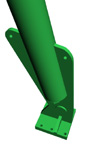

    3-D Grimshaw Models

    .obj format, about 29K
    .dxf format, about 239K
    .fmz format, about 195K
    .igs format, about 122K


    2-D Grimshaw Models

    .dxf format, about 12 K
    .fmz format, about 158K
    .igs format, about 11K
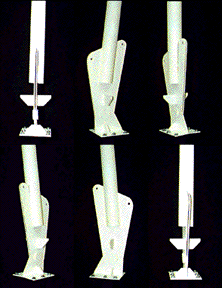


    Fabricated Grimshaw Model: QuickTime Movie & VRML
    .mov format, about 15 MB
    .wrl format, about 84K



    2-D Calatrava Models
    .dxf format, about 10K
    .fmz format, about 157K
    .igs format, about 11K


  • Correspondances

  • Media Directories


    This project of the Gateway Engineering Education Coalition, (NSF Award EEC-9444246), is supported in part by the Engineering Education and Centers Division of the National Science Foundation

    Return to Remote Component Design and Prototyping Page