URBAN DESIGN STUDIO/ FALL - 95
PROBES
LOWER MANHATTAN
Josephine Cheung
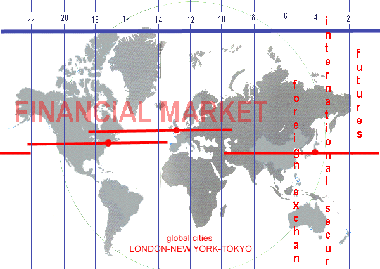
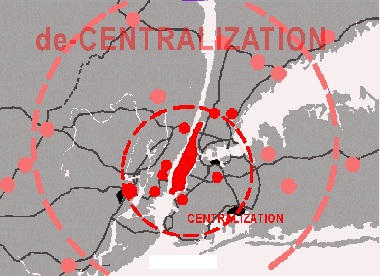
Centralization & De-centralization
NYC shrinking (regional and city scale) - become smaller and poorer.
1. since 1969, NYC poorer relative to the nation, the state, and the region.
2. decentralizaion of manufacturing and corporate headquaters -
the development of interstate highway system and technological progress (air travel and tele-communication) accelerated the process. Headquarters of Fortune 500 : 1965-129 frims, 1988-48 firms.
NYC booming (global and national) - in international economic activities. centralization of corporate service/producer service firms - (i.e. telecommunication, ari transportation, legal services, investment banking, advertising, business consulting, accounting, ) req'd by corporations in metropolitan markets.
Josephine Cheung notes by Grahame Shane.
Josephine's initial approach to the project was very abstract,
concentrating on the 24 hour clock of the international capital market
and the 24 hour rythm of the Downtown day. Josephine identified several
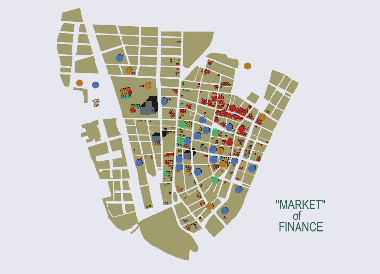
business clusters, stocktrading, insurance, consultants etc with
separate gepographic locations downtown.
It was difficult at first to
give precise and material instances of the international market
activity which could be tied to Broad Street. Slowly Josephine began to
look at the vacant buildings along the street compiling an inventory of
planned uses, some retail, some residential, some digital design
studios, some gyms, some restaurants etc, which began to etch in the
changing framework of the area.
Her earlier research linked these
activities to the lives of traders who worked around the clock and lived
close to their work, often far from their country of origins, working
for international corporations. At a District Scale Josephine began to
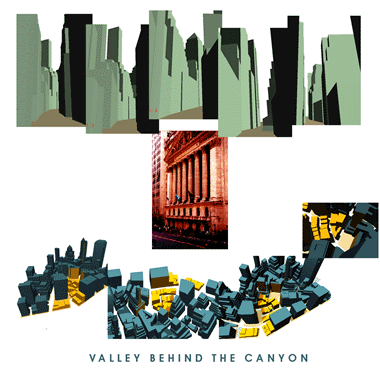
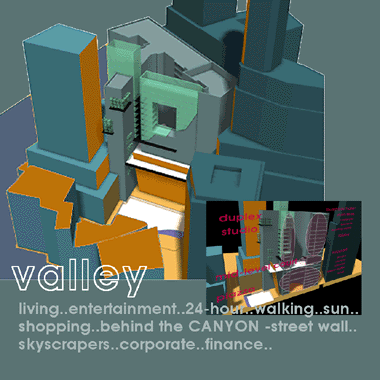
link these emerging activites to building morphologies, noting the big
difference between the "canyon" of Broad Street and the "valley" of the
low scaled remnants of Dutch New Amsterdam around Stone Street etc,
closeby.
Her Probe chose a vacant site on Williams Street which backed
onto the Broad Street canyon and directly faced the Valley of the old
dutch village.
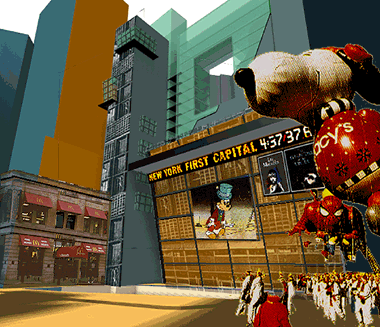
Josephine reprogrammed the block using existing buildings
and new elements from her previous research to create a rich hybrid of
work, live, hotel, entertainment and shopping functions, including a new
mediated public space which faced onto Williams Street.
Final Jurors; Irena Latek, Christine Boyer, Marissa Oliver, Mark Robbins, Lauren Otis, Michael Webb, Michael Manfredi, James Sanders, Joan Ockman, Andrea Kahn.
The Final Jury presentation was very concise and precise.
Andrea Kahn
praised the logic of the mixture of uses, especially the service
functions. She wondered if the creation of the open space facing the
"valley" was enough to bridge the gap? What were the projections for the
other uses in the "valley". How would those buildings be re-programed?
Brian McGrath wondered if the rooftops of the valley could be activated
and other links form to the "canyon"? There were many comments about the
sectional distribution of functions (while I was distracted from taking
notes by the arrival of tea).
Mark Robbins commented on the screens and
facades of the public space, including the cut "window" lighting the old
interior court.
Joan Ockman commented on the domestic scale of the
"valley" compared to the monumental height of the "canyon". She
questioned the employment of these natural metaphors in such a man
made environment, wondering if this was appropriate way to describe the
situation?
Irena Latek argued that this was a powerful metaphor which
worked well and made a great project, giving a rich "geography", fully
inscribing the project in three dimensions through the section of the
city.