
Grahame Shane
Brian Mc. Grath
Victoria Benatar
STUDENT PROBES
East Harlem is suffering from a cycle of disinvestment,
abandonment and demolition. The study area is centered on Fifth
Avenue and bounded by Lenox Avenue to the West and includes Park and
Lexington Avenue to the East. Two Parks - Marcus Garvey and Central
Park are within the neighborhood. Housing occupies much of East
Harlem. Some large scale high rise apartments on douple size
superblocks are exeptions to the overall low scale character of the
area. The population consists mainly of Latin and African Americans.
The surrounding neighborhoods in Upper Manhattan, make up greater
Harlem, and there are many prominent institutions nearby, the Apollo
Theater, Cathedral of St the Divine, Mount Sinai Hospital, Museo El
Barrio and Columbia University. The area is well served by mass
transportation. There is, however, a cultural, economical and social
disconnection from the rest of Manhattan .
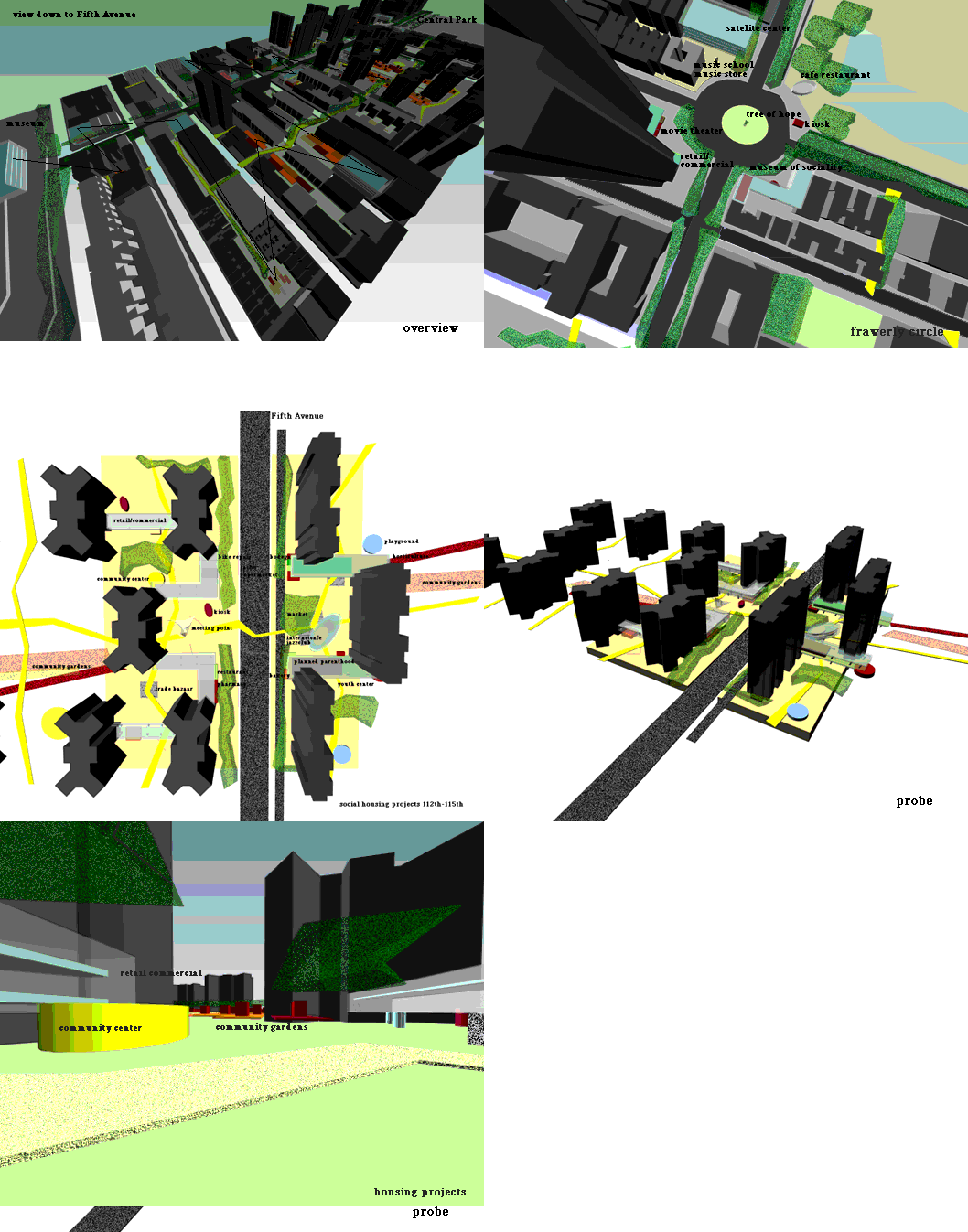
Large tracts of vacant land, some comprising nearly entire blocks, are spread along Fifth Avenue - north of 110th street. Smaller assemblages and isolated lots are dispersed throughout the area. Upon investigation, the blocks reveal various energies: the vacant hidden lots, the playgrounds, and the green space between the housing-projects.
The vacant lots present a challenge to create community gardens
within the blocks,who a giving the residents a sense of
responsibility and pride of place.
The intersection of 110th and Fifth Avenue represents the transition
between Central and East Harlem. By taking the opportunity to infill
the vacant lots by proposing retail, commercial, community activities
and cultural events, a flux towards Marcus Garvey Memorial Park is
created. This new network laces the blocks together across Fifth
Avenue.
Marcus Garvey Memorial Park is recognizable as a hill, which is
apparent when approaching Manhattan by car via theTriborough Bridge.
A museum is the connection between Fifth Ave. and the rest of
Harlem's cultural institutions (i.e. Apollo Theater). Given it's
prominent position, the museum becomes an icon, creating a local,
metropolitan, and global connection.
At the intersection of Fifth Avenue and 110th St.. Frawerly Circle
provides a transition/filter between Harlem and the rest of
Manhattan. A satellite center will accommodate cultural and social
opportunities to the community while simultaneously representing
Harlem's unique resources to the world.
The "green spaces" in the social housing projects between 112th and
115th are underutilized. Fences lock the occupants out of these green
spaces and playgrounds are buried by asphalt. A network within the
community is created by giving these spaces back to the residents and
developing them into gardens connected to community centers. By
providing retail and commercial activities the social housing
projects become a magnet rather than a void. The retail and
commercial activities are tied together with the community life (i.e.
there is a central horticultural cooperative which provides jobs,
services, and gardening materials to the occupants with the
opportunity that the gardens can prosper and sell back to the
community.)
For comments about the project write to:
[email protected]
PROBES[] REGION[] DISTRICT[] START[] HOME[] CURRICULUM[] GASPP[]