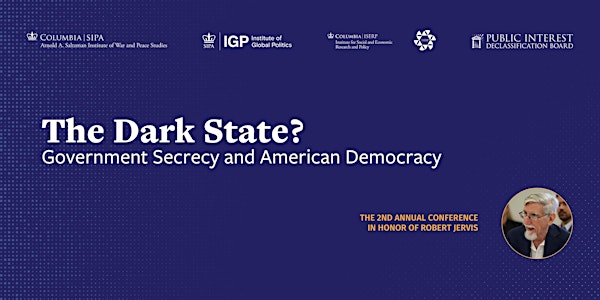
The 2nd Annual Conference in Honor of Robert Jervis
“The Dark State? Government Secrecy and American Democracy”
RSVP here.
Friday, April 19, 2024
School of International and Public Affairs
Columbia University in the City of New York
Presented by the Arnold A. Saltzman Institute of War and Peace Studies (SIWPS), the Institute of Global Politics (IGP), the Institute for Social and Economic Research and Policy (ISERP), and the Public Interest Declassification Board (PIDB).
This event will be in-person and livestreamed.
Named in honor of one of the modern era’s most significant international relations scholars, the Conference in Honor of Robert Jervis is Columbia’s premier international security event. This year’s conference will address the need for reform of America’s system for protecting state secrets. In cooperation with the bipartisan Public Interest Declassification Board, we are bringing together constitutional experts, journalists, members of the intelligence community, the tech community, and academics to debate and discuss the system of protecting sensitive security information and ensuring the public’s right to know what officials do in their name.
Conference Schedule:
9:30am: Light Breakfast
10:15am-10:30am: Welcome and Introduction
Featuring:
V. Page Fortna, Director, Arnold A. Saltzman Institute of War and Peace Studies; Harold Brown Professor of U.S. Foreign and Security Policy, Department of Political Science, Columbia University
Keren Yarhi-Milo, Dean, School of International and Public Affairs; Adlai E.
Stevenson Professor of International Relations, Department of Political Science, Columbia University
10:30am-12:00pm: Panel I: The Law of Secrecy
Panel Description: There is a contradiction at the core of our constitutional system. Presidents need to be able to act “with secrecy, and dispatch.” But representative government requires a well-informed electorate, and Congress must check any abuse of power. How is either possible if presidents are sovereign in deciding what constitutes national security information and who can have access to it? The question has never been fully addressed in court, and without knowing the answer it is unclear what Congress can do, and whether journalists and whistleblowers may face new legal jeopardy.
Featuring:
Heidi Kitrosser, William W. Gurley Professor of Law, Northwestern Law
David Pozen, Charles Keller Beekman Professor of Law, Columbia Law
Ben Wizner, Director, Speech, Privacy, and Tech Project, ACLU
Moderated by:
Carter Burwell, Counsel, Debevoise & Plimpton LLP
12:00pm-1:00pm: Lunch
1:00pm-2:30pm: Panel II: The Use and Misuse of Artificial Intelligence to Manage Dangerous Information
Panel Description: New information technology could help address the notorious problem of over-classification, accelerating the review and release of a large backlog of information the public has a right to know. At the same time, the newest kinds of AI, like large language models, can increase vulnerabilities, such as empowering bad actors with unprecedented access to dangerous information. What are the policy tradeoffs and long-term implications of using technology in managing national security information?
Featuring:
Camille François, Lecturer of International and Public Affairs, SIPA
Carmen Medina, Owner, MedinAnalytics LLC
Hanna Wallach, Partner Research Manager, Microsoft Research
Moderated by:
Sue Halpern, Author; Journalist; Former Staff Writer, The New Yorker
2:30pm-2:45pm: Break
2:45pm-4:15pm: Panel III: The Crisis of Overclassification: Can Proposed Reforms Help?
Panel Description: Presidents have long been able to set the rules for defining and protecting national security information through executive orders. But the complexity and scope of the contemporary national security apparatus has long defied attempts to reduce overclassification, and the number and size of leaks continue to grow. What new measures now under consideration could make a meaningful difference, and what more should citizens expect from their government?
Featuring:
Michael Collins, Chair, National Intelligence Council
Joe Lambert, former Director for Information Management Services, CIA
Tim Naftali, Senior Research Scholar and Adjunct Professor, Columbia SIPA; Member, Department of State Historical Advisory Committee
Moderated by:
Elizabeth Saunders, Professor of Political Science, Department of Political Science, Columbia University
4:15pm-4:45pm: Roundtable: Reflections on What We Have Learned
Featuring:
Matthew Connelly, Professor of International and Global History, Columbia
University
Keren Yarhi-Milo, Dean, School of International and Public Affairs; Adlai E.
Stevenson Professor of International Relations, Department of Political Science, Columbia University
Other Panelists TBA
4:45pm: Closing Remarks
4:50pm-6:00pm: Reception
 Columbia University