

Domesday book or The great survey of England of William the Conqueror A.D. MLXXXVI
(Southampton : Ordnance Survey Office, 1862.)
|
||

 Click here and hold to drag menu around
|





|
|
|
|

|
Page [84] | 
|
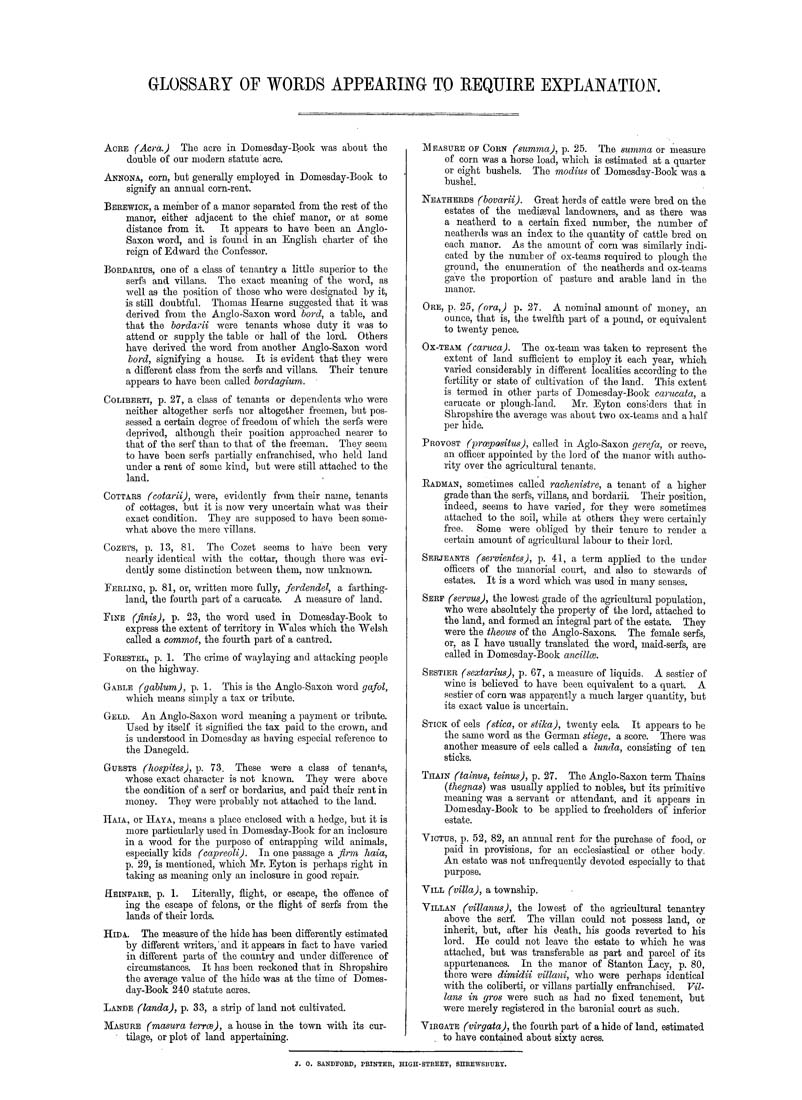
GLOSSARY OF  WORDS  APPEAIOTG TO KEQULRE  EXPLANATIOH


Aceb (Acrä.)   The acre in Domesday-Book  was about the

     double of our modern Statute acre.


Annona, com, but generally employed in Domesday-Book to

     signify an annüal corn-rent.


Beeewick, a meinber of a manor separated from the rest of the

     manor, either  adjacent to the chief manor,  or  at  some

     distance from  it.    It  appears to have been an Anglo-

     Saxon word, and is found in an English charter of the

     reign of Edward the Confessor.


Boedabius, one  of a class of tenantry a  little  superior to the

     serfs and villans.   The exact meaning of the word, as

     well as the position of those who were designated by it,

     is still doubtful.   Thomas Hearne suggested that it was

     derived from the  Anglo-Saxon word bord, a table, and

     that the bordarii  were  tenants whose  duty it was to

     attend or supply the table or hall of  the lord.   Others

     have derived the word from another Anglo-Saxon  word

     bord, signifying a  house.  It is evident  that they were

     a different class from the serfs and villans.  Their tenure

     appears to have been called bordagium.


Coliberti, p. 27, a class of tenants  or  dependents who were

     neither altogether serfs nor altogether freemen,  but pos-

     sessed a certain degree of freedom of which the serfs were

     deprived, although  their position  approached nearer to

     that of the serf than to that of the freeman.  They seem

     to have been serfs partially enfranchised,  who held land

     under a rent of some kind, but were still  attached to the

     land.


Cottars (eotarii),  were, evidently from their name, tenants

     of  cottages, but it is now very uncertain what was  their

     exact condition.  They are supposed to have been some-

     what above the mere villans.


Cozets,  p. 13,  81.  The  Cozet  seems to have  been  very

     nearly identical with the  cottar, though  there was evi¬

     dently some distinction between  them,  now unknown.


Febling, p. 81,  or,  written more fully, ferdendel,  a farthing-

     land, the fourth part of a carucate.  A  rneasure of land.


Eine (finis), p.  23, the word used in Domesday-Book  to

     express the extent of territory in "Wales which the "Welsh

     called a eommot, the fourth part  of a cantred.


Forestel, p. 1.  The crime of waylaying and attacking people

     on  the highway.


Gable  (gäblum), p. 1.   This is the Anglo-Saxon word gafol,

     which means simply a tax or tribute.


Geld.   An Anglo-Saxon word meaning  a payment or tribute.

     TJsed by itself  it signifled the tax paid to the crown, and

     is understood in Domesday as having especial reference to

     the Danegeld.


Guests  (hospites),  p. 73.   These were a class  of tenants,

     whose exact character is not  known.   They  were  above

     tbe condition of a serf or bordarius,  and paid their rent in

     money.  They were probably not attached to the land.


Haia, or Haya, means a place enclosed with a hedge,  but it is

     more particularly used in Domesday-Book  for an inclosure

     in a wood  for  the purpose of entrapping wild  animals,

     especially kids  (eapreoli).  In one passage a firm  haia,

     p. 29, is mentioned, which Mr. Eyton is perhaps right in

     taking as meaning only an inclosure in good repair.


Heinfare, p. 1.   Literally, night, or escape, the offence of

     ing the escape of felons,  or the night  of serfs from the

     lands of their lords.


Hida.   The rneasure of the hide has been differently estimated

     by  different writers,' and it appears in fact to have varied

     in  different parts of the country and under difference of

     circumstances.   It has been reckoned that in  Shropshire

     the average value of the hide was at the time of Domes¬

     day-Book 240 Statute acres.


Lande (landa), p. 33,  a strip of land not cultivated.


Masuee (masura terrae), a house in the town with its cur-

     tilage, or plot of land  appertaining.


Measure of Cobn (summa), p. 25.   The summa or rneasure

     of com was a horse load, which is estimated at a quarter

     or eight busheis.  The modius of Domesday-Book was a

     bushel.


Neatherds (bovarii).   Great herds of cattle were bred on the

     estates of the medireval landowners,  and as  there  was

     a neatherd to a  certain  fixed number, the number of

     neatherds was an  index to the quantity of  cattle bred on

     each manor.  As  the  amount of com was  similarly indi-

     cated by the  number  of ox-teams required to plough the

     ground, the  enumeration  of the neatherds and ox-teams

     gave the proportion of  pasture  and arable land in the

     manor.


Ore, p. 25, (ora,) p.  27.  A nominal amount  of money, an

     ounce, that is, the twelfth part of a pound, or equivalent

     to twenty pence.


Ox-team  (caruca).  The  ox-team was taken to represent the

     extent  of land sufHcient  to employ it  each year, which

     varied considerably in different localities according to the

     fertility or state of cultivation  of the land. This extent

     is termed in other parts of Domesday-Book carucata, a

     carucate or plough-land.   Mr.  Eyton  cons'iders  that in

     Shropshire the average was about two ox-teams and a half

     per hide.


Provost  fprmpositus), called  in Aglo-Saxon gerefa, or reeve,

     an officer appointed by the lord of the manor with autho-

     rity over  the agricultural tenants.


Radman,  sometimes called rachenistre, a tenant of a higher

     grade than the serfs, villans, and bordarii.  Their position,

     indeed, seems to  have varied, for they were  sometimes

     attached  to the  soil, while  at others they  were certainly

     free.   Some  were obliged by their tenure to render a

     certain amount of agricultural labour to  their lord.


Serjeants (servientes), p. 41, a term applied to  the under

     officers of the manorial court,  and also to stewards of

     estates.   It is a word which was used in many senses.


Serf (servus), the lowest grade of the agricultural population,

     who  were absolutely the property of the lord, attached to

     the land, and formed an integral part of  the estate.  They

     were the  theows of the Anglo-Saxons.   The female serfs,

     or, as I have usually translated the word, maid-serfs, are

     called in  Domesday-Book ancilloe.


Sestiee (sextarius), p. 67,  a measure  of liquids. A sestier of

     wine is believed to have been equivalent to a quart.  A.

     sestier of com was apparently a much larger quantity, but

     its exact value is uncertain.


Stick of eels  (stica, or stika), twenty eels.  It appears to be

     the same  word as the  German stiege, a score.   There was

     another measure of eels called a  lunda,  consisting of ten

     sticks.


Thajn (talnus, teinus), p. 27.   The Anglo-Saxon term Thains

     (thegnas) was usually  applied to nobles, but its primitive

     meaning was a servant or attendant, and  it appears in

     Domesday-Book to be applied to freeholders of  inferior

     estate.


Victus, p. 52, 82, an annual rent for the purchase of food, or

     paid  in provisions, for an ecclesiastical or other body.

     An estate was not unfrequently devoted especially to that

     purpose.


Vill (villa), a township.


Villan (villanus), the lowest  of  the agricultural tenantry

     above the serf.    The  villan could not possess land, or

     inherit, but, after his death, his goods reverted to his

     lord.  He could  not  leave the  estate to which  he  was

     attached, but was transferable  as part  and parcel of its

     appurtenances.  In the manor of  Stanton Lacy, p. 80,

     thore were dimidii villani, who were  perhaps identical

     with the  coliberti, or villans partially enfranchised.   Vil¬

     lans  in gros were such as had no  fixed tenement,  but

     were merely registered  in the baronial court as such.


Virgate (virgata), the fourth part of a hide of land, estimated

   .  to have contained about sixty acres.


>STREET, SHREWSBÜBY.


3. 0.  SANDPOBD, PBINTEB, HIGH
|
|
|
Page [84] |
|