

Knapp, Shepherd, A history of the Brick Presbyterian Church in the City of New York
(New York : Trustees of the Brick Presbyterian Church, 1909.)
|
||

 Click here and hold to drag menu around
|





|
|
|
|

|
Page 203 | 
|
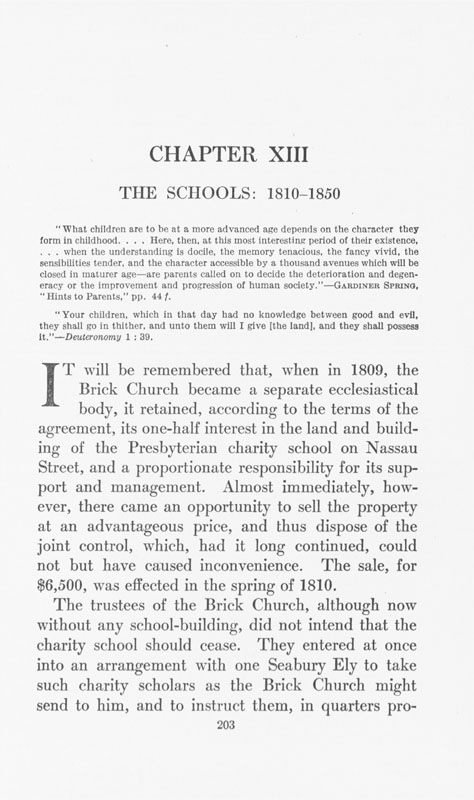
CHAPTER XIII THE SCHOOLS: 1810-1850 ""What children are to be at a more advanced age depends on the character they form in childhood. . . . Here, then, at this most interesting period of their existence, . . . when the understanding is docile, the memory tenacious, the fancy vivid, the sensibilities tender, and the character accessible by a thousand avenues which will be closed in maturer age—are parents called on to decide the deterioration and degen¬ eracy or the improvement and progression of human society."—Gardiner Spring, " Hints to Parents," pp. 44 /. "Your children, which in that day had no knowledge between good and evil, they shall go in thither, and unto them will I give [the landl, and they shall possess it."—Deuteronomy 1 ; 39. IT will be remembered that, when in 1809, the Brick Church became a separate ecclesiastical body, it retained, according to the terms of the agreement, its one-half interest in the land and build¬ ing of the Presbyterian charity school on Nassau Street, and a proportionate responsibility for its sup¬ port and management. Almost immediately, how¬ ever, there came an opportunity to sell the property at an advantageous price, and thus dispose of the joint control, which, had it long continued, could not but have caused inconvenience. The sale, for $6,500, was effected in the spring of 1810. The trustees of the Brick Church, although now without any school-building, did not intend that the charity school should cease. They entered at once into an arrangement with one Seabury Ely to take such charity scholars as the Brick Church might send to him, and to instruct them, in quarters pro- 203 |
|
|
Page 203 |
|