

Men of affairs in New York
(New York : L.R. Hamersley, 1906.)
|
||

 Click here and hold to drag menu around
|





|
|
|
|

|
Page 1 | 
|
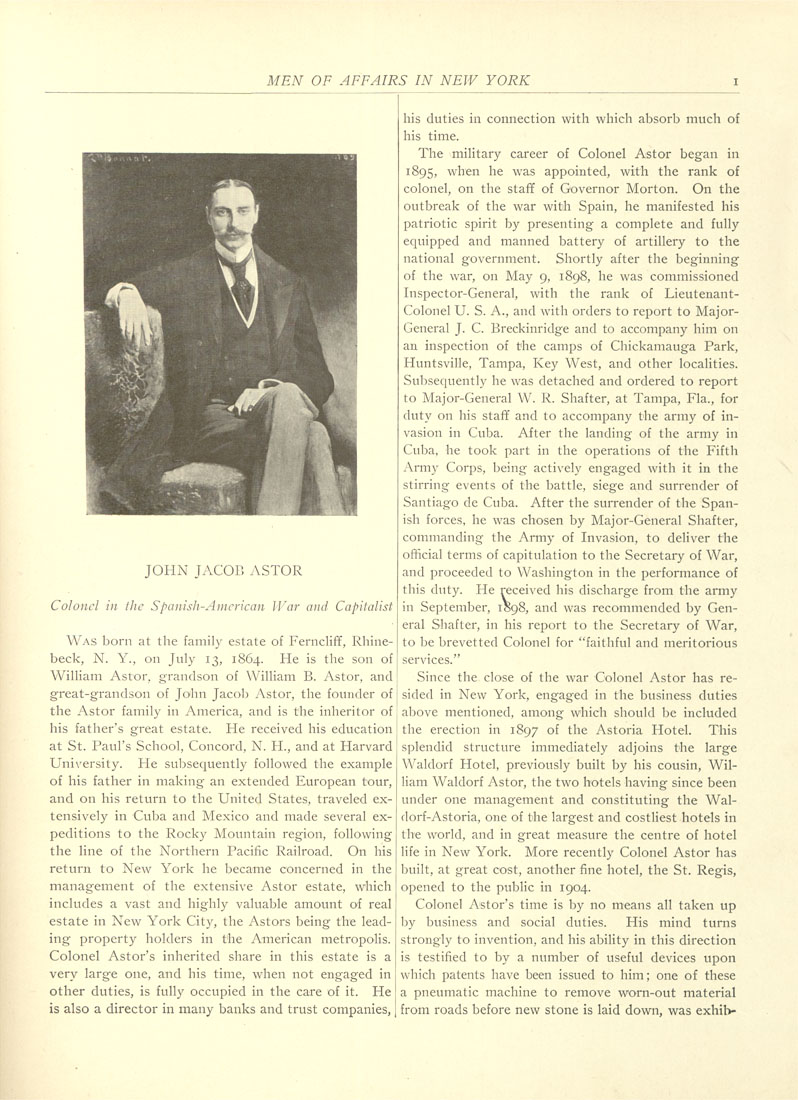
MEN OF AFFAIRS IN NEW YORK JOHN JACOB ASTOR Colonel in the Spanish-American War and Capitalist Was born at the family estate of Ferncliff, Rhine- beck, N. Y., on July 13, 1864. He is the son of William Astor, grandson of William B. Astor, and great-grandson of John Jacob Astor, the founder of the Astor family in America, and is the inheritor of his father's great estate. He received his education at St. Paul's School, Concord, N. H., and at Harvard University. He subsec[uently followed the example of his father in making an extended European tour, and on his return to the United States, traveled ex¬ tensively in Cuba and Mexico and made several ex¬ peditions to the Rocky Mountain region, following the line of the Northern Pacific Railroad. On his return to New York he became concerned in the management of the extensive Astor estate, which includes a vast and highly valuable amount of real estate in New York Cit}^, the Astors being the lead¬ ing property holders in the American metropolis. Colonel Astor's inherited share in this estate is a very large one, and his time, when not engaged in other duties, is fully occupied in the care of it. He is also a director in many banks and trust companies, his duties in connection with which absorb much of his time. The military career of Colonel Astor began in 1895, when he was appointed, with the rank of colonel, on the staff of Governor Morton. On the outbreak of the war with Spain, he manifested his patriotic spirit by presenting a complete and fully equipped and manned battery of artillery to the national government. Shortly after the beginning of the war, on May 9, 1898, he was commissioned Inspector-General, with the rank of Lieutenant- Colonel U. S. A., and with orders to report to Major- General J. C. Breckinridge and to accompany him on an inspection of the camps of Chickamauga Park, Huntsville, Tampa, Key West, and other localities. Subsequently he was detached and ordered to report to Major-General W^ R. Shafter, at Tampa, Fla., for duty on his staff and to accompany the army of in¬ vasion in Cuba. After the landing of the army in Cuba, he took part in the operations of the Fifth Army Corps, being actively engaged with it in the stirring events of the battle, siege and surrender of Santiago de Cuba. After the surrender of the Span¬ ish forces, he was chosen by Major-General Shafter, commanding the Army of Invasion, to deliver the official terms of capitulation to the Secretary of War, and proceeded to Washington in the performance of this duty. He received his discharge from the army in September, 1898, and was recommended by Gen¬ eral Shafter, in his report to the Secretary of War, to be brevetted Colonel for ''faithful and meritorious services." Since the close of the war Colonel Astor has re¬ sided in New York, engaged in the business duties above mentioned, among which should be included the erection in 1897 of the Astoria Hotel. This splendid structure immediately adjoins the large Waldorf Hotel, previously built by his cousin, Wil¬ liam Waldorf Astor, the two hotels having since been under one management and constituting the Wal¬ dorf-Astoria, one of the largest and costliest hotels in the world, and in great measure the centre of hotel life in New York. More recently Colonel Astor has built, at great cost, another fine hotel, the St. Regis, opened to the public in 1904. Colonel Astor's time is by no means all taken up by business and social duties. His mind turns strongly to invention, and his ability in this direction is testified to by a number of useful devices upon which patents have been issued to him; one of these a pneumatic machine to remove worn-out material from roads before new stone is laid down, was exhib- |
|
|
Page 1 |
|