

The New York clipper annual (1892)
(New York : Frank Queen Pub. Co., 1883-)
|
||

 Click here and hold to drag menu around
|





|
|
|
|

|
Page 19 | 
|
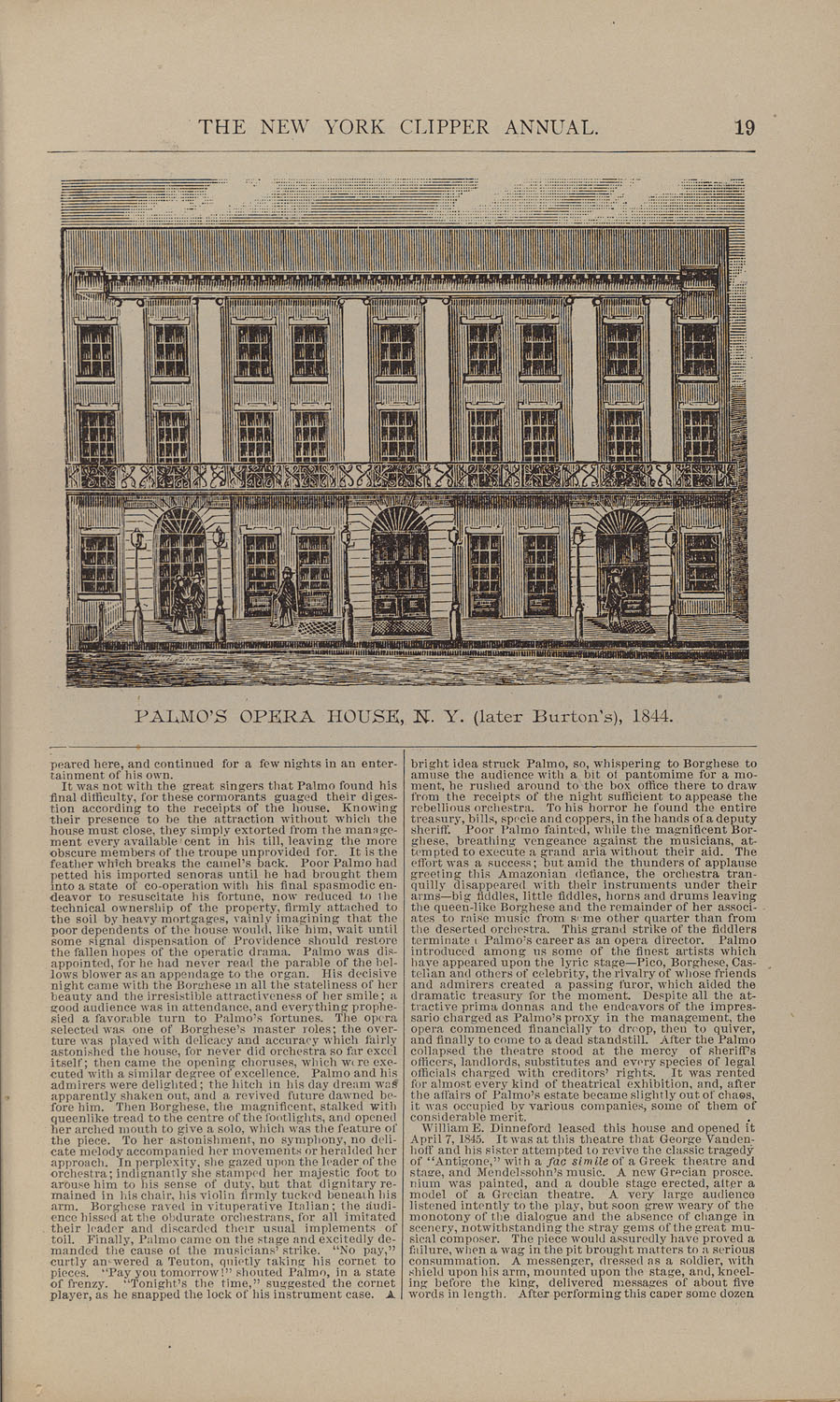
THE NEW YORK CLIPPER ANNUAL. 19 PALMO'S OPERA HOUSE, N. Y. (later Burton's), 1844. peared here, and continued for a few nights in an enter¬ tainment of his own. It Avas not Avitli the great singers that Palmo found his final difficulty, for these cormorants guaged their diges¬ tion according to the receipts of the house. KnoAving their presence to be the attraction Avithout which the house must close, they simply extorted from the manage¬ ment every available cent in his till, leaving the more obscure members of the troupe unprovided for. It is the feather Avhich breaks the camel's back. Poor Palmo had petted his imported senoras until he had brought them into a state of co-operation Avith his final spasmodic en¬ deavor to resuscitate his fortune, noAv reduced to the technical OAvnership of the property, firmly attached to the soil by heavy mortgages, vainly imagining that the poor dependents of the house Avouhl, like him, wait until some signal dispensation of Providence should restore the fallen hopes of the operatic drama. Palmo was dis¬ appointed, for he had never read the parable of the bel- loAvs blower as an appendage to the organ. His decisive night came Avith the Borghese in all the stateliness of her beauty and the irresistiijle attractiveness of her smile; a good audience Avas in attendance, and CA'erything prophe¬ sied a favorable turn to Palme's fortunes. The ope ra selected Avas one of Borghese's master regies; the over¬ ture was played Avith delicacy and accurac.y Avhich fairly astonisheei the house, for never did orchestra so far exce-l itself; then came the opening choruses, which were exe¬ cuted Avith a similar degree of excellence. Palmo and his admirers Avere delighted; the hitch in his day dream wai*i apparently shaken out, and a revived future daAvned be¬ fore him. Then Borghese, the magnificent, stalked with queenlike tread to the centre of the loctlights, and opened her arched mouth to give a solo, which was the feature of the piece. To her astonishment, no symphony, no deli¬ cate melody accompanied her movements f)r heralded her approach. In perplexity, she gazed upon the leader of the orchestra; indignantly she stamped her majestic foot to arouse him to his sense of duty, but that dignitary re¬ mained in his chair, his A'iolin firml.y tucked beneaih his arm. Borghese raveel in Autuperative Italian; the audi¬ ence hisscnl at the obdurate orchestrans, feir all imitated their leader and discarded their usual implements of toil. Finally, Palmo came on the stage and excitedly de¬ manded the cause of the musicians' strike. "No pay," curtly answered a Teuton, quie'tly taking his cornet to pieces. "Pay you tomorrow!" shouted Palmo, in a state of frenzy. "Toni.ght's the time," suggested the cornet player, as he snapped the lock of his instrument case. A bright idea struck Palmo, so, whispering to Borghese to amuse the audience with a bit of pantomime for a mo¬ ment, he rushed around to the box office there to draAV from the receipts of the night sufficient to appease the rebellie)us e)rchestra. To his horror he found the entire treasury, bills, specie and coppers, in the hands of a deputy sherift'. Poor Palmo fainted, while the magnificent Bor¬ ghese, breathing vengeance against the musicians, at¬ tempted to execute a grand aria Avithout their aid. The effort Avas a success; "but amid the thunders of applause greeting this Amazonian defiance, the orchestra tran¬ quilly disappeared Avith their instruments under their arms'—big fiddles, little fiddles, horns and drums leaving the queen-like Borghese and the remainder of her associ¬ ates to raise music from S' me other quarter than from the deserted orchestra. This grand strike of the fiddlers terminate I Palmo's career as'^an opera director. Palmo introduced among us some of the finest artists which have appeared upon the lyric stage—Pico, Borghese, Cas¬ tellan and others of celebrity, the rivalr.y e)f whose friends and admirers created a passing furor", Avhich aided the dramatic treasur.y for the moment. Despite all the at¬ tractive prima donnas and the endeavors of the impres- sario charged as Palmo's proxy in the mana.gement, the opera commenced financially to droop, then to quiver, and finally to come to a dead standstill. After the Palmo collapsed the theatre stood at the mercy of sherifPs officers, landlords, substitutes and every species of legal officials char.ged Avith creditors' rights. It was rented for almost every kind of theatrical exhibition, and, after the affairs of Palme)'s estate became slightly out of chass, it AA-as occupied by various companies, some of them of considerable merit. William E. Dinneford leased this house and opened it April 7, 1845. It Avas at this theatre that George Vanden- hoft" and his sister attempted to rcAdve the classic tragedy of "Antigone," Avith a fac simile of a Greek theatre and stasre, and Mendelssohn's music. A ncAV GrAcian prosce. nium was painted, and a double stage erected, alt.er a model of a Grecian theatre. A very large audience listened intently to the play, but soon groAV Avear.y of the monotony of the dialogue and the absence of change in scenery, notAvithstandihg the stray gems of the great mu¬ sical composer. The piece would assuredl.y have proA'ed a failure, when a Avag in the pit brought matters to a serious consummation. A messen.ger, dressed as a sejldier, with shield upon his arm, mounted upon the stage, and, kneel¬ ing before the kin.g, delivered messages of about five Avords in length. After performing this caner some dozen |
|
|
Page 19 |
|