

The New York clipper annual (1892)
(New York : Frank Queen Pub. Co., 1883-)
|
||

 Click here and hold to drag menu around
|





|
|
|
|

|
Page 25 | 
|
THE  NEW YORK  CLIPPER  ANNUM.


25


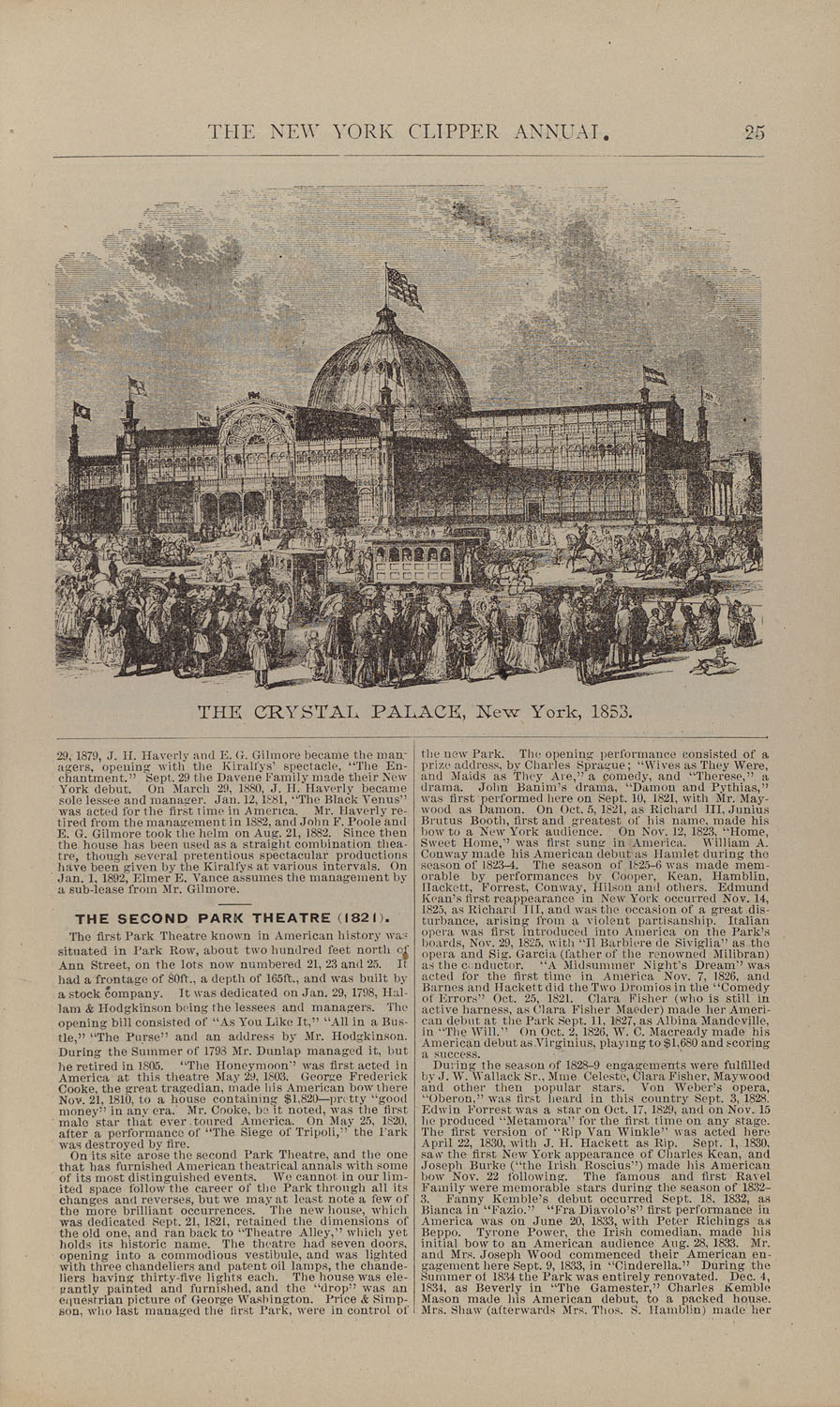
THE  CRYSTAL PALACE, New York, 1853.


29, 1879, J. II. Haverly anel E. G. Gilmore became the man"
agers, opening Avith the Kiralfys' spectacle, "The En¬
chantment" Sept. 29 the DaA'ene Family made their Ncav
York debut. On Marcli 29, 1880, J. H. Haverly became
sole lessee and manager. Jan. 12,1S81, "The Black Venus"
was acted for the first time in America. Mr. Haverly re¬
tired from the management in 1882, and John F. Poole and
E. G. Gilmore took the helm on Au.g. 21, 1882. Since then
the house has been used as a straight combinatiem thea¬
tre, though several pretentious spectacular productions
have been given by the Kiralfys at various intervals. On
Jan. 1, 1892, Elmer E. Vance assumes the management by
a sub-lease from Mr. Gilmore.


if


THE SECOND PARK THEATRE (1821).

The first Park Theatre known in American hi.story Ava;-
situated in I'ark Row, about two hundred feet north o,
Ann Street, on the lots now numbered 21, 23 and 25,
had a frontage of 80ft., a depth of 165ft., anel was built b.y
a stock company. It Avas dedicated on Jan. 29, 1798, Hal¬
lam &. Hodgkinson being the lessees and managers. The
opening bill consisted of "As You Like It," "All in a Bus¬
tle," "The Purse" and an address by Mr. Hodgkinson.
During the Summer of 1793 Mr. Dunlap managed it, but
he retired in 1805. "The IIone.ymoon'' Avas first acted in
America at this theatre Maj' 29, 1803. (ieorge Frederick
Cooke, the great tragedian, made his American boAv there
Nov. 21, 1810, to a house containing $1,820—])ri tty "gooel
money" in any era. Mr. Cooke, belt noted, Avas the first
male star that ever.toured America. On May 2.5, 1820,
after a performance of "The Siege of Tripoli," the Park
Avas destroyed by fire.

On its site aro'se the second Park Theatre, and the one
that has furnished American theatrical annals with some
of its most distinguished events. Wo cannot in our lim¬
ited space follow the career of the Park through all its
changes anel reverses, but Ave ma.y at least note a few of
the more brilliant occurrences. The neAV house, Avhich
was dedicated Sept. 21, 1821, retained the dimensions of
the old one, and ran back to "Theatre Alley," which yet
holds its historic name. The the'atre had seven doors,
opening into a commoelious vestibule, and Avas lighted
with three chandeliers and patent oil lamps, the chande¬
liers having thirty-five lights each. The house was ele¬
gantly painted and furnished, and the "drop" was an
e/iue.s'trian picture of George Washington. Price & Simp¬
son, Avho last managed the first Park, Avere in control of


the noAv Park. The opening performance consisted of a
prize address, by Charles Sprague; "Wives as They Were,
and Maids as They Are," a comedy, and "Therese," a
drama. John Banim's drama, "Damon and Pythias,"
Avas first performed here on Sept. 10, 1821, with Mr. May-
Avood as Damon. On Oct. 5, 1821, as Richard III, Junius
Brutus Booth, first and greatest of his name, made his
bow- to a Ncav York audience. On Nov. 12, 1823, "Home,
Sweet Home," Avas first sung in Ameiica. William A.
CouAvay made his American elebut as Hamlet during the
season of 1823-4. The season of 182.5-6 Avas made mem¬
orable by performances by Cooper, Kean, Hamblin,
Hackett, Forrest, Conway, Hilson and others. Edmund
Kean's first reappearance in New York occurred Nov. 14,
1825, as Richard III, and Avasthe occasion of a great dis¬
turbance, arising from a violent partisanship. Italian
opera Avas first introduced into America on the Park's
boards, Nov. 29, 1825, with "II Barbiere de Siviglia" as the
e)pera and Sig. Garcia (father of the renownenl Milibran)
as the c nductor. "A Midsummer Night's Dream'' Avas
acted for the first time in America'Noa-. 7, 1826, and
Barnes and Hackett did the Two Dre)miosin the "Comedy
of Errors" Oct. 25, 1821. Clara Fisher (who is still in
active harness, as (jlara Fisher Maeder) made her Ameri¬
can debut at the Park Sept. 11, 1827, as Albina Mandeville,
in "The Will." On Oct 2, 1826, W. C. Macready made his
American debut as.Virginius, playing to $1,680 and scoring
a success.

During the season of 1828-9 enga.gements Avere fulfilled
by J. W. Wallack Sr., Mine Celeste, Clara Fisher, Maywood
and other then popular stars. Von Weber's opera,
"Oberon," Avas first heard in this country Sept. 3, 1828.
Edwin Forrest Avas a star on Oct. 17, 1829, and on Nov. 15
he produced "Metamora" for the first time on any stage.
The first Aversion of "Rip Van Winkle'" Avas acted here
April 22, 1830, Avith J. H. Hackett as Rip. Sept. 1, 1830,
saw the first Ncav York appearance of Charles Kean, and
Joseph Burke ("the Irish Roscius'') made his American
benv NoA'. 22 folloAving. The famous and first Ravel
Family were memorable stars during the season of 1832-
3. Fanny Kemble's debut occurred Sept. 18, 1832, as
Bianca in "Fazio." "Fra Diavolo's" first performance iii
America Avas on June 20, 1833, Avith Peter Richings as
Beppo. Tyrone Power, the Irish ce)median, made his
initial boAV to an American audience Aug. 28, 1833. Mr.
and Mrs. Joseph Wood commenced their American en¬
gagement here Sept. 9, 1833, in "Cinderella." During the
Summer ot \?>M the Park Avas entirely renewated. Dec. 4,
1834, as Beverly in "The Gamester," Charles Kemble
Mason made his American debut, to a packed house.
Mrs. Shaw (aftei-Avards Mrs. Thos. S. Ilamblin) made her
|
|
|
Page 25 |
|