

Fifth Avenue; glances at the vicissitudes and romance of a world-renowned thoroughfare
(New York : Printed for the Fifth Avenue Bank of New York, 1915.)
|
||

 Click here and hold to drag menu around
|





|
|
|
|

|
Page 18 | 
|
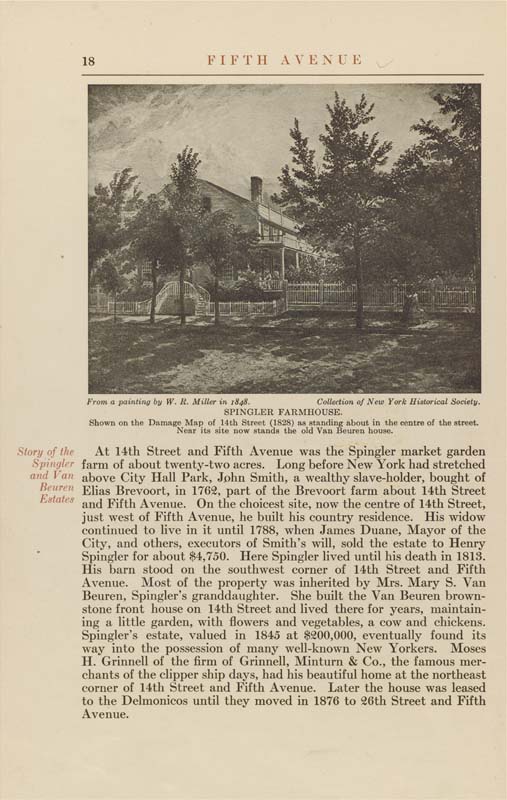
18 FIFTH AVENUE Story of the Spingler and Van Beuren Estates From a painting by W. R. Miller in 1848. Collection of New York Historical Society. SPINGLER FARMHOUSE. Shown on the Damage Map of 14th Street (1828) as standing about in the centre of the street. Near its site now stands the old Van Beuren house. At 14 th Street and Fifth Avenue was the Spingler market garden farm of about twenty-two acres. Long before New York had stretched above City Hall Park, John Smith, a wealthy slave-holder, bought of Elias Brevoort, in 1762, part of the Brevoort farm about 14th Street and Fifth Avenue. On the choicest site, now the centre of 14th Street, just west of Fifth Avenue, he built his country residence. His widow continued to live in it until 1788, when James Duane, Mayor of the City, and others, executors of Smith's will, sold the estate to Henry Spingler for about $4,750. Here Spingler lived until his death in 1813. His barn stood on the southwest corner of 14th Street and Fifth Avenue. Most of the property was inherited by Mrs. Mary S. Van Beuren, Spingler's granddaughter. She built the Van Beuren brown¬ stone front house on 14th Street and lived there for years, maintain¬ ing a little garden, with flowers and vegetables, a cow and chickens. Spingler's estate, valued in 1845 at $200,000, eventually found its way into the possession of many well-known New Yorkers. Moses H. Grinnell of the firm of Grinnell, Minturn & Co., the famous mer¬ chants of the clipper ship days, had his beautiful home at the northeast corner of 14th Street and Fifth Avenue. Later the house was leased to the Delmonicos until they moved in 1876 to 26th Street and Fifth Avenue. |
|
|
Page 18 |
|