

Fifth Avenue; glances at the vicissitudes and romance of a world-renowned thoroughfare
(New York : Printed for the Fifth Avenue Bank of New York, 1915.)
|
||

 Click here and hold to drag menu around
|





|
|
|
|

|
Page 26 | 
|
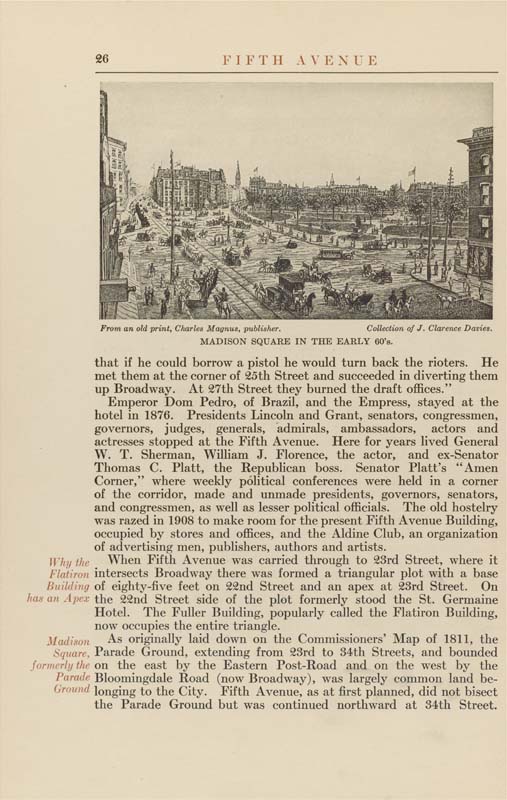
26 FIFTH AVENUE Why the Flatiron Building has an Apex Madison Square, formerly the Parade Ground From an old print, Charles Magnus, publisher. Collection of J. Clarence Davies. MADISON SQUARE IN THE EARLY GO's. that if he could borrow a pistol he would turn back the rioters. He met them at the corner of 25th Street and succeeded in diverting them up Broadway. At 27th Street they burned the draft offices." Emperor Dom Pedro, of Brazil, and the Empress, stayed at the hotel in 1876. Presidents Lincoln and Grant, senators, congressmen, governors, judges, generals, admirals, ambassadors, actors and actresses stopped at the Fifth Avenue. Here for years lived General W. T. Sherman, William J. Florence, the actor, and ex-Senator Thomas C. Piatt, the Republican boss. Senator Piatt's "Amen Corner," where weekly political conferences were held in a corner of the corridor, made and unmade presidents, governors, senators, and congressmen, as well as lesser political officials. The old hostelry was razed in 1908 to make room for the present Fifth Avenue Building, occupied by stores and offices, and the Aldine Club, an organization of advertising men, publishers, authors and artists. When Fifth Avenue was carried through to 23rd Street, where it intersects Broadway there was formed a triangular plot with a base of eighty-five feet on 22nd Street and an apex at 23rd Street. On the 22nd Street side of the plot formerly stood the St. Germaine Hotel. The Fuller Building, popularly called the Flatiron Building, now occupies the entire triangle. As originally laid down on the Commissioners' Map of 1811, the Parade Ground, extending from 23rd to 34th Streets, and bounded on the east by the Eastern Post-Road and on the west by the Bloomingdale Road (now Broadway), was largely common land be¬ longing to the City. Fifth Avenue, as at first planned, did not bisect the Parade Ground but was continued northward at 34th Street. |
|
|
Page 26 |
|