

Fifth Avenue; glances at the vicissitudes and romance of a world-renowned thoroughfare
(New York : Printed for the Fifth Avenue Bank of New York, 1915.)
|
||

 Click here and hold to drag menu around
|





|
|
|
|

|
Page 52 | 
|
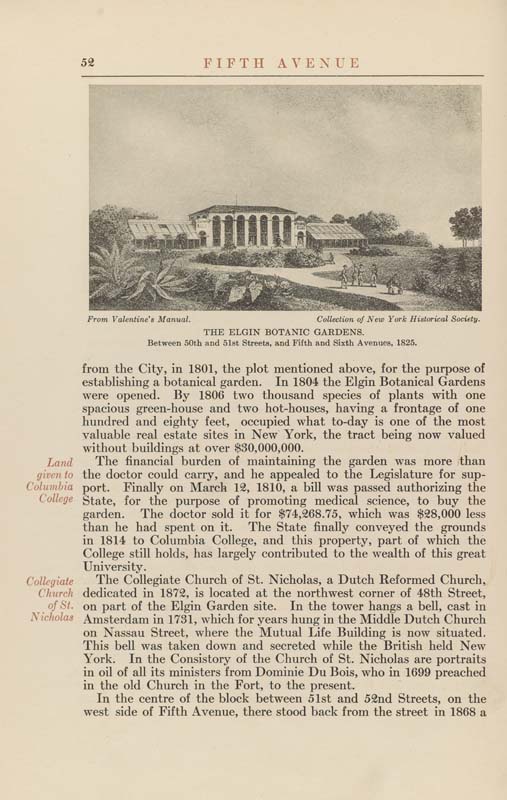
52 FIFTH AVENUE From Valentine's Manual. Collection of New York Historical Society. THE ELGIN BOTANIC GARDENS. Between 50th and 51st Streets, and Fifth and Sixth Avenues, 1825. Land given to Columbia College Collegiate Church of St. Nicholas from the City, in 1801, the plot mentioned above, for the purpose of establishing a botanical garden. In 1804 the Elgin Botanical Gardens were opened. By 1806 two thousand species of plants with one spacious green-house and two hot-houses, having a frontage of one hundred and eighty feet, occupied what to-day is one of the most valuable real estate sites in New York, the tract being now valued without buildings at over $30,000,000. The financial burden of maintaining the garden was more than the doctor could carry, and he appealed to the Legislature for sup¬ port. Finally on March 12, 1810, a bill was passed authorizing the State, for the purpose of promoting medical science, to buy the garden. The doctor sold it for $74,268.75, which was $28,000 less than he had spent on it. The State finally conveyed the grounds in 1814 to Columbia College, and this property, part of which the College still holds, has largely contributed to the wealth of this great University. The Collegiate Church of St. Nicholas, a Dutch Reformed Church, dedicated in 1872, is located at the northwest corner of 48th Street, on part of the Elgin Garden site. In the tower hangs a bell, cast in Amsterdam in 1731, which for years hung in the Middle Dutch Church on Nassau Street, where the Mutual Life Building is now situated. This bell was taken down and secreted while the British held New York. In the Consistory of the Church of St. Nicholas are portraits in oil of all its ministers from Dominie Du Bois, who in 1699 preached in the old Church in the Fort, to the present. In the centre of the block between 51st and 52nd Streets, on the west side of Fifth Avenue, there stood back from the street in 1868 a |
|
|
Page 52 |
|