

Fifth Avenue; glances at the vicissitudes and romance of a world-renowned thoroughfare
(New York : Printed for the Fifth Avenue Bank of New York, 1915.)
|
||

 Click here and hold to drag menu around
|





|
|
|
|

|
Page 65 | 
|
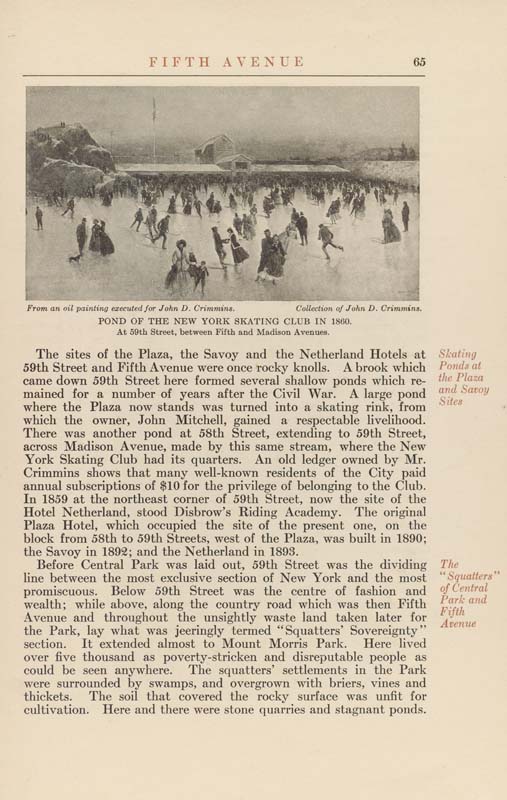
FIFTH AVENUE 65 From an oil painting executed Jar J utin V. L'nin::iins. Collection of John D. Crimmins. POND OF THE NEW YORK SKATING CLUB IN 1860. At 59th Street, between Fifth and Madison Avenues. The sites of the Plaza, the Savoy and the Netherland Hotels at 59th Street and Fifth Avenue were once rocky knolls. A brook which came down 59th Street here formed several shallow ponds which re¬ mained for a number of years after the Civil War. A large pond where the Plaza now stands was turned into a skating rink, from which the owner, John Mitchell, gained a respectable livelihood. There was another pond at 58th Street, extending to 59th Street, across Madison Avenue, made by this same stream, where the New York Skating Club had its quarters. An old ledger owned by Mr. Crimmins shows that many well-known residents of the City paid annual subscriptions of $10 for the privilege of belonging to the Club. In 1859 at the northeast corner of 59th Street, now the site of the Hotel Netherland, stood Disbrow's Riding Academy. The original Plaza Hotel, which occupied the site of the present one, on the block from 58th to 59th Streets, west of the Plaza, was built in 1890; the Savoy in 1892; and the Netherland in 1893. Before Central Park was laid out, 59th Street was the dividing line between the most exclusive section of New York and the most promiscuous. Below 59th Street was the centre of fashion and wealth; while above, along the country road which was then Fifth Avenue and throughout the unsightly waste land taken later for the Park, lay what was jeeringly termed "Squatters' Sovereignty" section. It extended almost to Mount Morris Park. Here lived over five thousand as poverty-stricken and disreputable people as could be seen anywhere. The squatters' settlements in the Park were surrounded by swamps, and overgrown with briers, vines and thickets. The soil that covered the rocky surface was unfit for cultivation. Here and there were stone quarries and stagnant ponds. Skating Ponds at the Plaza and Savoy Sites The ''Squatters" of Central Park and Fifth Avenue |
|
|
Page 65 |
|