

The poor in great cities.
(London : K. Paul, Trench, Trübner & Co., 1896.)
|
||

 Click here and hold to drag menu around
|





|
|
|
|

|
Page 104 | 
|
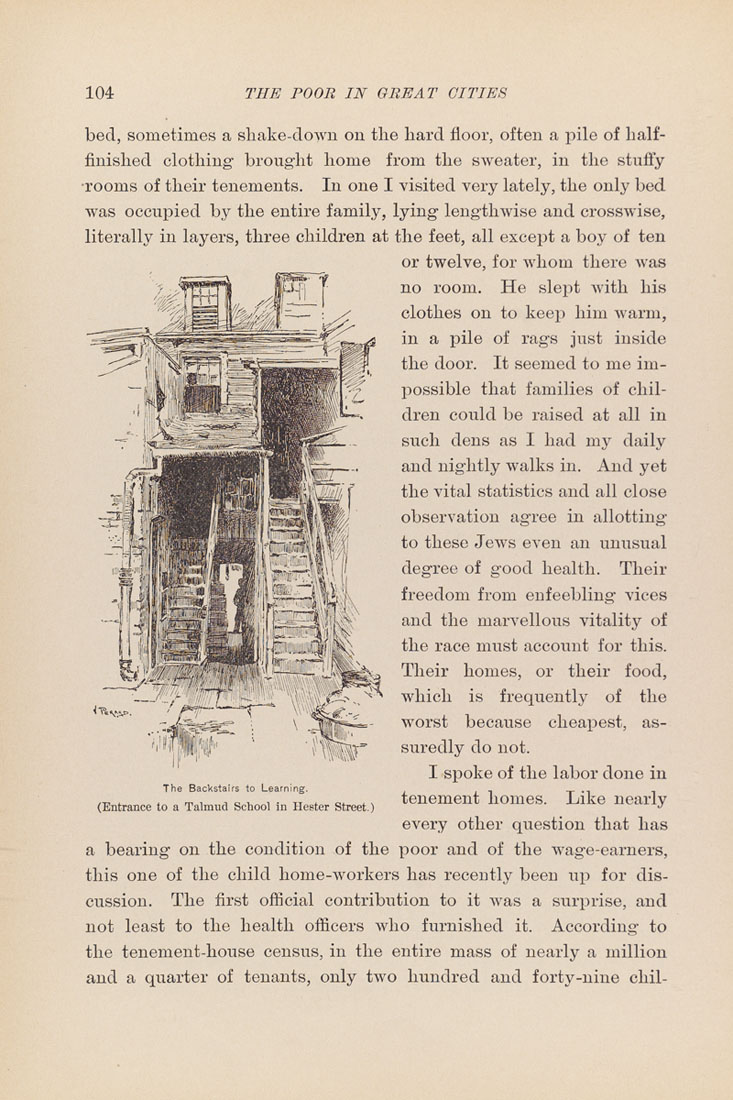
104 THE POOR IN GREAT CITIES bed, sometimes a shake-down on the hard floor, often a pile of half- finished clothing brought home from the sweater, in the stuffy -rooms of their tenements. In one I visited very lately, the only bed was occupied by the entire family, lying lengthwise and crosswise, literally in layers, three children at the feet, all except a boy of ten or twelve, for whom there was no room. He slept with his clothes on to keep him warm, in a pile of rags just inside the door. It seemed to me im¬ possible that families of chil¬ dren could be raised at all in such dens as I had my daily and nightly walks in. And yet the vital statistics and all close observation agree in allotting to these Jews even an unusual degree of good health. Their freedom from enfeebling vices and the marvellous vitality of the race must account for this. Their homes, or their food, which is frequently of the w^orst because cheax3est, as¬ suredly do not. I spoke of the labor done in tenement homes. Like nearly every other question that has a bearing on the condition of the poor and of the wage-earners, this one of the child home-workers has recently been ux3 for dis¬ cussion. The first official contribution to it Avas a surxorise, and not least to the health officers who furnished it. According to the tenement-house census, in the entire mass of nearly a million and a quarter of tenants, only two hundred and forty-nine chil- \e\^5^. The Backstairs to Learning. (Entrance to a Talmud School in Hester Street.) |
|
|
Page 104 |
|