

The poor in great cities.
(London : K. Paul, Trench, Trübner & Co., 1896.)
|
||

 Click here and hold to drag menu around
|





|
|
|
|

|
Page 380 | 
|
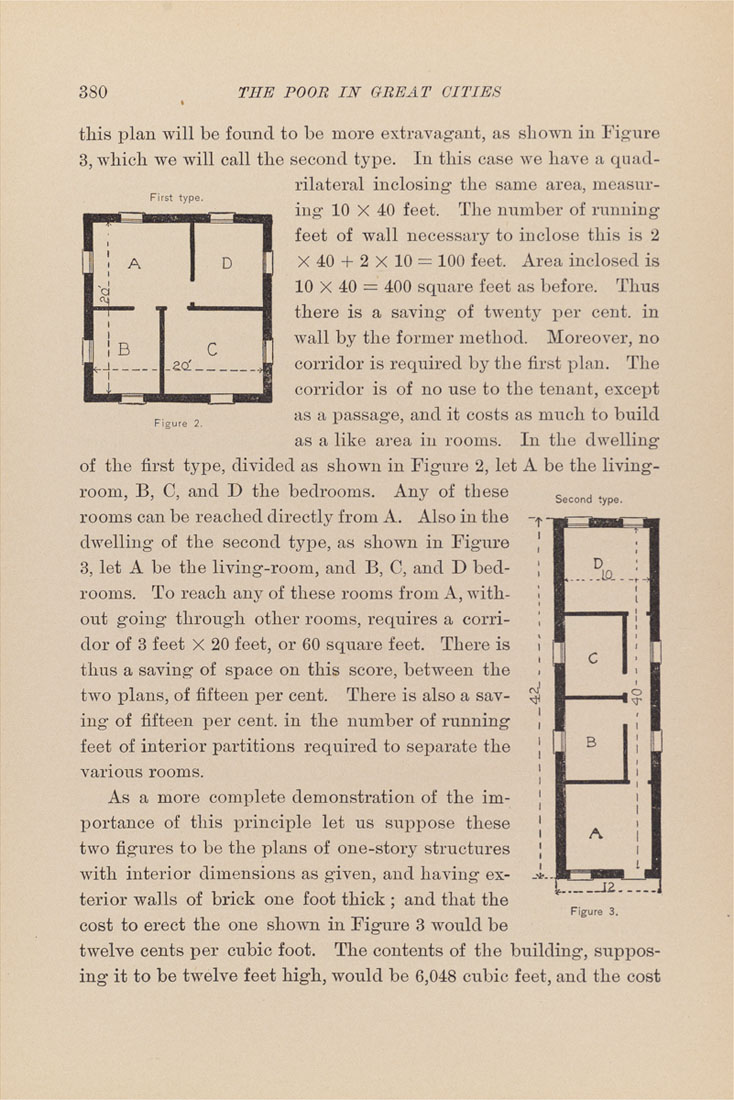
380 THE POOR IN GREAT CITIES Second type. this plan will be found to be more extravagant, as shown in Figure 3, which we will call the second type. In this case we have a quad¬ rilateral inclosing the same area, measur¬ ing 10 X 40 feet. The number of running feet of wall necessary to inclose this is 2 X 40 + 2 X 10 = 100 feet. Area inclosed is 10 X 40 = 400 square feet as before. Thus there is a saving of twenty per cent, in wall by the former method. Moreover, no corridor is required by the first plan. The corridor is of no use to the tenant, except ^. , as a passage, and it costs as much to build Figure 2. i. r^ :> as a like area in rooms. In the dwelling of the first type, divided as shown in Figure 2, let A be the living- room, B, C, and D the bedrooms. Any of these rooms can be reached directly from A. Also in the dwelling of the second type, as shown in Figure 3, let A be the living-room, and B, C, and D bed¬ rooms. To reach any of these rooms from A, with¬ out going through other rooms, requires a corri¬ dor of 3 feet X 20 feet, or 60 square feet. There is thus a saving of space on this score, between the two plans, of fifteen per cent. There is also a sav¬ ing of fifteen per cent, in the number of running feet of interior partitions required to separate the various rooms. As a more complete demonstration of the im¬ portance of this principle let us suppose these two figures to be the plans of one-story structures with interior dimensions as given, and having ex¬ terior walls of brick one foot thick ; and that the cost to erect the one shown in Figure 3 would be twelve cents per cubic foot. The contents of the building, suppos¬ ing it to be twelve feet high, would be 6,048 cubic feet, and the cost Figure 3. |
|
|
Page 380 |
|