

Parton, James, The life and times of Aaron Burr (v. 1)
(Boston : J.R. Osgood, 1876.)
|
||

 Click here and hold to drag menu around
|





|
|
|
|

|
Page [305] | 
|
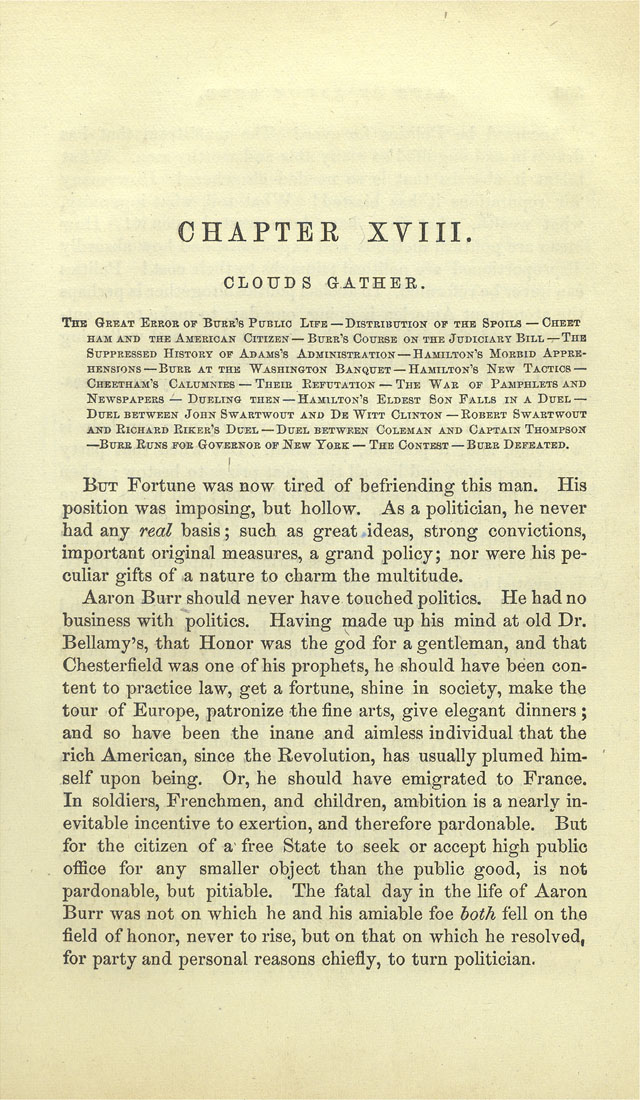
CHAPTER XYIII. CLOUDS GATHER, The Geeat Eekor of Bukk's Pitblio Life—Distkibution of the Spoils — Oheet ham AND THE AmEKIOAN OiTIZEN—BuEE'S OoUKSE ON THE JtJDICIAKY BiLL — ThB Suppressed Histoky of Adams's Administeation — Hamilton's Moebid Appeb¬ hensions—Buee at the Washington Banquet — Hamilton's New Tactics — Cheetham's Calumnies — Theie Eefutation — The Wak of Pamphlets and Newspapers — Dueling then — Hamilton's Eldest Son Falls in a Duel — Duel between John Swartwout and De Witt Clinton —Eobbkt Swabtwout AND Eichaed Eikee's Duel — Duel between Coleman and Captain Thompson —BUKE EUNS FOE GOVEENOE OF NeW ToEK — ThE CONTEST — BUEE DEFEATED. I But Fortune was now tired of befriending this man. His position was imposing, but hollow. As a politician, he never had any real basis; such as great ideas, strong convictions, important original measures, a grand policy; nor were his pe¬ culiar gifts of a nature to charm the multitude. Aaron Burr should never have touched politics. He had no business with politics. Having made up his mind at old Dr. Bellamy's, that Honor was the god for a gentleman, and that Chesterfield was one of his prophets, he should have been con¬ tent to practice law, get a fortune, shine in society, make the tour of Europe, patronize the fine arts, give elegant dinners; and so have been the inane and aimless indiAddual that the rich American, since the Revolution, has usually plumed him¬ self upon being. Or, he should have emigrated to France. In soldiers. Frenchmen, and children, ambition is a nearly in¬ evitable incentive to exertion, and therefore pardonable. But for the citizen of a~ free State to seek or accept high public office for any smaller object than the public good, is not pardonable, but pitiable. The fatal day in the life of Aaron Burr Avas not on which he and his amiable foe both fell on the field of honor, never to rise, but on that on which he resolved, for party and personal reasons chiefly, to turn politician. |
|
|
Page [305] |
|