

History of the bench and bar of New York (v. 1)
(New York : New York History Co., 1897-99.)
|
||

 Click here and hold to drag menu around
|





|
|
|
|

|
Page 118 | 
|
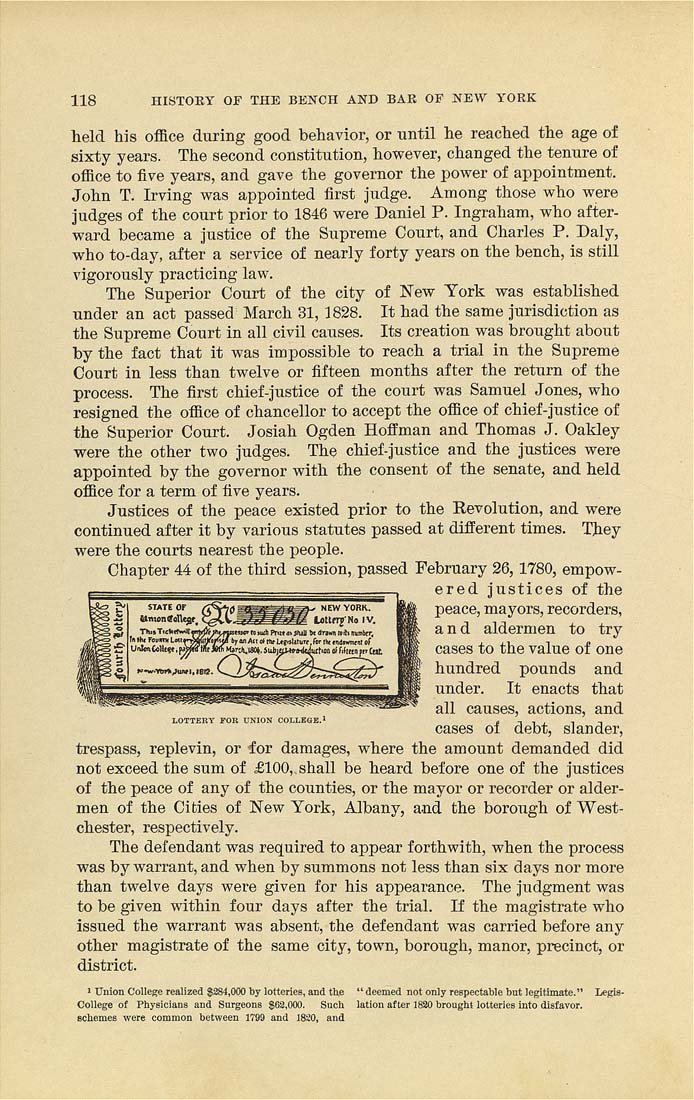
118 HISTOEY OE THE BENCH AKD BAR OE NEW Y'OKK held his office during good behavior, or until he reached the age of sixty years. The second constitution, however, changed the tenure of ofiice to five years, and gave the governor the power of appointment. John T. Irving was appointed first judge. Among those who were judges of the court prior to 1846 were Daniel P. Ingraham, who after¬ ward became a justice of the Supreme Court, and Charles P. Baly, who to-day, after a service of nearly forty years on the bench, is still vigorously practicing law. The Superior Court of the city of New York was established under an act passed March 31, 1828. It had the same jurisdiction as the Supreme Court in all civil causes. Its creation was brought about by the fact that it was impossible to reach a trial in the Supreme Court in less than twelve or fifteen months after the return of the process. The first chief-justice of the court was Samuel Jones, who resigned the office of chancellor to accept the office of chief-justice of the Superior Court. Josiah Ogden Hoffman and Thomas J. Oakley were the other two judges. The chief-justice and the justices were appointed by the governor with the consent of the senate, and held office for a term of five years. Justices of the peace existed prior to the Revolution, and were continued after it by various statutes passed at different times. They were the courts nearest the people. Chapter 44 of the third session, passed February 26,1780, empow- ered justices of the peace, mayors, recorders, and aldermen to try cases to the value of one hundred pounds and under. It enacts that all causes, actions, and cases of debt, slander, trespass, replevin, or ior damages, where the amount demanded did not exceed the sum of £100,,shall be heard before one of the justices of the peace of any of the counties, or the mayor or recorder or alder¬ men of the Cities of New York, Albany, and the borough of West¬ chester, respectively. The defendant was required to appear forthwith, when the process was by warrant, and when by summons not less than six days nor more than twelve days were given for his appearance. The judgment was to be given within four days after the trial. If the magistrate who issued the warrant was absent, the defendant was carried before any other magistrate of the same city, town, borough, manor, precinct, or district. 1 Union College realized S284,0OO by lotteries, and the " deemed not only reapectable bnt legitimate." Legis- College of Pbyeiciane and Snrgeons I6S.O0O, Such lation after 1830 brouglit lotteries into disfavor, schemes were common between 1799 and 1820, and |
|
|
Page 118 |
|