

Sturtevant, A. H. The North American species of Drosophila
(Washington : Carnegie Institution of Washington, 1921.)
|
||

 Click here and hold to drag menu around
|





|
|
|
|

|
Page iii | 
|
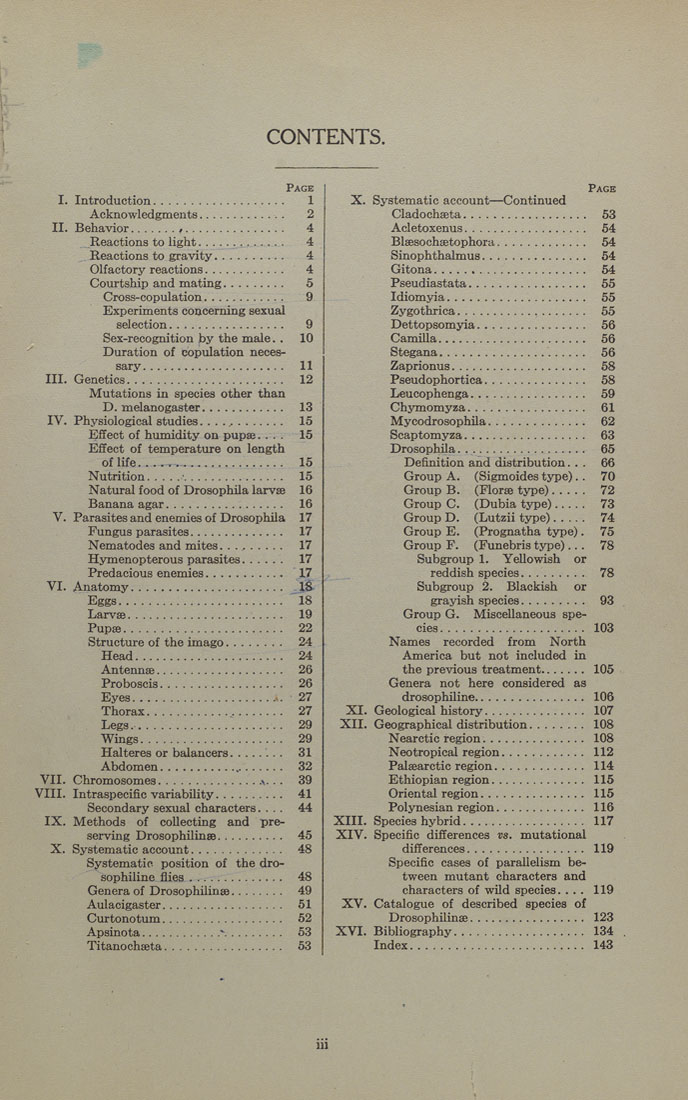
CONTENTS. Page I. Introduction................... 1 Acknowledgments............. 2 II. Behavior.......,............... 4 Reactions to light............. 4 Reactions to gravity.......... 4 Olfactory reactions............ 4 Courtship and mating......... 6 Cross-copulation............ 9 Experiments concerning sexual selection................. 9 Sex-recognition by the male. . 10 Duration of copulation neces¬ sary..................... 11 III. Genetics....................... 12 Mutations in species other than D. melanogaster............ 13 IV. Physiological studies. . . .,........ 15 Effect of humidity on pupse. ... 15 Effect of temperature on length of life..................... 15 Nutrition.....■............... 15 Natural food of Drosophila larvse 16 Banana agar................. 16 V. Parasites and enemies of Drosophila 17 Fungus parasites.............. 17 Nematodes and mites......... 17 Hjrmenopterous parasites...... 17 Predacious enemies........... 17 VI. Anatomy...................... IS Eggs........................ 18 Larvse....................... 19 Pup83....................... 22 Structure of the imago........ 24 Head...................... 24 Antennae................... 26 Proboscis.................. 26 Eyes....................... 27 Thorax.................... 27 Legs...................... 29 Wings..................... 29 Halteres or balancers........ 31 Abdomen................... 32 VII. Chromosomes...............\. . . 39 VIII. Intraspecific variability.......... 41 Secondary sexual characters.... 44 IX. Methods of collecting and pre¬ serving DrosophilinsB.......... 45 X. Systematic account............. 48 Systematic position of the dro- sophiline flies.............. 48 Genera of Drosophilinse........ 49 Aulacigaster.................. 51 Curtonotum.................. 52 Apsinota............"......... 53 Titanochseta................. 53 Page X. Systematic account—Continued Cladochseta.................. 53 Acletoxenus.................. 54 Blsesochsetophora............. 54 Sinophthalmus............... 64 Gitona...................... 54 Pseudiastata................. 55 Idiomyia................... . 55 Zygothrica................... 55 Dettopsomyia................ 56 Camilla...................... 56 Stegana..................... 56 Zaprionus.................... 58 Pseudophortica............... 58 Leucophenga................. 59 Chymomyza................. 61 Mycodrosophila.............. 62 Scaptomyza.................. 63 Drosophila................... 65 Definition and distribution. . . 66 Group A. (Sigmoides type).. 70 Group B. (Florae type)..... 72 Group C. (Dubia type)..... 73 Group D. (Lutzii type)..... 74 Group E. (Prognatha type). 75 Group F. (Funebris type)... 78 Subgroup 1. Yellowish or reddish species......... 78 Subgroup 2. Blackish or grayish species......... 93 Group G. Miscellaneous spe¬ cies ..................... 103 Names recorded from North America but not included in the previous treatment....... 105 Genera not here considered as drosophiline................ 106 XI. Geological history............... 107 XII. Geographical distribution........ 108 Nearctic region............... 108 Neotropical region............ 112 Palsearctic region............. 114 Ethiopian region.............. 115 Oriental region............... 115 Polynesian region............. 116 XIII. Species hybrid.................. 117 XIV. Specific differences vs. mutational differences................. 119 Specific cases of parallelism be¬ tween mutant characters and characters of wild species. ... 119 XV. Catalogue of described species of Drosophilinas................. 123 XVI. Bibliography................... 134 Index......................... 143 |
|
|
Page iii |
|