

Sturtevant, A. H. The North American species of Drosophila
(Washington : Carnegie Institution of Washington, 1921.)
|
||

 Click here and hold to drag menu around
|





|
|
|
|

|
Page 39 | 
|
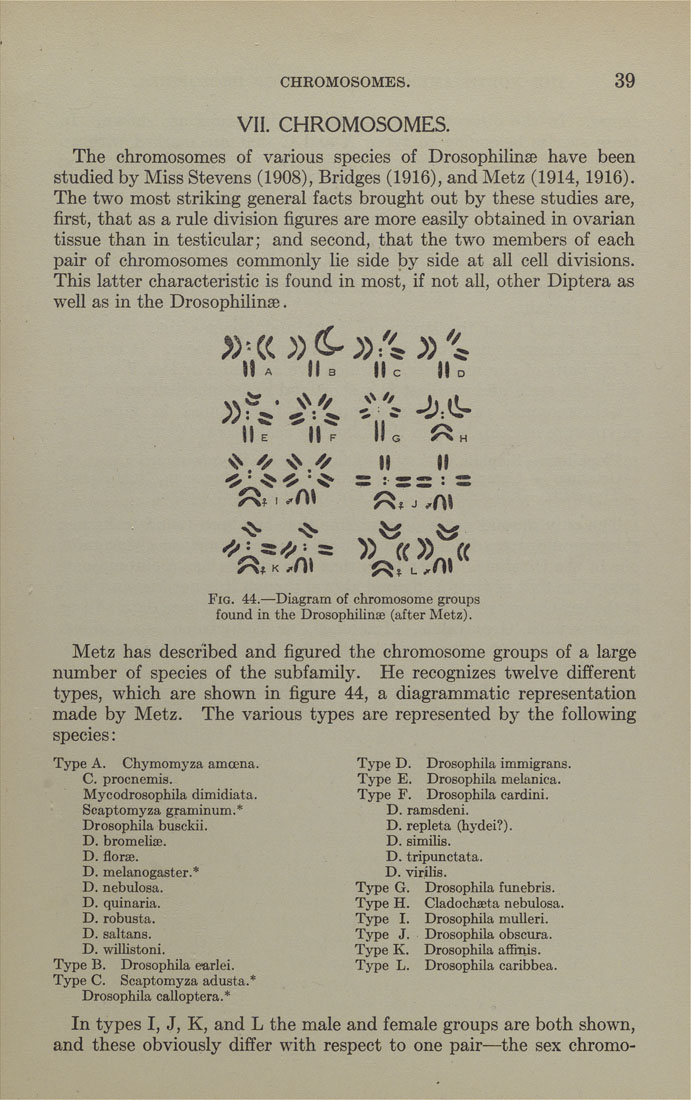
CHROMOSOMES. 39 VII. CHROMOSOMES. The chromosomes of various species of Drosophilinse have been studied by Miss Stevens (1908), Bridges (1916), and Metz (1914, 1916). The two most striking general facts brought out by these studies are, first, that as a rule division figures are more easily obtained in ovarian tissue than in testicular; and second, that the two members of each pair of chromosomes commonly lie side by side at all cell divisions. This latter characteristic is found in most, if not all, other Diptera as well as in the Drosophilinse. Ha Ub He Do He Up II g ^h <^.^ ^// M It ^ f^, K '.n\ Fig. 44.—Diagram of chromosome groups found in the Drosophilinse (after Metz). Metz has described and figured the chromosome groups of a large number of species of the subfamily. He recognizes twelve different types, which are shown in figure 44, a diagrammatic representation made by Metz. The various types are represented by the following species: Type A. Chymomyza amcena. Type D. Drosophila immigrans C. procnemis. Type E. Drosophila melanica. Mycodrosophila dimidiata. Type F. Drosophila cardini. Scaptomyza graminum.* D. ramsdeni. Drosophila busckii. D. repleta (hydei?). D. bromelise. D. similis. D. florae. D. tripunctata. D. melanogaster.* D. virilis. D. nebulosa. Type G. Drosophila funebris. D. quinaria. Type H. Cladochseta nebulosa. D, robusta. Type I. Drosophila mulleri. D. saltans. Type J. Drosophila obscura. D. willistoni. Type K. Drosophila affitiis. Type B. Drosophila earlei. Type L. Drosophila caribbea. Type C. Scaptomyza adusta.* Drosophila calloptera.* In types I, J, K, and L the male and female groups are both shown, and these obviously differ with respect to one pair—the sex chromo- |
|
|
Page 39 |
|