

Sturtevant, A. H. The North American species of Drosophila
(Washington : Carnegie Institution of Washington, 1921.)
|
||

 Click here and hold to drag menu around
|





|
|
|
|

|
Page 108 | 
|
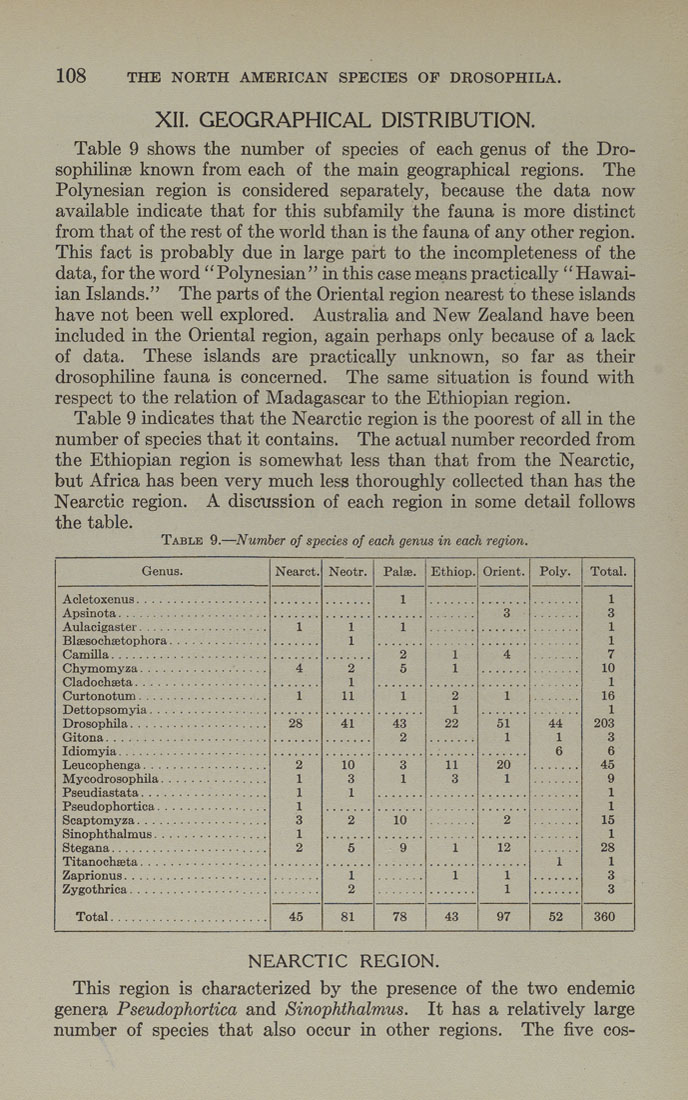
108 THE NORTH AMERICAN SPECIES OF DROSOPHILA. XII. GEOGRAPHICAL DISTRIBUTION. Table 9 shows the number of species of each genus of the Dro¬ sophilinse known from each of the main geographical regions. The Polynesian region is considered separately, because the data now available indicate that for this subfamily the fauna is more distinct from that of the rest of the world than is the fauna of any other region. This fact is probably due in large part to the incompleteness of the data, for the word "Polynesian" in this case means practically "Hawai¬ ian Islands." The parts of the Oriental region nearest to these islands have not been well explored. Australia and New Zealand have been included in the Oriental region, again perhaps only because of a lack of data. These islands are practically unknow^n, so far as their drosophiline fauna is concerned. The same situation is found with respect to the relation of Madagascar to the Ethiopian region. Table 9 indicates that the Nearctic region is the poorest of all in the number of species that it contains. The actual number recorded from the Ethiopian region is somewhat less than that from the Nearctic, but Africa has been very much less thoroughly collected than has the Nearctic region. A discussion of each region in some detail follows the table. Table 9.—Number of species of each genus in each region. Genus. Nearct. Neotr. Palae. Ethiop. Orient. Poly. Total. 1 1 3 1 1 7 10 1 16 1 203 3 6 45 9 1 1 15 1 28 1 3 3 3 1 1 1 1 2 5 1 1 4 Chjanomyza.................. 4 2 1 11 1 1 2 1 22 1 28 41 43 2 51 1 44 1 6 2 1 1 1 3 1 2 10 3 1 3 1 11 3 20 1 2 10 2 5 9 1 12 1 1 2 1 1 1 Total....................... 45 81 78 43 97 52 360 NEARCTIC REGION. This region is characterized by the presence of the two endemic genera Pseudophortica and Sinophthalmus. It has a relatively large number of species that also occur in other regions. The five cos- |
|
|
Page 108 |
|